| 통합을 말하기 전에, 먼저 먹고사는 문제부터 해결하라 ai호남뉴스 박충배 편집/칼럼/논설 aihnnewsr@kakao.com |
| 2026년 01월 05일(월) 10:57 |
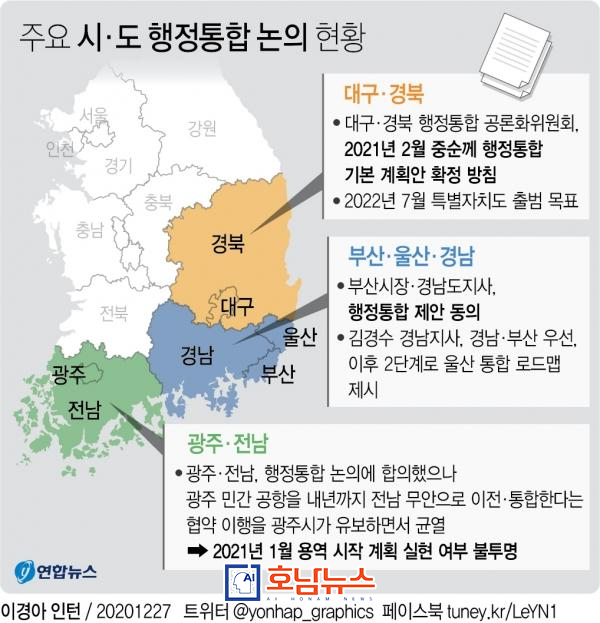 전국 시도통합 계획도 / 사진제공=호남뉴스 |
박충배 편집/칼럼/논설
【사설】
광주·전남 행정통합 논의가 다시 속도를 내고 있다.
2월 말까지 특별법 통과를 목표로 한다는 일정까지 제시됐다.
그러나 묻지 않을 수 없다.
이 통합이 도민의 삶을 당장 얼마나 바꿀 수 있는가.
지금 도민이 듣고 싶은 말은 “메가시티”도, “행정 효율”도 아니다.
소득이 오를 것인지, 일자리가 늘 것인지, 이동이 빨라질 것 인지다.
이 질문에 답하지 못하는 통합은 시작부터 실패다.
도민의 삶은 행정 실험 대상이 아니다.
전문가들은 말한다.
“통합은 장기적 성장 전략이다.”
그러나 도민의 현실은 장기 전략을 기다릴 여유가 없다.
전남의 경제성장률은 0.9%, 수도권은 2.9%다.
이미 격차는 숫자로 증명됐다.
도민이 체감하는 위기는 보고서가 아니라 지갑에서 먼저 나타난다.
농촌의 소득은 정체됐고, 청년은 떠나며, 교통은 여전히 느리다.
이런 상황에서 행정 통합부터 밀어붙이는 것은 현실을 외면한 채 구조 개편만 강요하는 행정 편의주의다.
통합의 기준은 ‘삶의 질’이어야 한다.
여론은 분명하다.
도민이 원하는 통합의 우선 과제는 SOC 확충 25.2%, 통합 교통체계 구축 17.5%다.
이 숫자는 명령이다.
먼저 길을 뚫고, 시간을 줄이고, 비용을 낮추라는 요구다.
철도 하나, 도로 하나, 대중교통 노선 하나가 도민에게는 그 어떤 선언보다 절실하다.
행정 통합은 책상 위에서 완성되지만, 삶의 통합은 도로 위에서, 버스 안에서, 병원 가는 길에서 증명된다.
도시 논리로 농촌을 재단하지 말라 광주의 도시 행정과 전남의 농촌 행정은 다르다.
속도도 다르고, 문제도 다르고, 해법은 더 다르다.
이 둘을 하나로 묶는 순간, 농촌의 느림은 비효율로, 농촌의 보호는 특혜로 낙인찍히고 인구의 도시 집중화가 될 커다란 위험이 있다.
그래서 전남은 통합 이전에 요구한다.
혁신적인 규제 완화다.
농지, 에너지, 해양, 산업 실증 규제가 풀리지 않는 통합은 전남에 새로운 기회가 아니라 새로운 족쇄가 된다.
상생을 막는 것은 구조가 아니라 정치다
통합의 최대 걸림돌로 소지역주의 33.5%가 꼽힌 이유는 분명하다.
세 차례 통합이 무산된 것도 같은 이유다.
누가 더 가져가느냐의 싸움이 시작되는 순간, 통합은 곧바로 분열로 바뀌었다.
그래서 도민은 요구한다.
“결정권을 우리에게 돌려 달라.”
통합 결정 방식에서 56.1%가 주민투표를 선호하는 것은 통합이 행정의 문제가 아니라 민주주의의 문제임을 뜻한다.
행정 통합보다 경제 통합이 먼저다.
통합은 목표가 아니다.
경제를 살리기 위한 수단일 뿐이다.
교통망이 연결되지 않은 통합, 산업이 연계되지 않은 통합, 규제가 그대로인 통합은 이름만 바꾼 행정구역일 뿐이다.
도민이 원하는 것은 단순하다.
더 빨리 이동하고, 더 많이 벌고, 더 안정적으로 사는 것이다.
그것이 보장되지 않는다면, 아무리 그럴듯한 통합도 도민의 동의를 얻을 수 없다.
결론
광주·전남 통합은 다시 선택의 기로에 섰다.
이번에도 도민의 삶을 비켜간 채 추진된다면, 결과는 이미 정해져 있다.
통합을 하려면, 먼저 먹고사는 문제부터 해결하라.
그렇지 않다면, 통합은 또 한 번 도민 위에 세워진 실패한 실험으로 기록될 것이다.
도민은 더 이상 기다리지 않는다.
말이 아니라, 지금 당장 바뀌는 삶을 요구하고 있다.
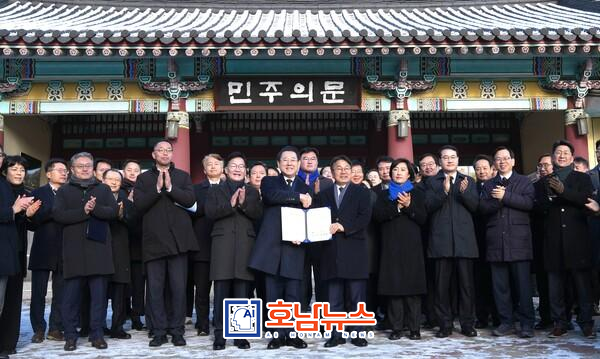 광주,전남 통합선언문 낭독(5.18묘지 앞) / 사진제공=호남뉴스 |
[Jeonnam = Honam News]
honamnews@kakao.com
Park Chung-bae
Editor / Columnist / Commentary
[Editorial]
Before Talking About Integration, Solve the Problem of Making a Living First
The discussion on administrative integration between Gwangju and Jeonnam is once again gaining speed.
A timetable has even been presented, aiming to pass a special law by the end of February.
Yet we cannot help but ask:
How much will this integration actually change the lives of residents right now?
What residents want to hear is not “mega-city” or “administrative efficiency.”
They want to know whether their income will rise, whether jobs will increase, and whether mobility will become faster.
An integration that cannot answer these questions is a failure from the very start.
The lives of residents are not an experiment in administrative reform.
Experts say,
“Integration is a long-term growth strategy.”
But residents do not have the luxury of waiting for long-term strategies.
Jeonnam’s economic growth rate stands at 0.9%, while the metropolitan area records 2.9%.
The gap has already been proven by numbers.
The crisis residents feel does not appear first in reports, but in their wallets.
Rural incomes have stagnated, young people are leaving, and transportation remains slow.
Pushing administrative integration first under these conditions is nothing more than administrative convenience that ignores reality while forcing structural reform.
The standard for integration must be quality of life.
Public opinion is clear.
The top priorities residents want from integration are SOC expansion (25.2%) and the construction of an integrated transportation system (17.5%).
These numbers are not suggestions—they are commands.
They are demands to open roads first, shorten travel time, and lower costs.
A single railway line, a single road, a single public transportation route matters more to residents than any grand declaration.
Administrative integration may be completed at desks, but integration of life is proven on the road, on buses, and on the way to hospitals.
Do not judge rural areas by urban logic.
Gwangju’s urban administration and Jeonnam’s rural administration are fundamentally different.
Their speed is different. Their problems are different. Their solutions are different.
The moment they are forcibly bound together, rural “slowness” is labeled inefficiency, rural protection is stigmatized as privilege, and the risk of massive population concentration in cities becomes real.
That is why Jeonnam demands something before integration:
radical regulatory reform.
Integration that leaves intact regulations on farmland, energy, marine industries, and industrial demonstration projects does not bring Jeonnam new opportunities—it imposes new shackles.
What blocks coexistence is not structure, but politics.
There is a clear reason why local regionalism (33.5%) is cited as the greatest obstacle to integration.
It is the same reason integration has failed three times before.
The moment the fight over who gains more begins, integration immediately turns into division.
That is why residents now demand:
“Return the decision-making power to us.”
The fact that 56.1% prefer a resident referendum for deciding integration shows that this is not merely an administrative issue, but a question of democracy.
Economic integration must come before administrative integration.
Integration is not the goal.
It is merely a means to revive the economy.
Integration without connected transportation networks,
integration without linked industries,
integration that leaves regulations untouched
is nothing more than an administrative district with a new name.
What residents want is simple:
to move faster, earn more, and live more stably.
If this is not guaranteed, no matter how impressive the integration may sound, it will never gain the consent of residents.
Conclusion
Gwangju–Jeonnam integration stands once again at a crossroads.
If it is pushed forward while bypassing the lives of residents, the outcome is already clear.
If you want integration, solve the problem of making a living first.
Otherwise, integration will once again be recorded as a failed experiment imposed on residents.
Residents will wait no longer.
They demand not words, but lives that change—starting now.
 ai호남뉴스 박충배 편집/칼럼/논설 aihnnewsr@kakao.com