| ‘인구 10만’ 간판부터 내건 솔라시도…정작 사람을 데려올 계획은 어디 있나. 허풍인가 허울인가 해남군청은 무엇을 근거로 군민을 현혹하는가. ai호남뉴스 박충배 편집/칼럼 aihnnewsr@kakao.com |
| 2026년 07월 10일(금) 16:24 |
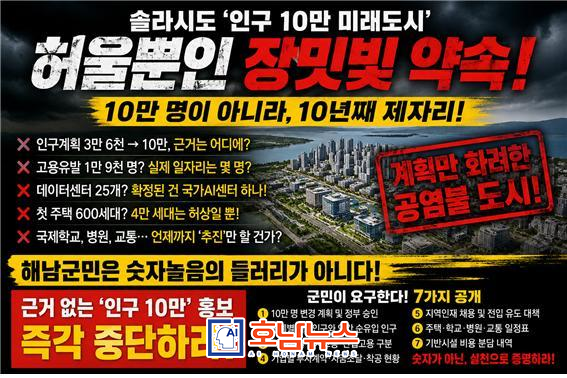 허울뿐인 장미빛 약속 솔라시도 / 사진제공=chat gpt |
【해남=AI호남뉴스】 aihnnews@kakao.com
해남 솔라시도를 인구 10만 명의 AI·에너지 미래도시로 만들겠다는 거대한 청사진이 연일 발표되고 있다. 국가AI컴퓨팅센터와 데이터센터파크, RE100 산업단지, 국제학교, 의료시설, 대규모 주거단지를 한데 묶어 새로운 자족도시를 만들겠다는 구상이다.
그러나 ‘인구 10만’이라는 숫자를 걷어내고 사업별 확정 내용과 실제 추진 일정을 들여다보면 상황은 달라진다. 현재 공개된 자료만으로는 언제, 어떤 기업에서, 몇 개의 상시 일자리가 생기고, 그중 몇 명이 가족과 함께 해남에 정착해 10만 명을 채울 것인지 확인하기 어렵다.
국가AI컴퓨팅센터 유치는 분명 해남의 산업지도를 바꿀 중대한 성과다. 하지만 국가 핵심시설 하나를 유치했다는 사실과 인구 10만 명의 신도시가 실제로 만들어진다는 주장은 전혀 다른 차원의 문제다. 지금 필요한 것은 장밋빛 전망을 반복하는 홍보가 아니라 인구와 일자리, 주택, 학교, 병원, 교통을 연결한 검증 가능한 실행계획이다.
공식 계획 3만6,600명에서 갑자기 10만 명…무엇이 달라졌나
2024년까지 대외적으로 알려진 솔라시도 구성지구의 계획은 2,089만㎡ 부지에 2030년까지 1조4,400억 원을 투입해 1만4,640세대, 인구 3만6,600명의 자족도시를 조성하는 것이었다. 이는 해남군이 소개한 기존 기업도시 개발계획과도 일치한다.
그런데 2025년 말부터 솔라시도는 갑자기 ‘인구 10만 에너지 신도시’로 확대됐다. 사업시행자 측 홈페이지에는 인구 10만 명을 위한 주거단지 4만 세대와 일자리 2만 개 이상을 조성하겠다는 내용이 제시돼 있다.
문제는 기존 계획인구 3만6,600명을 10만 명으로 늘리게 된 구체적인 근거다. 인구가 약 6만3,400명 늘고 주택계획이 1만4,640세대에서 4만 세대로 확대됐다면 도시개발계획과 토지이용계획, 기반시설 부담계획, 재원조달계획도 그에 맞춰 전면적으로 바뀌어야 한다.
그러나 현재까지 공개된 자료에서는 10만 명을 수용하기 위한 법정 개발계획 변경 내용과 연도별 인구유입 계획, 재원조달 규모가 명확하게 제시되지 않고 있다. ‘정부의 의지’, ‘기업 유치 전망’, ‘미래 수요’를 모아 숫자를 키웠을 뿐이라면 10만 명은 도시계획이 아니라 홍보 구호에 불과하다.
고용유발 1만9,500명이 곧 해남 주민 1만9,500명은 아니다
전남도는 2026년 5월 국가AI컴퓨팅센터 유치를 공식 발표했다. 삼성SDS 컨소시엄이 참여하는 이 사업은 2030년까지 2조4,065억 원을 투입해 2028년 GPU 1만5,000장, 2030년 5만 장을 단계적으로 확보하는 내용이다. 전남도는 경제유발 효과 6조4,000억 원, 부가가치 1조5,000억 원, 고용창출 약 1만9,500명을 전망했다.
하지만 발표자료에는 1만9,500명 가운데 공사기간 건설인력과 전국 단위 간접고용, 생산유발 고용, 센터의 직접 상시고용이 각각 몇 명인지 구분돼 있지 않다. 해남군민을 몇 명 채용하고, 외지 전문인력 중 몇 명이 해남으로 주소를 옮길지도 제시되지 않았다.
경제성 분석에서 말하는 ‘고용유발 인원’은 데이터센터 건물 안에서 장기간 근무하는 상시근로자 수와 동일하지 않다. 건설·장비생산·운송·전력·통신·서비스 분야에서 간접적으로 발생하는 일자리까지 포함될 수 있으며, 그 일자리가 반드시 해남에 생긴다는 보장도 없다.
더욱이 데이터센터는 막대한 자본과 전력을 투입하지만 자동화 수준이 높아 제조공장처럼 대규모 생산인력이 상주하는 시설은 아니다. 국가AI컴퓨팅센터 유치의 전략적 가치를 평가절하 할 이유는 없지만, 고용유발 효과를 주민등록인구 증가로 곧바로 환산해서도 안 된다.
해남군과 전남도는 최소한 국가AI컴퓨팅센터의 직접 상시고용 인원, 협력업체 고용, 지역인재 채용 목표, 외지인력 정착 예상 인원, 동반가족 수를 구분해 공개해야 한다. 이 수치가 없다면 ‘AI센터가 들어오면 인구 10만 도시가 된다’는 주장은 검증할 방법이 없다.
데이터센터 25개는 확정 사업이 아니라 2037년까지의 유치 목표
2023년 산업통상자원부 발표를 보면 솔라시도 데이터센터파크는 40MW급 데이터센터 최대 25개를 유치해 총 1GW 규모로 조성한다는 사업이다. 투자규모는 최대 10조 원으로 전망됐으며 1단계에서 2027년까지 최초 5개 동을 유치하고, 이후 2037년까지 단계적으로 25개 동을 채우는 구상이었다.
여기서 주목해야 할 단어는 ‘건립 확정’이 아니라 ‘업무협약’과 ‘유치 추진’이다. 정부 발표 역시 7개 투자기업이 데이터센터 25개 동을 단계적으로 유치할 계획이라고 명시했다. 이는 부지와 기반시설을 마련해 앞으로 운영기업과 투자자를 끌어오겠다는 뜻이지, 25개 데이터센터의 입주계약과 자금조달이 모두 완료됐다는 의미가 아니다.
실제로 2025년 전남도가 발표했던 15조 원 규모의 3GW 슈퍼클러스터 사업은 투자사가 약속한 자금을 마련하지 못해 본계약이 불발됐고, 계약 시한이 연장됐다. 당시 보도에서도 실제 투자 여부가 불투명하다는 지적이 나왔다.
국가AI컴퓨팅센터는 이제 최종 참여자가 선정되고 착공 절차에 들어간 확정성이 높은 사업이다. 반면 나머지 데이터센터와 글로벌 기업 프로젝트는 투자 의향, 업무협약, 입지 검토, 유치 추진 단계가 섞여 있다. 확정 사업과 희망 사업을 모두 합산해 인구 10만 명의 근거로 제시하는 것은 행정의 신뢰를 떨어뜨릴 수 있다.
4만 세대를 말하지만 당장 제시된 주택은 약 6,600세대
사업시행자 측이 제시한 인구 10만 명의 주거 목표는 4만 세대다. 그러나 해남군이 현재 구체적으로 발표한 솔라시도 주택계획은 첫마을 약 600세대, 공공지원민간임대주택 약 4,000세대, 솔라시도CC 인근 스마트그린빌리지 약 2,000세대 등 모두 약 6,600세대다.
6,600세대는 4만 세대 목표의 6분의 1 수준이다. 나머지 3만3,000여 세대가 어느 부지에, 어떤 방식으로, 어느 시기에 공급되는지는 아직 구체적으로 드러나지 않았다.
첫 마을 주택단지는 당초 2026년 6월 착공과 분양을 목표로 발표됐다. 하지만 2026년 7월 10일 현재 공개적으로 확인할 수 있는 자료에서는 실제 착공식이나 공사 개시를 알리는 공식 발표를 찾기 어렵다. 착공 목표가 지켜졌는지, 인허가와 시공사 선정, 분양 일정이 어디까지 진행됐는지 해남군과 시행자가 명확히 밝혀야 한다.
주택을 먼저 지으면 인구가 저절로 생기는 것도 아니다. 안정적인 일자리와 학교, 병원, 대중교통, 상업시설이 갖춰지지 않은 상태에서 주택 공급만 앞서면 미분양과 공실, 투기성 토지거래가 나타날 수 있다. 실제 솔라시도 주변에서는 개발 기대감에 따른 토지가격 상승과 투기 과열을 우려하는 목소리도 제기됐다.
국제학교와 병원은 ‘가능성’인가, 확정된 개교·개원 계획인가
솔라시도 홍보자료에는 국제학교와 의료시설, 호텔, 문화시설, 미래형 교통체계가 등장한다. 하지만 도시 인구를 끌어오는 것은 시설의 이름이 아니라 개교일과 개원일, 운영기관, 사업비, 재원조달 여부다.
기업도시 내 국제학교 설립이 가능하도록 법률이 개정됐다는 사실과 실제 학교가 건립돼 학생을 모집한다는 것은 다르다. 의료기관 투자협약 역시 병원 부지 확보, 의료법인 설립, 병상 허가, 전문인력 확보, 착공과 개원으로 이어져야 비로소 정주 인프라가 된다. 2025년 보도에서도 솔라시도가 실제 AI 신도시가 되려면 교육·의료·복지 등 취약한 정주여건을 개선해야 한다는 지적이 나왔다.
특히 고급 AI 인력과 연구자가 가족을 데리고 해남으로 이주하려면 단순한 아파트 공급만으로는 부족하다. 자녀교육, 응급의료, 문화생활, 배우자의 일자리, 광주·목포 접근 교통망이 함께 갖춰져야 한다.
그런데 현재 발표는 대부분 ‘추진한다’, ‘조성할 계획이다’, ‘유치할 예정이다’라는 미래형 표현에 머물러 있다. 인구 10만 명을 내세우려면 학교와 병원의 이름보다 개교·개원 시점부터 공개해야 한다.
20년간 반복된 계획 변경…이번에는 숫자보다 이행률로 말해야
솔라시도는 2005년 관광·레저형 기업도시 시범사업으로 지정됐고, 2009년 정부의 개발계획 승인을 받아 2013년 착공했다. 사업기간은 여러 차례 조정돼 현재 2030년까지로 설정돼 있다.
그러나 사업은 장기간 지연됐고 2024년에는 착공 이후 10년이 넘도록 전체 공정률이 30%대에 머문다는 비판이 나왔다. 2025년 해남군의회에서도 잦은 계획 변경과 사업 지연에 대한 질타가 이어졌다.
이런 전력이 있는 사업에서 계획인구를 3만6,600명에서 10만 명으로 대폭 늘렸다면, 주민과 국민에게 더욱 엄격한 근거를 제시하는 것이 당연하다. 과거 계획이 왜 지연됐는지, 미 이행 사업은 무엇인지, 새 계획이 과거와 무엇이 다른지 설명하지 않은 채 더 큰 숫자를 내놓는 것은 신뢰를 회복하는 방식이 아니다.
‘인구 10만’이 진짜 정책이라면 일곱 가지부터 공개하라
전남도와 해남군, 사업시행자는 인구 10만 명을 홍보문구가 아닌 정책목표로 사용하려면 최소한 다음 내용을 공개해야 한다.
첫째, 기존 계획인구 3만6,600명을 10만 명으로 변경한 법정계획과 정부 승인 여부다.
둘째, 2028년·2030년·2035년 등 단계별 목표인구와 연간 순유입 인구다.
셋째, 국가AI컴퓨팅센터와 각 데이터센터의 직접 상시고용, 건설고용, 간접 고용유발 인원을 구분한 자료다.
넷째, 기업별 투자협약과 본계약, 자금조달, 착공, 준공 현황을 구분한 사업 목록이다.
다섯째, 지역인재 채용비율과 해남군 전입·실거주를 유도할 구체적인 제도다.
여섯째, 주택 4만 세대의 블록별 공급 일정과 학교·병원·상업시설·대중교통 개설 일정이다.
일곱째, 데이터센터에 필요한 전력망과 용수, 도로 등 공공기반시설의 비용을 국가와 기업, 지방자치단체가 각각 얼마나 부담하는지에 대한 내역이다.
국가AI센터 성과를 ‘인구 부풀리기’에 소비해서는 안 된다
국가AI컴퓨팅센터 유치는 해남이 농어업 중심 지역을 넘어 AI·에너지 산업도시로 전환할 수 있는 중요한 기회다. 이 성과 자체를 과소평가해서는 안 된다.
그러나 국가사업의 경제유발 효과와 아직 확정되지 않은 민간투자, 2037년까지의 데이터센터 유치 목표를 한데 합쳐 당장 인구 10만 명이 들어올 것처럼 포장해서도 안 된다.
인구는 조감도에서 생기지 않는다. 업무협약서에서 태어나지도 않는다. 안정적인 상시 일자리와 실제 가동하는 기업, 아이를 보낼 학교, 아플 때 갈 병원, 매일 이용할 교통망이 있어야 사람이 들어오고 가족이 머문다.
솔라시도에 지금 필요한 것은 더 화려한 조감도나 더 큰 숫자가 아니다. 한 개 기업의 확정 투자, 한 명의 상시고용, 한 세대의 실제 입주를 차곡차곡 증명하는 행정이다.
‘인구 10만’은 희망을 표현하는 구호가 아니라 결과에 책임져야 하는 공적 약속이다. 근거 없는 전망으로 기대감과 땅값만 끌어올린 뒤 사업이 지연된다면 그 피해는 주민과 지역사회가 떠안게 된다.
전남도와 해남군은 이제 답해야 한다.
솔라시도 인구 10만 명은 정부 승인을 받은 실행계획인가, 기업 유치가 모두 성공한다는 가정 아래 만든 전망치인가, 아니면 또 하나의 거대한 홍보문구인가.
[AI Honam News Special Investigative Analysis]
Solaseado Puts Up the “Population of 100,000” Sign First—but Where Is the Actual Plan to Bring People In?
Is It Empty Boasting or a Hollow Promise? On What Grounds Is Haenam County Misleading Its Residents?
Official planned population abruptly raised from 36,600 to 100,000
National AI Computing Center projects 19,500 induced jobs, but permanent employment and local settlement figures remain undisclosed
Twenty-five data centers are only a target to be attracted by 2037—not confirmed investments
Only about 600 homes in the first residential project…Concrete plans for education, healthcare, transportation and essential public services must come first
【Haenam=AI Honam News】 aihnnews@kakao.com
A grand blueprint is being promoted almost daily to transform Solaseado in Haenam into an AI and renewable-energy city with a population of 100,000.
The vision combines the National AI Computing Center, a large-scale data center park, a RE100 industrial complex, an international school, medical facilities and extensive residential development into a new self-sufficient city.
However, once the headline figure of “100,000 residents” is stripped away and the confirmed details and actual schedules of individual projects are examined, the picture looks very different.
Based on currently available public information, it remains unclear when permanent jobs will be created, which companies will create them, how many workers will actually be employed, and how many of those workers will relocate to Haenam with their families and settle there as residents.
The attraction of the National AI Computing Center is undoubtedly a major achievement that could transform Haenam’s industrial landscape.
But attracting one major national facility and actually building a new city with 100,000 residents are two entirely different matters.
What is needed now is not repeated promotion of an optimistic vision, but a verifiable implementation plan connecting population growth with jobs, housing, schools, hospitals and transportation.
From an Official Plan of 36,600 Residents to 100,000—What Exactly Changed?
Until 2024, the publicly announced plan for Solaseado’s Guseong District called for the development of a self-sufficient city on approximately 20.89 million square meters of land by 2030.
The project was expected to involve an investment of 1.44 trillion won, the construction of 14,640 housing units and accommodation for a population of 36,600.
This was also consistent with the original enterprise-city development plan introduced by Haenam County.
Beginning in late 2025, however, Solaseado was suddenly rebranded as an “energy city for 100,000 residents.”
The project developer’s website now presents a plan to create 40,000 housing units for a population of 100,000 and more than 20,000 jobs.
The central question is what concrete evidence justified raising the planned population from 36,600 to 100,000.
If the projected population increased by approximately 63,400 and the housing target expanded from 14,640 units to 40,000, the urban development plan, land-use plan, infrastructure financing plan and funding strategy should all have been comprehensively revised.
Yet publicly available materials still do not clearly show the legally amended development plan required to accommodate 100,000 people, the annual schedule for population inflow or the total funding needed.
If officials simply combined the government’s stated commitment, expectations for corporate investment and speculative future demand to produce a larger number, then the 100,000 figure is not an urban plan. It is merely a promotional slogan.
An Employment-Inducement Estimate of 19,500 Does Not Mean 19,500 New Haenam Residents
In May 2026, South Jeolla Province officially announced that it had secured the National AI Computing Center.
The project, involving a consortium led by Samsung SDS, calls for an investment of 2.4065 trillion won by 2030.
It plans to secure 15,000 graphics processing units by 2028 and expand the total to 50,000 by 2030.
South Jeolla Province projected economic effects of 6.4 trillion won, added value of 1.5 trillion won and the creation of approximately 19,500 jobs.
However, the official announcement did not distinguish among temporary construction workers, nationwide indirect employment, jobs generated through production and supply chains, and permanent workers directly employed at the computing center.
Nor did it specify how many Haenam residents would be hired or how many outside specialists would actually move their registered residence to Haenam.
The “employment-inducement figure” used in economic impact analyses is not equivalent to the number of permanent workers employed inside a data center.
It may include jobs generated indirectly in construction, equipment manufacturing, logistics, electricity, telecommunications and service industries.
There is also no guarantee that all of those jobs will be located in Haenam.
Data centers require enormous amounts of capital and electricity, but because they are highly automated, they do not employ large numbers of production workers in the same way as manufacturing plants.
There is no reason to underestimate the strategic value of attracting the National AI Computing Center.
However, the projected employment effect must not be directly converted into an assumed increase in Haenam’s registered population.
At a minimum, Haenam County and South Jeolla Province should disclose separate figures for permanent direct employment at the National AI Computing Center, employment by partner companies, local talent recruitment targets, the estimated number of outside workers expected to settle in Haenam, and the number of accompanying family members.
Without these figures, there is no way to verify the claim that the arrival of the AI center will create a city of 100,000 residents.
Twenty-Five Data Centers Are Not Confirmed Projects, but a Target to Be Pursued by 2037
According to a 2023 announcement by the Ministry of Trade, Industry and Energy, the Solaseado Data Center Park aims to attract up to twenty-five 40-megawatt data centers, creating a combined capacity of one gigawatt.
The projected investment was estimated at up to 10 trillion won.
Under the plan, the first five facilities were to be attracted by 2027, with the total gradually increasing to twenty-five by 2037.
The crucial terms here are not “confirmed construction,” but “memorandum of understanding” and “investment attraction.”
The government announcement also stated that seven investment companies planned to attract twenty-five data center buildings in stages.
That means land and infrastructure would be prepared in an effort to attract operators and investors in the future.
It does not mean that tenancy agreements, investment financing and construction contracts for all twenty-five data centers have already been completed.
In fact, the 15-trillion-won, three-gigawatt supercluster project announced by South Jeolla Province in 2025 failed to proceed to a final contract because the investor could not secure the promised financing.
The contract deadline was subsequently extended, and media reports at the time raised questions about whether the investment would ever materialize.
The National AI Computing Center has a relatively high degree of certainty because a final participant has been selected and preparations for construction have begun.
By contrast, the remaining data center and global corporate projects are at varying stages, including expressions of interest, memoranda of understanding, site reviews and investment-attraction efforts.
Combining confirmed projects with aspirational projects and presenting the total as the basis for a population of 100,000 risks undermining public trust in the administration.
The Goal Is 40,000 Housing Units, but Only About 6,600 Have Been Specifically Announced
The project developer has presented a residential target of 40,000 housing units for a city of 100,000 people.
However, the housing projects currently announced in specific terms by Haenam County amount to approximately 6,600 units.
These include about 600 homes in the first residential village, approximately 4,000 public-supported private rental units and around 2,000 units in the Smart Green Village near the Solaseado Country Club.
A total of 6,600 units is only about one-sixth of the 40,000-unit target.
It remains unclear where the other 33,000 or more units will be built, how they will be financed and when they will be supplied.
The first-village housing project was originally announced with a target of beginning construction and sales in June 2026.
However, as of July 10, 2026, publicly available information does not show a formal announcement confirming that a groundbreaking ceremony or actual construction work has begun.
Haenam County and the developer must clearly disclose whether the construction target was met and explain the current status of permits, contractor selection and the sales schedule.
Building houses first does not automatically create a population.
If housing supply proceeds without stable jobs, schools, hospitals, public transportation and commercial facilities, the result may be unsold units, vacancies and speculative land transactions.
Concerns have already been raised about rising land prices and excessive speculation around Solaseado due to expectations surrounding the development.
Are the International School and Hospital Real Projects—or Merely Possibilities?
Promotional materials for Solaseado refer to an international school, medical facilities, hotels, cultural facilities and a future transportation system.
However, what attracts residents is not the name of a proposed facility, but its opening date, operator, budget and confirmed funding.
The fact that the law has been amended to allow an international school in an enterprise city is not the same as actually constructing a school and enrolling students.
Likewise, an investment agreement for a medical institution becomes genuine residential infrastructure only when it leads to the acquisition of a hospital site, establishment of a medical corporation, approval of beds, recruitment of medical professionals, construction and eventual opening.
Media reports in 2025 also pointed out that Solaseado would have to improve its weak education, healthcare and welfare infrastructure if it was to become a genuine AI city.
Highly skilled AI professionals and researchers will not move their families to Haenam simply because apartments are available.
They also need quality education for their children, emergency medical care, cultural amenities, employment opportunities for their spouses and reliable transportation connections to Gwangju and Mokpo.
Yet most current announcements remain framed in the future tense: “will be promoted,” “is planned” or “will be attracted.”
Before advertising a city of 100,000 residents, officials should first disclose the actual opening dates of its schools and hospitals.
Twenty Years of Repeated Plan Changes—This Time, Officials Must Speak Through Implementation Rates, Not Bigger Numbers
Solaseado was designated as a pilot tourism and leisure enterprise-city project in 2005.
The government approved its development plan in 2009, and construction began in 2013.
The project period has been revised several times and is currently scheduled to continue through 2030.
However, the project has suffered prolonged delays.
In 2024, critics pointed out that the overall completion rate remained in the 30 percent range more than ten years after construction began.
In 2025, the Haenam County Council also criticized repeated plan changes and project delays.
Given that history, if the planned population is being increased dramatically from 36,600 to 100,000, the administration has an even greater responsibility to provide residents and the public with rigorous supporting evidence.
Officials must explain why previous plans were delayed, which projects remain unfulfilled and how the new plan differs from earlier promises.
Announcing even larger numbers without providing such explanations is not a credible way to restore public trust.
If the “Population of 100,000” Is a Real Policy, Seven Items Must Be Disclosed First
If South Jeolla Province, Haenam County and the project developer intend to use the population target of 100,000 as an official policy rather than a promotional slogan, they should disclose at least the following information.
First, they must disclose the legally amended development plan and whether central-government approval was obtained to raise the planned population from 36,600 to 100,000.
Second, they must provide phased population targets for 2028, 2030 and 2035, together with annual net migration targets.
Third, they must separately disclose permanent direct employment, temporary construction employment and indirect employment generated by the National AI Computing Center and each data center.
Fourth, they must provide a project-by-project list distinguishing memoranda of understanding, final investment contracts, financing completion, groundbreaking and project completion.
Fifth, they must disclose local recruitment targets and specific measures to encourage workers to transfer their registered residence to Haenam and actually live there.
Sixth, they must publish a block-by-block schedule for the supply of 40,000 housing units and the opening schedules of schools, hospitals, commercial facilities and public transportation.
Seventh, they must disclose how the costs of electricity transmission, water supply, roads and other public infrastructure required by the data centers will be divided among the national government, corporations and local governments.
The Achievement of the National AI Center Must Not Be Used to Inflate Population Projections
Attracting the National AI Computing Center gives Haenam a major opportunity to move beyond an economy centered on agriculture and fisheries and develop into an AI and renewable-energy industrial city.
That achievement should not be underestimated.
However, officials must not combine the projected economic effects of a national project, unconfirmed private investment and a data center attraction target extending through 2037 and present them as though 100,000 residents will arrive immediately.
Population does not emerge from an architectural rendering.
It is not created by signing a memorandum of understanding.
People move in and families stay only when there are secure permanent jobs, operating companies, schools for their children, hospitals for medical care and transportation systems they can use every day.
What Solaseado needs now is not another glamorous rendering or an even larger number.
The administration must steadily demonstrate one confirmed corporate investment, one permanent job and one genuinely occupied household at a time.
A “population of 100,000” is not merely an expression of hope.
It is a public commitment for which officials must accept responsibility.
If unsupported projections merely raise expectations and land prices before projects are delayed, the damage will ultimately be borne by residents and the local community.
South Jeolla Province and Haenam County must now answer.
Is Solaseado’s population target of 100,000 part of an implementation plan formally approved by the government?
Is it merely a projection based on the assumption that every corporate investment attraction effort will succeed?
Or is it yet another enormous promotional slogan?
 ai호남뉴스 박충배 편집/칼럼 aihnnewsr@kakao.com