| ‘AI 거물 8인’ 샌프란시스코 집결…대한민국 AI 밸류체인 형성의 밑그림 그렸다 이재용·최태원·정의선·이해진, 한국 반도체·모빌리티·플랫폼 대표해 참석 ai호남뉴스 박충배 편집/칼럼 aihnnewsr@kakao.com |
| 2026년 07월 25일(토) 10:48 |
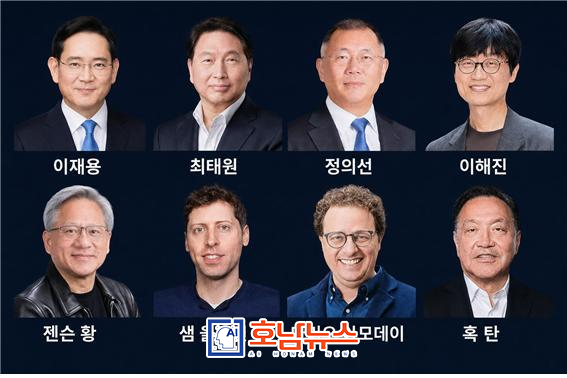 센프란시스코 8명 깐부 회동 /사진제공=YTN |
대한민국을 인공지능 반도체와 데이터센터, 초거대 AI 모델, 로봇·자율주행이 하나로 연결되는 글로벌 AI 밸류체인의 핵심 거점으로 만들기 위한 밑그림이 미국 샌프란시스코에서 제시됐다.
이재명 대통령은 24일(현지시간) 미국 샌프란시스코에서 글로벌 AI 기업 최고경영자들과 잇따라 면담한 데 이어 ‘샌프란시스코 AI 서밋’에 참석해 대한민국의 AI 투자 확대와 국제협력 구상을 담은 ‘샌프란시스코 AI 선언’을 발표했다.
이번 행사에는 한국을 대표하는 이재용 삼성전자 회장, 최태원 SK그룹 회장, 정의선 현대자동차그룹 회장, 이해진 네이버 의장이 참석했다.
미국 측에서는 젠슨 황 엔비디아 최고경영자, 샘 올트먼 오픈AI 최고경영자, 다리오 아모데이 앤트로픽 최고경영자, 혹 탄 브로드컴 최고경영자가 함께했다.
8명의 기업인은 세계 AI 산업을 움직이는 핵심 축을 상징한다.
이재용 회장이 이끄는 삼성전자는 고대역폭메모리와 파운드리, 첨단 패키징, 데이터센터용 반도체를 담당할 수 있다. 최태원 회장의 SK그룹은 SK하이닉스의 HBM을 중심으로 AI 메모리 공급망에서 핵심적인 위치를 차지하고 있다.
정의선 회장의 현대자동차그룹은 자율주행차와 로봇, 스마트팩토리를 아우르는 ‘피지컬 AI’의 실증 무대를 제공할 수 있다. 이해진 의장의 네이버는 초거대 AI 모델과 클라우드, 검색·콘텐츠·서비스 플랫폼을 연결하는 역할을 맡을 수 있다.
미국 기업들의 역할도 분명하다.
젠슨 황의 엔비디아는 AI 학습과 추론에 필요한 GPU와 소프트웨어 생태계를, 혹 탄의 브로드컴은 맞춤형 AI 반도체와 초고속 네트워크 기술을 보유하고 있다.
샘 올트먼의 오픈AI와 다리오 아모데이의 앤트로픽은 세계 최고 수준의 생성형 AI와 초거대언어모델을 개발하는 기업이다. 반도체와 메모리, 네트워크가 AI의 기반시설이라면 오픈AI와 앤트로픽은 이를 실제 지능형 서비스로 전환하는 핵심 사업자다.
이번 만남은 삼성전자와 SK하이닉스의 반도체·메모리, 엔비디아와 브로드컴의 연산·네트워크 기술, 오픈AI와 앤트로픽의 AI 모델, 현대차그룹의 로봇·모빌리티, 네이버의 클라우드·플랫폼을 하나의 생태계로 연결하려는 구상으로 풀이된다.
이 대통령은 다리오 아모데이 CEO와의 면담에서 대한민국 정부가 AI 분야 투자를 대대적으로 확대할 계획이라며 한국 기업과의 협력 및 국내 투자에 관심을 가져달라고 요청했다.
아모데이 CEO는 한국의 메모리 제조기업과 데이터센터 등 여러 분야에서 협력할 수 있다는 뜻을 밝혔다. 앤트로픽은 과학기술정보통신부와 AI 보안 및 사이버산업 분야 협력을 위한 양해각서도 체결했다. 다만 양해각서는 협력 의향을 확인하는 단계인 만큼 구체적인 투자금액과 사업 일정은 후속 협상을 통해 확정해야 한다.
이 대통령은 젠슨 황, 샘 올트먼, 혹 탄 CEO와도 각각 만나 한국의 AI 투자계획과 반도체·데이터센터·AI 서비스 협력 방안을 논의했다. 정부는 이를 통해 대한민국을 단순한 메모리 반도체 공급국이 아니라 AI 설계부터 학습·추론, 데이터센터, 로봇과 모빌리티 서비스까지 연결되는 ‘AI 전 주기 국가’로 발전시킨다는 구상이다.
이번 서밋은 정부가 추진하는 반도체·AI 데이터센터·피지컬 AI 중심의 ‘3대 메가프로젝트’를 글로벌 빅테크 기업과 연결하는 외교 무대라는 점에서도 의미가 있다. 대통령실은 사전 브리핑에서 대한민국을 글로벌 AI 생태계의 대체 불가능한 협력국으로 만들고 투자와 기술협력을 끌어내겠다는 방침을 밝혔다. 대통령실 순방 브리핑
그러나 세계적인 기업 수장들이 한자리에 모였다는 사실만으로 AI 밸류체인이 완성되는 것은 아니다.
장기 메모리 공급계약 규모와 데이터센터 투자지역, GPU 공급량, 국내 기업의 참여 범위, 기술이전과 공동연구 계획, 국내에서 만들어질 상시 일자리 등이 구체적으로 공개돼야 이번 회동을 실질적인 성과로 평가할 수 있다.
특히 AI 데이터센터가 들어설 지역에는 막대한 전력과 용수뿐 아니라 전문인력, 대학·연구기관, 주거·교통·교육·의료 기반이 필요하다. 수도권 밖 국가AI컴퓨팅센터와 지역 데이터센터 사업도 이번 글로벌 협력망에 어떤 방식으로 포함될지 분명하게 제시해야 한다.
샌프란시스코에서 만난 8명의 기업인은 AI 밸류체인을 구성하는 핵심 퍼즐을 대부분 갖추고 있다. 이제 정부가 해야 할 일은 ‘AI 거물들의 회동’이라는 장면을 홍보하는 데 머무르지 않고, 기업별 투자액과 계약 내용, 국내 생산과 지역 일자리로 이어지는 실행계획을 국민 앞에 투명하게 공개하는 것이다.
이번 샌프란시스코 회동은 대한민국 AI 산업의 완성이 아니라 출발점이다. 세계 AI 공급망의 핵심국가라는 목표가 현실이 되려면 회동 이후 체결되는 계약과 실제 투자가 그 답을 보여줘야 한다.
Eight AI Titans Gather in San Francisco, Sketching the Blueprint for Korea’s AI Value Chain
Lee Jae-yong, Chey Tae-won, Chung Eui-sun and Lee Hae-jin represent Korea’s semiconductor, mobility and platform industries
Jensen Huang, Sam Altman, Dario Amodei and Hock Tan join the gathering of global AI leaders
Initiative seeks to connect AI chips, memory, data centers, foundation models and physical AI
President Lee Jae Myung unveils the “San Francisco AI Declaration,” inviting the world to choose Korea as an AI investment destination
Anthropic signs an MOU with Korea’s Ministry of Science and ICT on AI security and the cybersecurity industry
“Beyond the high-profile meeting, investment figures, supply contracts, domestic jobs and regional economic benefits must be disclosed”
【SAN FRANCISCO, USA=AI Honam News】 aihnnews@kakao.com
A blueprint has been unveiled in San Francisco to transform South Korea into a pivotal hub in the global artificial intelligence value chain, linking AI semiconductors, data centers, foundation models, robotics and autonomous driving.
South Korean President Lee Jae Myung held a series of meetings with the chief executives of leading global AI companies in San Francisco on July 24, local time. He subsequently attended the San Francisco AI Summit and announced the “San Francisco AI Declaration,” outlining Korea’s plans to expand AI investment and strengthen international cooperation.
Representing South Korea at the event were Samsung Electronics Chairman Lee Jae-yong, SK Group Chairman Chey Tae-won, Hyundai Motor Group Executive Chair Chung Eui-sun and Naver founder and board chair Lee Hae-jin.
The global technology sector was represented by Nvidia CEO Jensen Huang, OpenAI CEO Sam Altman, Anthropic CEO Dario Amodei and Broadcom President and CEO Hock Tan.
Together, the eight business leaders represent the core pillars driving the global AI industry.
Samsung Electronics, led by Lee Jae-yong, is positioned to contribute high-bandwidth memory, semiconductor foundry services, advanced packaging and chips for data centers. Chey Tae-won’s SK Group, led by SK hynix in the HBM sector, holds a critical position in the AI memory supply chain.
Hyundai Motor Group, headed by Chung Eui-sun, can provide a real-world testing ground for physical AI encompassing autonomous vehicles, robotics and smart factories. Naver, led by Lee Hae-jin, can connect foundation models with cloud computing, search, content and digital service platforms.
The roles of the US companies are equally clear.
Jensen Huang’s Nvidia provides the GPUs and software ecosystem required for AI training and inference, while Hock Tan’s Broadcom possesses advanced capabilities in custom AI semiconductors and high-speed networking technologies.
Sam Altman’s OpenAI and Dario Amodei’s Anthropic develop some of the world’s most advanced generative AI systems and large language models. If semiconductors, memory and networks form the infrastructure of AI, OpenAI and Anthropic are among the key companies converting that infrastructure into intelligent services.
The meeting is therefore seen as an attempt to connect Samsung Electronics and SK hynix’s semiconductor and memory capabilities, Nvidia and Broadcom’s computing and networking technologies, OpenAI and Anthropic’s AI models, Hyundai Motor Group’s robotics and mobility operations, and Naver’s cloud and platform services into a unified ecosystem.
During his meeting with Amodei, President Lee said the South Korean government planned to substantially expand investment in AI and asked Anthropic to consider greater cooperation with Korean companies and additional investment in Korea.
Amodei expressed interest in working with Korean memory manufacturers and cooperating in areas including data centers. Anthropic also signed a memorandum of understanding with Korea’s Ministry of Science and ICT covering AI security and the cybersecurity industry.
However, an MOU represents an initial expression of intent. Specific investment figures and implementation schedules will have to be determined through subsequent negotiations.
President Lee also met separately with Jensen Huang, Sam Altman and Hock Tan to discuss Korea’s AI investment plans and potential cooperation in semiconductors, data centers and AI services.
Through these efforts, the Korean government aims to develop the country beyond its traditional role as a supplier of memory semiconductors. Its goal is to build a full-cycle AI economy encompassing chip design, AI training and inference, data centers, robotics and mobility services.
The summit also served as a diplomatic platform connecting the government’s “Three Mega Projects”—centered on semiconductors, AI data centers and physical AI—with major global technology companies.
In its advance briefing, the presidential office said the government intended to establish Korea as an indispensable partner in the global AI ecosystem and secure tangible investment and technology cooperation.
Nevertheless, bringing the world’s leading corporate executives together does not mean that an AI value chain has already been completed.
The scale of long-term memory supply contracts, locations of data center investments, volume of GPU supplies, scope of participation by Korean companies, technology transfers, joint research programs and the number of permanent domestic jobs must all be disclosed before the meeting can be assessed as a substantive achievement.
Regions hosting AI data centers will require not only enormous amounts of electricity and water but also skilled personnel, universities, research institutions, housing, transportation, education and healthcare infrastructure.
The government must also explain how the National AI Computing Center and regional data center projects outside the Seoul metropolitan area will be incorporated into this global cooperation network.
The eight corporate leaders who met in San Francisco represent most of the essential pieces required to construct an AI value chain.
The government’s next responsibility is to move beyond promoting the spectacle of an “AI titans’ gathering” and transparently disclose company-specific investment amounts, contractual details, domestic production plans and the jobs and regional economic benefits expected to follow.
The San Francisco gathering marks the beginning—not the completion—of South Korea’s AI industrial strategy. Whether the country can genuinely become a core player in the global AI supply chain will ultimately be determined by the contracts signed and investments delivered after the summit.
 ai호남뉴스 박충배 편집/칼럼 aihnnewsr@kakao.com