| “내 자식이 국가의 총부리에 쓰러졌어도 그렇게 말하겠는가”…5·18 왜곡에 피해자의 가슴은 다시 찢어진다 국회서 ‘5·18 재조명’ 포럼 열려…전두환 책임 부정·참배 재검토 주장 ai호남뉴스 박충배 편집/칼럼 aihnnewsr@kakao.com |
| 2026년 08월 14일(금) 09:24 |
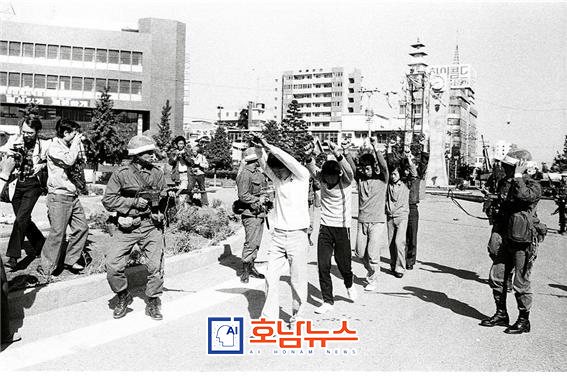 5.18 민주화운동 당시 군부에 연행되는 시민 / 사진제공=5.18단체 |
1980년 5월 광주를 직접 경험하고 국가폭력으로 피해를 입은 사람에게 5·18민주화운동은 책이나 영상으로만 접하는 과거의 사건이 아니다.
거리에서 들렸던 총성, 계엄군의 폭력, 피 흘리며 쓰러진 시민, 가족을 찾아 헤매던 울음과 공포가 여전히 가슴속에 남아 있는 살아 있는 역사다.
그런 피해자 앞에서 소위 대한민국의 지성인과 정치인을 자처하는 사람들이 국회에 모여 “전두환에게 광주 학살의 책임이 없다”고 주장하고, 5·18 참배마저 재검토해야 한다고 말하는 현실은 참담하기 이를 데 없다.
도대체 자신들의 자식이, 형제와 자매가 국가의 총부리에 쓰러졌어도 그렇게 말할 수 있는가.
사랑하는 가족이 계엄군의 총탄에 목숨을 잃고, 이유도 모른 채 끌려가 구타와 고문을 당했어도 이를 단순한 ‘소요 사태’나 ‘초동대처 실패’로 설명할 수 있는가.
피해자와 유족의 상처를 헤아리기는커녕 가해 책임을 지우고 학살의 역사를 다시 논쟁거리로 돌리는 모습을 보면서 대한민국의 앞날을 걱정하지 않을 수 없다.
국회에서 다시 등장한 전두환 책임 부정
이진숙 국민의힘 의원은 지난 13일 국회도서관에서 새역사국민운동과 함께 5·18민주화운동을 재조명한다는 취지의 공개 포럼을 열었다.
이 자리에서 주동식 전 국민의힘 당협위원장은 “우파는 5·18에 무조건 굴복하고 무릎 꿇는 자세부터 버려야 한다.”며 “5·18 참배도 재검토해야 한다고 생각한다.”고 주장했다.
또 다른 발표에서는 전두환에게 광주 학살의 책임이 없다는 취지의 주장과 함께, 광주지역 지휘관과 경찰이 시위를 초기에 제대로 진압하지 않아 상황이 악화됐다는 논리가 제기됐다.
이에 취재진이 “전두환이 광주 학살의 책임이 없다는 주장이 나왔다”고 질문하자 이진숙 의원은 “그렇게 물으면 안 된다. 기자 자격이 없다.”고 반박했다.
그러나 공직자가 해야 할 일은 질문한 기자의 자격을 공격하는 것이 아니다. 국회라는 공적 공간에서 전두환 책임 부정과 5·18 참배 재검토 주장이 나온 데 대해 자신이 동의하는지, 대법원 판결과 국가 조사 결과를 인정하는지 분명하게 답하는 것이다.
이 의원이 문제의 모든 발언을 직접 한 것은 아니다. 하지만 행사를 주최하고 국회 공간을 제공한 정치인이라면 행사에서 나온 역사 왜곡을 바로잡고 피해자와 국민에게 입장을 설명해야 할 정치적 책임이 있다.
전두환의 책임은 이미 대법원이 판단했다
“전두환에게 광주 학살의 책임이 없다.”는 주장은 대법원 확정판결과 정면으로 충돌한다.
대법원은 1997년 4월 17일 전두환·노태우 등에 대한 판결에서 신군부의 12·12 군사반란과 비상계엄 전국 확대, 정치인 체포, 국회 봉쇄, 광주 무력진압 등을 권력 장악을 위한 일련의 내란행위로 판단했다.
대법원은 이를 혁명이나 사법심사 대상이 아닌 통치행위로 볼 수 없으며, 성공한 쿠데타 역시 처벌할 수 있다고 명시했다. 전두환은 이 판결로 내란수괴죄 등의 유죄가 확정됐다.
이는 전두환이 광주 현장에서 직접 총을 쐈는지를 따진 판결이 아니다. 신군부의 최고 핵심 인물로서 헌정질서를 파괴하고 군을 동원해 권력을 장악한 과정에 대한 형사책임을 인정한 것이다.
따라서 전두환이 서명한 최초 발포명령 문서가 발견되지 않았다는 이유만으로 “광주 학살에 책임이 없다”고 결론 내리는 것은 법원의 판단을 의도적으로 축소하거나 왜곡하는 주장이다.
발포명령자 미특정이 전두환 무책임을 뜻하지 않는다.
5·18진상규명조사위원회가 구체적인 최초 발포명령자를 최종 특정하지 못한 것은 사실이다. 그러나 이것이 전두환의 내란 책임이나 신군부의 광주 무력진압 책임까지 사라졌다는 뜻은 아니다.
“누가 최초 발포를 직접 명령했는가.”라는 문제와 “누가 불법적인 권력 장악과 군 투입, 유혈진압을 주도하고 지휘했는가.”라는 문제는 구분해야 한다.
국가 조사에서는 계엄군이 광주와 전남의 최소 20곳에서 50차례 이상 총기 등 무기를 사용한 사실이 확인됐다. 계엄군에 의해 숨진 것으로 파악된 희생자 166명 가운데 135명이 총상 사망자로 조사됐다.
국방부 5·18특별조사위원회 역시 육군이 500MD와 UH-1H 헬기를 이용해 1980년 5월 21일과 27일 광주시민을 상대로 사격했다고 발표했다. 계엄사령부가 문서 또는 구두로 헬기사격을 지시하고 무장헬기를 광주에 대기시킨 정황도 조사됐다.
최초 발포명령자가 아직 명확하게 규명되지 않았다는 사실은 앞으로 밝혀야 할 과제다. 그렇다고 이미 확인된 계엄군의 집단발포와 헬기사격, 신군부의 내란행위까지 없던 일이 되는 것은 아니다.
미확인 영역을 근거로 확정된 사실 전체를 부정하는 것은 학술적 검토가 아니라 논리적 기만에 가깝다.
“더 일찍 진압하지 않은 것이 잘못”이라는 위험한 논리
포럼에서는 정웅 사단장과 윤흥정 당시 전남도경국장이 시위 초기 강경진압에 나서지 않아 사태를 악화시켰다는 취지의 주장도 제기됐다.
이는 국가폭력의 책임을 현장에서 더 큰 유혈사태를 막으려 했던 사람에게 돌리는 위험한 주장이다.
5·18의 근본 원인은 지역 지휘관이나 경찰이 시민을 더 일찍, 더 강하게 진압하지 않았기 때문이 아니다. 신군부가 비상계엄을 전국으로 확대하고 국회를 봉쇄했으며, 정치인과 학생을 체포하고 공수부대를 광주에 투입해 시민을 폭행하고 살상한 데 있다.
초기에 시민을 더 가혹하게 진압했어야 한다는 논리대로라면 학살을 확대하지 않은 사람이 잘못이고, 더 많은 군대를 동원해 시민을 짓밟았어야 옳았다는 결론에 이른다.
불법적인 군 투입과 과잉진압의 책임은 사라지고, 국가폭력에 저항하거나 강경진압을 주저한 사람이 책임자로 뒤바뀌는 것이다. 이는 가해자와 피해자의 자리를 바꾸는 역사적 책임 전가다.
더욱이 전두환 회고록은 법원의 판결문이나 중립적인 국가 조사보고서가 아니다. 사건의 핵심 당사자가 자신의 책임을 방어하기 위해 작성한 일방적인 기록이다. 이를 대법원 확정판결이나 국가기관의 조사 결과보다 신뢰할 만한 근거처럼 내세우는 것은 객관적인 학술 연구라고 보기 어렵다.
“내 가족이 희생됐어도 같은 말을 하겠는가.”
5·18을 직접 겪은 피해자의 입장에서 이러한 주장을 접할 때마다 가슴이 다시 찢어진다.
총탄에 쓰러진 시민에게도 부모가 있었고, 자식과 형제자매가 있었다. 그들은 누군가의 소중한 가족이었으며, 평범한 일상을 살아가던 대한민국 국민이었다.
당시의 총성과 비명, 피 묻은 거리와 가족을 잃은 절규를 경험하지 못했다고 해서 그 고통을 함부로 재단할 권리는 누구에게도 없다.
특히 역사학자와 언론인, 정치인처럼 사회적 영향력이 큰 사람일수록 자신들의 말이 피해자와 유족에게 어떤 상처를 주는지 깊이 생각해야 한다.
자신의 자식이 국가의 총부리에 쓰러졌어도 “전두환에게 책임이 없다”고 말할 수 있는가.
자신의 형제와 자매가 거리에서 총탄을 맞았어도 “초기에 더 강하게 진압했어야 했다”고 주장할 수 있는가.
가족의 시신조차 찾지 못한 채 46년을 살아왔어도 5·18 묘역 참배를 “굴복”이나 “무릎 꿇기”라고 조롱할 수 있는가.
이 질문에 답하지 못한다면 지성인이라는 이름으로 피해자의 고통을 함부로 논해서는 안 된다.
5·18 참배는 광주에 대한 굴복이 아니다
5·18 참배는 특정 지역이나 정당, 정치세력에 굴복하는 행위가 아니다.
군사반란과 국가폭력으로 희생된 국민 앞에서 대한민국이 다시는 국가권력으로 국민을 살상하지 않겠다고 다짐하는 헌법적 행위다.
국회는 특별법을 통해 5·18을 헌정질서 파괴범죄와 반인도적 범죄에 맞선 민주화운동으로 규정했다. 국가기념일로 지정된 5월 18일에는 정부 주관 기념식이 열린다.
보수와 진보를 떠나 역대 대통령과 주요 정당 지도자들이 국립5·18민주묘지를 참배한 것도 광주에 굴복하기 위해서가 아니다. 국가폭력의 잘못을 기억하고 민주주의와 헌법 수호 의지를 밝히기 위해서다.
참배를 “무릎 꿇기”라고 말하는 것은 희생자와 유족뿐 아니라 대한민국의 법률과 사법부의 판결, 국가가 축적해 온 역사적 합의까지 모욕하는 것이다.
표현의 자유는 역사 조작의 면허가 아니다
5·18에 대한 연구와 토론은 계속돼야 한다. 아직 확인되지 않은 발포명령 체계, 암매장과 행방불명자 문제, 군과 정보기관의 은폐·왜곡 과정도 철저히 규명해야 한다.
그러나 연구와 토론은 확인된 사실과 증거를 존중하는 데서 출발해야 한다. 결론을 먼저 정해 놓고 전두환 회고록과 일부 주장만 선택해 국가 조사와 확정판결을 뒤집으려는 것은 학문이 아니다.
표현의 자유 역시 허위사실을 유포하거나 피해자의 존엄을 짓밟을 수 있는 무제한의 권리가 아니다. 현행 「5·18민주화운동 등에 관한 특별법」은 공연한 허위사실 유포를 처벌하도록 규정하고 있다.
정치인과 학자는 표현의 자유를 말하기 전에 자신의 발언에 합당한 사실적 근거와 사회적 책임부터 져야 한다.
대한민국의 앞날이 두려운 이유
대한민국의 앞날이 두려운 것은 역사를 질문하는 사람이 있기 때문이 아니다.
대법원의 확정판결과 국가의 공식 조사 결과가 존재하는데도 이를 외면하고, 학살 책임자를 변호하며, 피해자의 고통을 정치적 도구로 사용하는 사람들이 자신을 지성인이라고 내세우기 때문이다.
역사를 왜곡한 말이 국회에서 박수를 받고, 이를 비판하는 피해자와 기자가 오히려 공격받는 사회라면 민주주의의 기반은 흔들릴 수밖에 없다.
국회는 학살 책임자에게 면죄부를 발급하는 곳이 아니다. 피해자를 다시 심판대에 세우고 국가폭력을 정당화하는 역사 세탁소는 더더욱 아니다.
이진숙 의원과 포럼 관계자들은 분명하게 답해야 한다.
대법원이 확정한 전두환의 내란수괴죄를 인정하는가. 신군부의 불법적인 권력 장악과 광주 무력진압을 인정하는가. 계엄군의 시민 상대 집단발포와 헬기사격이라는 국가 조사 결과를 인정하는가.
이 모든 사실을 인정하면서도 전두환에게 책임이 없다고 주장한다면, 그것은 연구나 토론이 아니라 책임 회피를 위한 역사 왜곡이라는 비판을 피할 수 없다.
5·18 피해자와 유족에게 필요한 것은 가해자를 위한 또 하나의 변명이 아니다. 국가와 정치권의 진정한 사과, 남은 진실의 규명, 책임 있는 기억과 재발 방지다.
자신의 자식과 형제자매가 국가의 총부리에 쓰러졌어도 같은 말을 할 수 있는가.
그 질문 앞에서조차 아무런 부끄러움을 느끼지 못한다면, 대한민국이 두려워해야 할 것은 46년 전의 진실이 아니라 오늘날에도 계속되는 양심과 역사인식의 붕괴다.
“Would They Still Say This If Their Own Children Had Fallen Before the Guns of the State?”—Distortion of May 18 Tears Open Victims’ Wounds Once Again
National Assembly forum held to “reexamine May 18,” featuring claims denying Chun Doo-hwan’s responsibility and questioning memorial visits
Former party official Joo Dong-sik says conservatives should “stop kneeling” and reconsider visits to the May 18 cemetery
Claims absolving Chun contradict Supreme Court rulings and official state investigations
Rep. Lee Jin-sook hosted the controversial forum but failed to actively correct its distortions
Supreme Court ruled that martial-law expansion and the armed suppression of Gwangju formed part of an insurrection to seize power
Official investigations confirmed repeated gunfire by martial-law troops and helicopter shootings; failure to identify the first person who ordered fire does not erase responsibility
“Would they say the same thing if their own children, brothers or sisters had been shot by the state?”
“Freedom of expression is not a license to trample established history and the dignity of victims”
“The National Assembly must not become a historical laundromat that exonerates those responsible for a massacre and victimizes the dead all over again”
【Gwangju–Jeonnam, South Korea = AI Honam News】 aihnnews@kakao.com
For those who personally lived through May 1980 in Gwangju and suffered under state violence, the May 18 Democratic Uprising is not merely an event from the past encountered in books or documentary footage.
The sound of gunfire in the streets, the brutality of martial-law troops, citizens collapsing in blood, and the cries and terror of families desperately searching for their loved ones remain part of a living history etched into their hearts.
Against this background, it is deeply distressing to see people who present themselves as intellectuals and political leaders gathering inside the National Assembly to claim that Chun Doo-hwan bore no responsibility for the bloodshed in Gwangju and even to suggest reconsidering visits to pay tribute to the May 18 victims.
Would they still speak that way if their own children, brothers or sisters had fallen before the guns of the state?
If their loved ones had been killed by martial-law troops—or dragged away, beaten and tortured without cause—could they still dismiss the tragedy as a mere “disturbance” or the result of “failed initial containment”?
When people erase the responsibility of the perpetrators and turn a massacre back into a matter of political dispute, without the slightest regard for the wounds of victims and bereaved families, it becomes impossible not to fear for the future of the Republic of Korea.
Denial of Chun Doo-hwan’s Responsibility Returns to the National Assembly
On August 13, People Power Party lawmaker Lee Jin-sook co-hosted a public forum with the New History National Movement at the National Assembly Library under the stated purpose of reexamining the May 18 Democratic Uprising.
At the forum, Joo Dong-sik, a former People Power Party district committee chair, said: “The right must abandon its attitude of unconditionally surrendering and kneeling before May 18.” He added, “I believe visits to pay tribute to May 18 should also be reconsidered.”
Another presentation reportedly advanced the argument that Chun Doo-hwan bore no responsibility for the bloodshed in Gwangju. It also suggested that the situation escalated because local military commanders and police officers failed to suppress the demonstrations properly at an early stage.
When a reporter asked about the claim that Chun bore no responsibility for the Gwangju killings, Lee replied: “You must not ask a question that way. You are not qualified to be a journalist.”
Yet the duty of a public official is not to attack the qualifications of the journalist asking the question.
Lee should instead state clearly whether she agrees with the denial of Chun’s responsibility and the call to reconsider May 18 memorial visits—and whether she accepts the rulings of the Supreme Court and the findings of official state investigations.
Lee did not personally make every controversial remark at the forum. Nevertheless, as the lawmaker who hosted the event and provided access to a space inside the National Assembly, she bears a political responsibility to correct historical distortions made there and explain her position to the victims and the public.
The Supreme Court Has Already Ruled on Chun’s Responsibility
The assertion that “Chun Doo-hwan bore no responsibility for the Gwangju massacre” directly conflicts with the final judgment of South Korea’s Supreme Court.
On April 17, 1997, the Supreme Court ruled in the cases of Chun Doo-hwan, Roh Tae-woo and others that the December 12 military coup, the nationwide expansion of martial law, the arrest of political figures, the blockade of the National Assembly and the armed suppression of Gwangju constituted a series of insurrectionary acts aimed at seizing political power.
The Court made clear that these acts could not be regarded as a revolution or as acts of governance beyond judicial review. It also ruled that a successful coup could still be punished. Chun’s convictions, including for leading an insurrection, were thereby finalized.
The ruling was not about whether Chun personally pulled a trigger in Gwangju. It recognized his criminal responsibility as the central leader of the new military regime that destroyed the constitutional order and mobilized the armed forces in the process of seizing power.
Therefore, concluding that Chun bore no responsibility for the bloodshed merely because no written order bearing his signature has been found directing the initial firing represents an intentional narrowing or distortion of the Court’s judgment.
Failure to Identify the First Person Who Ordered Fire Does Not Exonerate Chun
It is true that the May 18 Democratization Movement Truth Commission did not ultimately identify the specific individual who issued the first order to fire.
But that does not mean Chun’s responsibility for insurrection—or the new military regime’s responsibility for the armed suppression of Gwangju—has disappeared.
The question “Who directly issued the first order to fire?” must be distinguished from the question “Who led and commanded the unlawful seizure of power, the deployment of troops and the resulting violent suppression?”
Official investigations found that martial-law troops used firearms and other weapons on at least 50 occasions at no fewer than 20 locations across Gwangju and the surrounding Jeonnam region. Of 166 victims identified as having been killed by martial-law forces, 135 were found to have died from gunshot wounds.
A special investigative committee under the Ministry of National Defense also concluded that the Army used 500MD and UH-1H helicopters to fire on citizens of Gwangju on May 21 and May 27, 1980. Investigators also found indications that the Martial Law Command issued helicopter-firing instructions orally or in writing and placed armed helicopters on standby in Gwangju.
The failure to conclusively identify the person who issued the first firing order remains a matter requiring further investigation. It does not erase the already established facts of repeated gunfire by martial-law troops, helicopter shootings or the new military regime’s acts of insurrection.
Using the areas that remain unresolved to deny the entirety of the facts already established is not serious academic scrutiny. It amounts to logical deception.
The Dangerous Claim That the Failure to Suppress Citizens Earlier Was the Real Mistake
The forum also featured an argument that Maj. Gen. Jeong Ung and then-South Jeolla Provincial Police Chief Yoon Heung-jeong aggravated the situation by failing to carry out a harsh crackdown at an early stage.
This is a dangerous attempt to shift responsibility for state violence onto those who sought to prevent even greater bloodshed on the ground.
The fundamental cause of May 18 was not that local military commanders or police officers failed to suppress citizens earlier or more violently.
It was that the new military regime expanded martial law nationwide, blocked the National Assembly, arrested politicians and students, and deployed airborne troops to Gwangju, where citizens were beaten and killed.
Following the logic that citizens should have been crushed more brutally at the outset leads to a perverse conclusion: that those who refused to expand the bloodshed were at fault, and that mobilizing more soldiers to trample citizens would have been the correct course of action.
Such reasoning makes the responsibility for unlawful troop deployment and excessive force disappear, while transforming those who resisted state violence—or hesitated to impose an even harsher crackdown—into the alleged culprits. It reverses the positions of perpetrator and victim and constitutes a grave displacement of historical responsibility.
Furthermore, Chun Doo-hwan’s memoir is neither a judicial ruling nor a neutral government investigation report. It is a one-sided account written by a principal party to the events in defense of his own conduct.
Presenting it as more credible than a final Supreme Court ruling or the findings of official investigations cannot reasonably be described as objective academic research.
“Would They Still Say This If Their Own Families Had Been Killed?”
As someone who personally experienced May 18 and suffered from it, encountering such claims tears open the heart all over again.
The citizens who fell to gunfire had parents, children, brothers and sisters. They were beloved members of their families and ordinary citizens of the Republic of Korea living ordinary lives.
No one has the right to dismiss their suffering merely because they did not personally hear the gunfire and screams, see the bloodstained streets or witness the anguish of families who lost their loved ones.
Historians, journalists and politicians, in particular, wield considerable influence over society. They must think deeply about the wounds their words inflict upon victims and bereaved families.
Could they say that Chun Doo-hwan bore no responsibility if their own children had fallen before the guns of the state?
Could they argue that the authorities should have cracked down more forcefully at the outset if their own brothers or sisters had been shot in the streets?
Could they ridicule a visit to the May 18 cemetery as “surrender” or “kneeling” if they had spent 46 years unable even to recover the remains of a missing family member?
If they cannot answer these questions, they have no right to invoke the name of intellectual inquiry while treating the suffering of victims so carelessly.
Paying Tribute to May 18 Is Not Surrendering to Gwangju
Visiting the May 18 cemetery is not an act of surrender to a particular region, political party or ideological faction.
It is a constitutional act through which the Republic of Korea stands before citizens killed by military rebellion and state violence and pledges that the state will never again use its power to kill its own people.
Through special legislation, the National Assembly has defined May 18 as a democratic movement that resisted crimes against the constitutional order and crimes against humanity. Every May 18, the government holds an official national commemoration.
Presidents and leaders of major political parties across the ideological spectrum have visited the May 18 National Cemetery—not to surrender to Gwangju, but to remember the wrongs of state violence and affirm their commitment to democracy and the constitutional order.
Describing such an act of remembrance as “kneeling” insults not only the victims and their families but also the nation’s laws, judicial rulings and the historical consensus that South Korea has built over decades.
Freedom of Expression Is Not a License to Manipulate History
Research and discussion concerning May 18 must continue. The firing command structure, suspected secret burials, missing persons and the concealment and manipulation of evidence by military and intelligence agencies still require exhaustive investigation.
Such research and debate, however, must begin with respect for verified facts and evidence.
Starting with a predetermined conclusion and selectively using Chun’s memoir and isolated claims to overturn official findings and final court judgments is not scholarship.
Freedom of expression is not an unlimited right to circulate false information or trample the dignity of victims. The current Special Act on the May 18 Democratization Movement provides criminal penalties for publicly disseminating false information about the uprising.
Before invoking freedom of expression, politicians and academics must first accept responsibility for the factual basis and social consequences of what they say.
Why the Future of the Republic of Korea Is Frightening
The future of the Republic of Korea is not frightening because some people ask questions about history.
It is frightening because people who call themselves intellectuals disregard final Supreme Court judgments and official government findings, defend those responsible for mass bloodshed and use the suffering of victims as a political instrument.
If historical distortions receive applause inside the National Assembly while victims and journalists who challenge them are attacked, the foundations of democracy will inevitably begin to crumble.
The National Assembly is not a place for issuing pardons to those responsible for mass killing. Still less should it become a historical laundromat that puts victims back on trial and legitimizes state violence.
Lee Jin-sook and the forum’s organizers must answer clearly.
Do they accept the Supreme Court’s final conviction of Chun Doo-hwan for leading an insurrection?
Do they acknowledge the new military regime’s unlawful seizure of power and armed suppression of Gwangju?
Do they accept the official findings that martial-law troops repeatedly fired on citizens and that helicopters were used in the shootings?
If they accept all these facts and still insist that Chun bore no responsibility, they cannot avoid criticism that their position is not research or debate but a distortion of history designed to evade responsibility.
What the victims and bereaved families of May 18 need is not another excuse for the perpetrators. They need a sincere apology from the state and political community, full disclosure of the remaining truth, responsible remembrance and firm measures to prevent such violence from ever happening again.
Would these people still say the same thing if their own children, brothers or sisters had fallen before the guns of the state?
If they feel no shame even when confronted with that question, then what the Republic of Korea must fear is not the truth of 46 years ago, but the continuing collapse of conscience and historical awareness today.
 ai호남뉴스 박충배 편집/칼럼 aihnnewsr@kakao.com