| “유족의 가슴에 또다시 언어의 총탄을 겨눴다”…국회서 되살아난 전두환 찬양, 국민의 이름으로 심판해야 이진숙 의원 주최 ‘5·18 재조명 포럼’서 역사 왜곡·폄훼 발언 쏟아져 ai호남뉴스 박충배 편집/칼럼 aihnnewsr@kakao.com |
| 2026년 08월 18일(화) 16:07 |
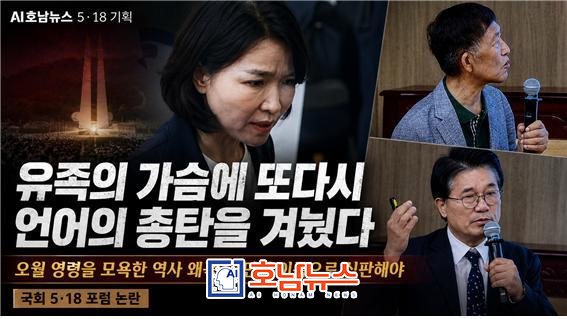 5.18 이진숙 폄하 / 사진제공=AI호남뉴스 |
1980년 5월 광주에서 계엄군의 총탄에 쓰러진 시민들은 46년이 지난 오늘까지도 완전히 눈을 감지 못하고 있다.
사랑하는 아들과 딸, 부모와 형제자매를 잃은 유족들은 국가폭력의 진실이 온전히 밝혀지고 다시는 같은 비극이 반복되지 않는 나라를 기다려 왔다. 그러나 2026년 8월 13일, 국민을 대표하는 국회에서 그들의 가슴을 다시 겨누는 언어의 총탄이 발사됐다.
총칼 대신 마이크를 들었을 뿐이다. 희생자를 향한 모욕과 전두환에 대한 미화, 5·18의 역사적 의미를 무너뜨리려는 발언은 오월 유족과 피해자들에게 또 하나의 폭력이었다.
국민의힘 이진숙 의원과 새역사국민운동은 이날 국회도서관 대강당에서 ‘5·18민주화운동의 재조명 국회 공개포럼’을 열었다.
학술적 성찰과 재조명을 내세웠지만 행사장에서 나온 발언들은 새로운 증거를 통한 진상규명보다 이미 사법적·역사적으로 확립된 5·18의 성격과 전두환 신군부의 책임을 뒤집는 데 집중됐다.
국회는 역사를 왜곡하는 사람들의 안전한 피난처가 아니다. 국민의 세금으로 운영되는 국회가 피해자와 유족의 존엄을 짓밟는 발언에 공적 권위와 확성기를 제공해서도 안 된다.
“소요 사태”라니…누구의 피를 지우려는가
새역사국민운동 공동대표인 이영훈 전 서울대 교수는 1980년 5월 광주를 ‘열흘간의 소요 사태’로 표현했다.
그는 전두환이 단임 약속을 지켰고 1987년 여야 타협을 통해 민주주의를 연착륙시켰다는 점을 강조하면서 전두환을 ‘부국과 민주정치 연착륙’의 인물로 평가했다.
그러나 전두환 정권이 어떻게 탄생했는지, 계엄군이 광주에서 시민들에게 어떤 폭력을 가했는지, 국가권력을 장악하기 위해 얼마나 많은 국민의 자유와 생명을 짓밟았는지에 대해서는 균형 있는 설명을 내놓지 않았다.
5·18은 우발적으로 발생한 단순한 소요가 아니다.
1979년 12·12 군사반란으로 군 지휘권을 장악한 신군부가 비상계엄을 전국으로 확대하고 민주화를 요구하는 시민들을 군대로 진압하는 과정에서 발생한 국가폭력과 이에 맞선 시민들의 민주화운동이다.
현행 「5·18민주화운동 등에 관한 특별법」도 5·18을 ‘헌정질서 파괴범죄와 반인도적 범죄에 대항해 시민들이 전개한 민주화운동’으로 명확하게 규정한다.
이를 ‘소요 사태’라고 부르는 것은 단순한 용어 선택이 아니다. 가해 권력의 책임을 흐리고 피해 시민에게 혼란의 책임을 돌리는 역사적 퇴행이다.
“전두환에게 뒤집어씌웠다”…대법원 판결까지 부정하려는가.
김용삼 펜앤마이크 대기자는 “무조건 전두환이라는 사람에게 다 뒤집어씌웠다”며 “지금도 전두환 살인마라고 이야기한다.”고 말했다.
김 씨는 1980년 당시 공식 군 지휘계통에 전두환이 포함되지 않았다는 점을 들어 광주 진압 책임이 전두환에게 부당하게 전가됐다는 취지의 주장을 펼쳤다.
그러나 이 주장은 대한민국 대법원의 확정판결과 정면으로 충돌한다.
대법원은 전두환을 5·18과 아무 관계가 없는 주변 인물로 판단하지 않았다. 12·12 군사반란과 비상계엄 확대, 광주 무력진압을 거쳐 국가권력을 장악한 일련의 과정을 내란으로 판단하고 전두환에게 반란수괴·내란수괴·내란목적살인 등의 유죄를 확정했다.
구체적인 최초 발포명령을 적은 문서나 단일 발포명령자가 최종 특정되지 않았다는 사실과 전두환에게 법적·정치적 책임이 없다는 주장은 전혀 다른 문제다.
공식 지휘계통이라는 좁은 형식만 떼어내 권력 장악 과정 전체를 지휘하고 이익을 얻은 신군부 핵심의 책임을 지우려 한다면, 그것은 진상규명이 아니라 책임 회피를 위한 역사 재구성에 불과하다.
“참배를 재검토하자”…희생자 앞에 고개 숙이는 것이 굴복인가
주동식 호남대안포럼 공동대표이자 전 국민의힘 광주 서구갑 당협위원장은 “우파는 5·18에 무조건 굴복하고 무릎 꿇는 자세부터 버려야 한다”며 “5·18 참배도 재검토해야 한다”고 주장했다.
그는 5·18 문제를 해결하려면 “대외적으로 고립시키고 내부적으로 분열시켜야 한다”는 취지의 발언까지 내놨다.
국립5·18민주묘지를 찾아 희생자 앞에 고개를 숙이는 것이 굴복인가.
국가폭력에 희생된 국민을 추모하고 헌정질서를 지키겠다고 다짐하는 것이 우파의 패배인가.
희생자의 묘역 앞에 서는 행위는 특정 정당이나 이념에 대한 복종이 아니다. 대한민국 헌법과 국민주권, 인간의 존엄을 지키겠다는 최소한의 국가적 예의다.
더구나 광주를 ‘대외적으로 고립’시키고 ‘내부적으로 분열’시켜야 한다는 발언은 광주시민과 5·18 공동체를 토론의 상대가 아니라 해체하고 약화해야 할 대상으로 바라본다는 점에서 충격적이다.
광주와 전남을 고립시키고 시민을 분열시키겠다는 발상이야말로 국민통합을 해치고 지역갈등을 정치적 수단으로 이용하는 위험한 행위다.
광주·전남특별시민들은 이러한 발언에 분노하지 않을 수 없다. 이는 1980년 5월을 직접 겪은 시민뿐 아니라 민주주의와 헌법을 지키려는 모든 국민을 모욕하는 말이기 때문이다.
이진숙 의원은 왜 책임 있는 답변을 피했는가.
이번 포럼을 국회로 불러들인 사람은 국민의힘 이진숙 의원이다.
이 의원은 “5·18이 성역이 되는 것이 자유대한민국에서 바람직한가.”, “5·18은 특정 진영의 소유물이 돼서는 안 된다”고 말했다.
그 말 자체만 떼어놓으면 역사적 사건에 대한 자유로운 토론을 주장하는 것으로 들릴 수 있다. 그러나 토론은 서로 다른 근거와 시각을 공정하게 검증할 때 성립한다.
이번 행사에서는 이영훈·김용삼·주동식 등 사실상 같은 방향의 역사관을 가진 인사들이 발표자로 나섰다. 5·18 피해자와 유족, 역사학자, 국가 조사 관계자, 헌법·형법 전문가가 동등하게 참여해 발표 내용을 검증하는 구조도 찾아보기 어려웠다.
특히 MBC 기자가 “전두환이 광주 학살의 책임이 없다는 주장이 나왔는데 동의하느냐.”고 묻자 이 의원은 명확한 답변 대신 “그렇게 물으면 안 된다.”며 “기자 자격이 없다.”고 말했다.
국회의원이 답해야 할 것은 기자의 자격이 아니다.
전두환에게 5·18의 법적·정치적 책임이 없다는 주장에 동의하는지, 5·18을 ‘소요 사태’라고 부르는 데 동의하는지, 묘역 참배를 재검토해야 한다는 주장에 동의하는지를 국민 앞에 분명하게 밝혀야 한다.
자신이 마련한 자리에서 피해자의 명예를 훼손할 수 있는 발언들이 쏟아졌다면 이를 바로잡고 책임 있는 입장을 내놓는 것이 주최자의 의무다. 질문한 기자를 공격하는 것으로 그 책임을 피할 수 없다.
표현의 자유는 역사적 허위에 대한 면허가 아니다
민주사회에서 역사적 사건에 대한 연구와 토론은 최대한 폭넓게 보장돼야 한다. 그러나 표현의 자유는 사실을 조작하고 확정판결을 지우며 피해자의 존엄을 훼손해도 된다는 무제한의 면허가 아니다.
새로운 자료가 있다면 공개하고 검증받으면 된다. 기존 조사와 판결에 오류가 있다고 생각한다면 구체적인 증거와 논리로 반박해야 한다.
하지만 국가폭력의 피해를 축소하고 전두환의 책임을 부정하면서 5·18 희생자 추모까지 ‘굴복’으로 규정하는 것은 학술적 검증을 가장한 정치적 공격이라는 비판을 피하기 어렵다.
특히 현행법은 5·18에 관한 명백한 허위사실을 신문·방송·출판물이나 공개 토론회 등에서 유포하는 행위를 처벌할 수 있도록 규정하고 있다.
다만 모든 비판적 의견이 곧바로 형사처벌 대상이 되는 것은 아니다. 수사기관과 사법부는 포럼의 전체 발표 자료와 발언 맥락을 확보해 구체적인 허위사실 유포가 있었는지 엄정하게 검토해야 한다.
국회도 표현의 자유라는 말 뒤에 숨을 것이 아니라 행사 자료와 영상, 장소 승인 과정, 주최·후원 관계를 투명하게 공개해야 한다.
국민의힘도 “개인 행사”라는 말로 끝내서는 안 된다
국민의힘 지도부는 이번 포럼이 당이 관여한 행사가 아니라 이진숙 의원 개인이 진행한 행사라고 선을 그었다. 당 차원에서 행사 개최에 우려를 전달했다는 설명도 나왔다.
그러나 현직 국민의힘 의원이 국회에서 주최한 행사다. 당 소속 정치인이 5·18 묘역 참배 재검토와 전두환 책임 부정 주장이 나오는 자리를 만들었다면 당은 “개인의 일”이라는 말만 되풀이할 수 없다.
국민의힘이 5·18 정신의 헌법 전문 수록과 국민통합을 진정으로 약속한다면 이번 발언들이 당의 공식 입장과 어떻게 다른지 분명히 밝혀야 한다.
이진숙 의원에게 책임 있는 해명과 사과를 요구하고, 당 윤리기준에 따라 조사할 사안이 있는지도 검토해야 한다.
민주주의는 말로 지켜지지 않는다. 역사 왜곡 앞에서 어떤 조치를 취하는지가 그 정당의 진정성을 보여준다.
유족에게 또 한 번 죽음을 강요하지 말라.
5·18 유족들은 가족이 왜 죽어야 했는지조차 묻지 못하던 세월을 견뎠다.
희생자는 폭도로 몰렸고 살아남은 시민은 고문과 감시, 사회적 낙인에 시달렸다. 진실을 말하려는 사람들은 체포되고 투옥됐다. 유족들은 가족의 영정 앞에서 마음껏 울 자유조차 빼앗겼다.
그 오랜 고통 끝에 대법원 판결과 특별법, 국가기념일 지정, 국립묘지 조성, 진상규명 절차가 이어졌다.
그런데 이제 와서 국회 안에서 5·18을 다시 ‘소요 사태’로 부르고 전두환에게 책임을 뒤집어씌웠다고 주장하며 희생자 묘역 참배를 재검토하자고 말한다면, 유족들에게는 사랑하는 가족의 죽음을 다시 설명하고 증명하라는 잔인한 요구가 된다.
이는 과거를 토론하는 일이 아니다. 살아 있는 피해자의 상처를 현재진행형으로 만드는 행위다.
1980년에는 계엄군의 총탄이 시민의 몸을 관통했다. 2026년에는 역사 왜곡과 모욕의 언어가 유족의 가슴을 다시 관통하고 있다.
총탄의 형태가 말로 바뀌었다고 해서 고통까지 가벼워지는 것은 아니다.
국민의 이름으로 책임을 물어야 한다
AI호남뉴스는 이번 포럼과 관련해 다음과 같이 요구한다.
첫째, 이진숙 의원은 포럼에서 나온 5·18 ‘소요 사태’ 규정, 전두환 책임 부정, 묘역 참배 재검토, 광주 고립·분열 주장에 동의하는지 국민 앞에 명확히 밝혀야 한다.
둘째, 이 의원과 발표자들은 5·18 피해자와 유족, 광주·전남특별시민에게 공개적으로 사과해야 한다.
셋째, 국회는 행사 대관과 공동주최 경위를 공개하고 국회의 품위 및 국회의원 윤리의무 위반 여부를 엄정하게 심사해야 한다.
넷째, 국민의힘은 해당 발언들이 당의 공식 역사인식과 다른지 분명히 밝히고 당 차원의 진상조사와 책임 있는 조치를 취해야 한다.
다섯째, 관계기관은 공개포럼에서 구체적인 허위사실 유포가 있었는지 전체 영상과 발표문을 토대로 법률에 따라 검토해야 한다.
여섯째, 정치권은 정략적 공방에만 머물지 말고 5·18 진상규명 자료의 체계적 공개, 피해자 명예회복, 유족의 정신적·사회적 치유를 위한 실질적인 대책을 마련해야 한다.
여기서 말하는 국민의 심판은 증오나 물리적 보복이 아니다.
선거와 국회 윤리절차, 법률과 사법제도, 공개적인 사실 검증을 통해 역사 왜곡에 책임을 묻는 민주적 심판이다. 폭력에는 법치로, 거짓에는 기록으로, 모욕에는 시민의 연대로 맞서야 한다.
광주·전남특별시민의 분노는 지역감정이 아니다
광주·전남특별시민들이 이번 사태에 분노하는 것은 지역의 명예만을 지키기 위해서가 아니다.
5·18은 광주만의 역사가 아니다. 국가가 국민에게 총을 겨누면 안 된다는 대한민국 전체의 약속이며, 군대가 정치권력의 도구가 돼서는 안 된다는 헌법적 교훈이다.
광주를 모욕하는 행위는 결국 대한민국 민주주의를 모욕하는 행위다. 오월 영령의 희생을 지우는 순간, 어떤 지역의 국민도 국가폭력으로부터 안전할 수 없다.
우리는 묻는다.
발표자들의 자녀와 부모, 형제자매가 국가의 총탄에 쓰러졌어도 5·18을 ‘소요 사태’라고 부를 수 있는가.
사랑하는 가족의 시신을 찾아 병원과 체육관을 헤매야 했어도 전두환에게 책임을 뒤집어씌웠다고 말할 수 있는가.
가족의 묘역 앞에 정치인들이 고개를 숙이는 모습을 보면서 그것을 ‘굴복’이라고 조롱할 수 있는가.
그 질문에 답하지 못한다면 더 이상 학문의 자유와 표현의 자유 뒤에 숨어서는 안 된다.
오월 영령을 두 번 죽이는 언어폭력을 멈춰야 한다. 피해자의 침묵을 강요하고 가해 권력의 책임을 지우려는 역사 퇴행을 국민이 용납해서는 안 된다.
AI호남뉴스는 5·18을 정쟁의 도구로 삼는 모든 세력에 분명히 경고한다.
광주는 고립되지 않는다. 광주·전남특별시민은 분열되지 않는다. 오월의 진실은 몇 사람의 왜곡된 말로 지워지지 않는다.
우리는 유족의 가슴에 또다시 언어의 총탄을 겨눈 행위를 결코 잊지 않을 것이다.
법과 기록, 선거와 시민의 양심으로 책임을 묻고, 대한민국 민주주의와 국민의 이름으로 반드시 심판할 것이다.
“Once Again, They Aimed Bullets of Words at the Hearts of the Bereaved”…Chun Doo-hwan Glorification Resurfaces at National Assembly, Must Be Judged in the Name of the People
Historical distortion and disparaging remarks pour out at “May 18 Reexamination Forum” hosted by lawmaker Lee Jin-sook
Lee Young-hoon reduces May 18 to a “civil disturbance” and glorifies Chun Doo-hwan as a leader who enabled a “soft landing for democracy”
Kim Yong-sam says, “Everything was pinned on Chun Doo-hwan”…claim directly conflicts with final Supreme Court ruling
Joo Dong-sik urges conservatives to “stop bowing to May 18 and reconsider cemetery visits”…also calls for “external isolation and internal division”
Lee Jin-sook avoids central issue, telling reporter “You are not qualified to be a journalist” when asked whether she agreed that Chun bore no responsibility
Supreme Court convicted Chun Doo-hwan of leading an insurrection, murder for the purpose of insurrection and other crimes
Current law defines May 18 as a democratic movement against crimes that destroyed the constitutional order and crimes against humanity
“Freedom of expression cannot be a license to trample victims’ honor and overturn history”
Organizers must apologize to the people of the Gwangju–Jeonnam Special Metropolitan City and the nation, while the National Assembly must impose ethical and legal accountability
“We will not remain silent over verbal violence that kills the spirits of May once again; we will judge it in the name of the people”
【GWANGJU–JEONNAM=AI HONAM NEWS】 aihnnews@kakao.com
The citizens of Gwangju who fell to the bullets of martial-law troops in May 1980 have still not been able to rest in peace, even 46 years later.
Families who lost beloved sons and daughters, parents and siblings have waited for the full truth about state violence to be revealed and for a nation in which such a tragedy can never happen again. Yet on August 13, 2026, bullets of words were once again fired at their hearts inside the National Assembly, the institution that is supposed to represent the people.
The speakers merely held microphones instead of guns. Their insults toward the victims, glorification of Chun Doo-hwan and attempts to dismantle the historical significance of May 18 constituted another form of violence against the victims and bereaved families of the May Democratic Uprising.
People Power Party lawmaker Lee Jin-sook and the New History National Movement held the “National Assembly Public Forum for the Reexamination of the May 18 Democratization Movement” that day in the auditorium of the National Assembly Library.
Although billed as an event for academic reflection and reexamination, its speakers focused less on uncovering the truth through new evidence than on reversing the legally and historically established character of May 18 and the responsibility of Chun Doo-hwan’s military faction.
The National Assembly must not become a safe haven for those who distort history. Nor should an institution funded by taxpayers lend public authority and a powerful platform to remarks that trample on the dignity of victims and their families.
Calling It a “Civil Disturbance”—Whose Blood Are They Trying to Erase?
Lee Young-hoon, a former Seoul National University professor and co-chair of the New History National Movement, described the events in Gwangju in May 1980 as a “ten-day civil disturbance.”
He emphasized that Chun Doo-hwan kept his single-term pledge and enabled a soft landing for democracy through the 1987 compromise between the ruling and opposition parties. He portrayed Chun as a figure who brought about “national prosperity and a soft landing for democratic politics.”
Yet he failed to offer a balanced account of how Chun’s regime was created, what violence martial-law troops inflicted on Gwangju citizens, or how extensively the regime violated the freedom and lives of the people to seize state power.
May 18 was not a simple disturbance that erupted by accident.
It was a democratic movement in which citizens resisted state violence after the new military faction seized military command through the December 12, 1979 military rebellion, expanded martial law nationwide and deployed troops to suppress citizens demanding democracy.
The current Special Act on the May 18 Democratization Movement explicitly defines May 18 as “a democratization movement carried out by citizens against crimes that destroyed the constitutional order and crimes against humanity.”
Calling it a “civil disturbance” is not merely a matter of terminology. It is a historical regression that obscures the responsibility of the perpetrators and shifts the blame for the turmoil onto the victimized citizens.
“Everything Was Pinned on Chun Doo-hwan”—Are They Trying to Deny the Supreme Court’s Ruling?
Kim Yong-sam, a senior journalist at PenN, said, “Everything was indiscriminately pinned on Chun Doo-hwan,” adding, “Even now, people call Chun Doo-hwan a murderer.”
Kim argued that responsibility for the suppression of Gwangju was unfairly transferred to Chun because he was not formally included in the military chain of command at the time.
This claim directly conflicts with the final ruling of the Supreme Court of the Republic of Korea.
The Supreme Court did not regard Chun as an uninvolved, peripheral figure with no connection to May 18. It found that the sequence of events through which Chun and the new military faction seized state power—including the December 12 military rebellion, the nationwide expansion of martial law and the armed suppression of Gwangju—constituted an insurrection. It upheld Chun’s convictions for leading a military rebellion, leading an insurrection and murder for the purpose of insurrection, among other crimes.
The fact that no written document recording a specific initial order to fire—or a single individual who issued it—has been conclusively identified is entirely different from claiming that Chun bore no legal or political responsibility.
If one isolates the narrow formality of the official chain of command to erase the responsibility of a central figure who directed and benefited from the overall seizure of power, that is not truth-finding. It is a reconstruction of history designed to evade accountability.
“Reconsider Paying Tribute”—Is Bowing Before the Victims an Act of Surrender?
Joo Dong-sik, co-chair of the Honam Alternative Forum and former People Power Party chair for Gwangju’s Seo-gu Gap constituency, said, “The right wing must abandon its attitude of unconditionally surrendering and kneeling before May 18.” He also said visits to the May 18 cemetery should be reconsidered.
He went so far as to suggest that the May 18 issue should be addressed by “isolating it externally and dividing it internally.”
Is paying respects to the victims at the May 18 National Cemetery an act of surrender?
Is commemorating citizens killed by state violence and pledging to defend the constitutional order a defeat for the political right?
Standing before the victims’ graves is not an act of submission to a particular party or ideology. It is the minimum expression of national respect for the Constitution of the Republic of Korea, popular sovereignty and human dignity.
The proposal to “isolate” Gwangju externally and “divide” it internally is even more shocking because it treats Gwangju citizens and the May 18 community not as participants in a public debate but as targets to be dismantled and weakened.
The idea of isolating Gwangju and Jeonnam and dividing their citizens is itself a dangerous attempt to undermine national unity and exploit regional conflict as a political weapon.
Residents of the Gwangju–Jeonnam Special Metropolitan City cannot help but be outraged by such statements. These remarks insult not only those who personally experienced May 1980 but everyone committed to defending democracy and the Constitution.
Why Did Lee Jin-sook Avoid a Responsible Answer?
It was People Power Party lawmaker Lee Jin-sook who brought this forum into the National Assembly.
Lee asked, “Is it desirable in the free Republic of Korea for May 18 to become a sacred domain?” She also said, “May 18 must not become the property of a particular political camp.”
Taken in isolation, those words may sound like a call for open discussion of a historical event. Genuine debate, however, is possible only when differing evidence and perspectives are examined fairly.
The speakers at this event—Lee Young-hoon, Kim Yong-sam and Joo Dong-sik—largely shared the same historical perspective. There was no apparent structure that gave May 18 victims and bereaved families, historians, officials involved in state investigations, and constitutional or criminal-law experts an equal opportunity to scrutinize their claims.
In particular, when an MBC reporter asked whether she agreed with the claim that Chun Doo-hwan bore no responsibility for the Gwangju massacre, Lee did not provide a clear answer. Instead, she said, “You should not ask the question that way,” and told the reporter, “You are not qualified to be a journalist.”
What a member of the National Assembly must address is not the reporter’s qualifications.
She must tell the public clearly whether she agrees that Chun Doo-hwan bore no legal or political responsibility for May 18, whether she agrees with describing May 18 as a “civil disturbance,” and whether she supports reconsidering visits to the victims’ cemetery.
When remarks capable of damaging the honor of victims pour out at an event she organized, the host has a duty to correct them and state a responsible position. She cannot escape that responsibility by attacking the reporter who asked the question.
Freedom of Expression Is Not a License for Historical Falsehood
In a democratic society, research and discussion concerning historical events should be protected as broadly as possible. Freedom of expression, however, is not an unlimited license to manipulate facts, erase final court rulings and violate the dignity of victims.
If there is new evidence, it should be disclosed and subjected to scrutiny. If speakers believe existing investigations and court rulings are wrong, they must challenge them with specific evidence and sound reasoning.
But minimizing the damage caused by state violence, denying Chun Doo-hwan’s responsibility and describing the commemoration of May 18 victims as “surrender” cannot escape criticism as a political attack disguised as academic examination.
Current law provides for punishment when demonstrably false claims about May 18 are publicly disseminated through newspapers, broadcasting, publications or public forums.
Not every critical opinion automatically constitutes a criminal offense. Investigative and judicial authorities should obtain the forum’s complete presentation materials and the full context of the remarks to determine strictly and impartially whether specific falsehoods were disseminated.
The National Assembly must not hide behind the phrase “freedom of expression.” It should disclose the forum materials and recordings, the process through which the venue was approved, and the event’s hosting and sponsorship arrangements.
The People Power Party Cannot Dismiss It as a “Personal Event”
The People Power Party leadership distanced itself from the forum, saying it was not a party-sponsored event but one conducted personally by Lee Jin-sook. The party also said it had conveyed concerns about holding the event.
Nevertheless, the event was hosted inside the National Assembly by a sitting People Power Party lawmaker. When a politician affiliated with the party creates a platform for calls to reconsider paying tribute at the May 18 cemetery and claims denying Chun Doo-hwan’s responsibility, the party cannot simply repeat that it was a personal matter.
If the People Power Party is sincere in its promises to incorporate the spirit of May 18 into the preamble of the Constitution and promote national unity, it must clearly explain how these remarks differ from its official historical position.
It should demand a responsible explanation and apology from Lee Jin-sook and examine whether the matter warrants investigation under the party’s ethical rules.
Democracy is not protected through words alone. A political party’s sincerity is revealed by what action it takes when history is distorted.
Do Not Force the Bereaved to Endure Death Once Again
The bereaved families of May 18 endured years in which they could not even ask why their loved ones had to die.
The dead were branded as rioters. Survivors suffered torture, surveillance and social stigma. Those who tried to tell the truth were arrested and imprisoned. Bereaved families were denied even the freedom to grieve openly before photographs of their loved ones.
Only after that prolonged suffering came Supreme Court rulings, special legislation, designation of May 18 as a national commemorative day, the establishment of a national cemetery and official truth-finding procedures.
To once again call May 18 a “civil disturbance” inside the National Assembly, to claim that responsibility was merely pinned on Chun Doo-hwan, and to demand reconsideration of visits to the victims’ cemetery is to impose a cruel burden on the bereaved: forcing them to explain and prove the deaths of their loved ones all over again.
This is not a debate about the past. It makes the wounds of living victims bleed again in the present.
In 1980, bullets fired by martial-law troops pierced the bodies of citizens. In 2026, historical distortion and insulting words are once again piercing the hearts of the bereaved.
The pain does not become lighter simply because the bullets now take the form of words.
Accountability Must Be Enforced in the Name of the People
AI Honam News makes the following demands regarding this forum.
First, Lee Jin-sook must clearly state before the public whether she agrees with describing May 18 as a “civil disturbance,” denying Chun Doo-hwan’s responsibility, reconsidering cemetery visits, and isolating and dividing Gwangju.
Second, Lee and the forum speakers must publicly apologize to the victims and bereaved families of May 18 and to the residents of the Gwangju–Jeonnam Special Metropolitan City.
Third, the National Assembly must disclose how the venue was approved and how the event was jointly organized, and it must strictly examine whether the dignity of the legislature and the ethical duties of a lawmaker were violated.
Fourth, the People Power Party must state clearly whether the remarks differ from its official historical position and undertake its own investigation and responsible action.
Fifth, relevant authorities should review the full video and presentation materials in accordance with the law to determine whether specific falsehoods were disseminated at the public forum.
Sixth, the political community must move beyond partisan conflict and establish practical measures for the systematic disclosure of May 18 truth-finding records, the restoration of victims’ honor, and the psychological and social healing of bereaved families.
The judgment we seek in the name of the people does not mean hatred or physical retaliation.
It means democratic judgment through elections, National Assembly ethics procedures, law, the judicial system and transparent verification of facts. Violence must be met with the rule of law, falsehoods with documentary evidence, and insults with civic solidarity.
The Anger of Gwangju–Jeonnam Residents Is Not Regional Hostility
The people of the Gwangju–Jeonnam Special Metropolitan City are not angry merely to defend the reputation of their region.
May 18 is not the history of Gwangju alone. It is a national pledge that the state must never turn its guns on its people and a constitutional lesson that the military must never become a tool of political power.
To insult Gwangju is ultimately to insult the democracy of the Republic of Korea. The moment the sacrifices of the May victims are erased, no citizen in any region can remain safe from state violence.
We ask:
If the speakers’ own children, parents or siblings had been struck down by state bullets, could they still call May 18 a “civil disturbance”?
If they had searched hospitals and gymnasiums for the bodies of their loved ones, could they still claim that responsibility had merely been pinned on Chun Doo-hwan?
If politicians bowed before the graves of their families, could they mock that act as “surrender”?
If they cannot answer these questions, they must no longer hide behind academic freedom and freedom of expression.
The verbal violence that kills the spirits of May for a second time must stop. The people must not tolerate a historical regression that forces victims into silence and erases the responsibility of those who wielded state power.
AI Honam News issues a clear warning to every force that seeks to use May 18 as a tool of partisan conflict.
Gwangju will not be isolated. The people of the Gwangju–Jeonnam Special Metropolitan City will not be divided. The truth of May cannot be erased by the distorted words of a few individuals.
We will never forget the act of once again aiming bullets of words at the hearts of the bereaved.
Through law and historical records, elections and the conscience of citizens, we will demand accountability and pass judgment in the name of the democracy and people of the Republic of Korea.
 ai호남뉴스 박충배 편집/칼럼 aihnnewsr@kakao.com