| 광주 군공항 250만평, 대한민국 반도체의 미래가 미군 협상에 발목 잡혀선 안 된다
미 7공군 “광주기지에 중요한 군사적 이해관계”…한미 공동운영기지 이전 협상 본격화 ai호남뉴스 박충배 편집/논설 aihnnewsr@kakao.com |
| 2026년 09월 07일(월) 10:42 |
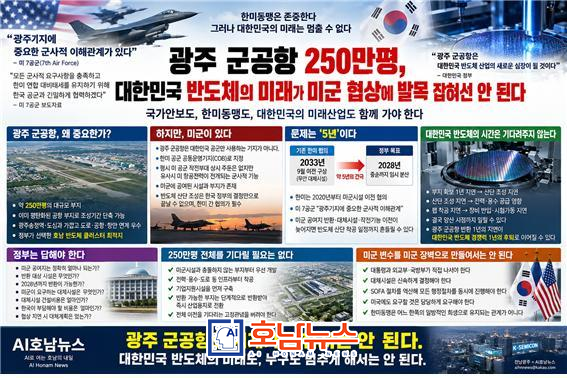 광주군공항 미군 발목잡기 / 사진제공=ai호남뉴스 |
[전남광주=AI호남뉴스] aihnnews@kakao.com
광주 군공항 약 250만평이 대한민국 반도체 산업의 새로운 심장으로 변신하려 하고 있다.
정부가 호남권 반도체 클러스터 입지로 광주 군공항을 선택한 이유는 분명하다. 약 250만평의 대규모 부지를 확보할 수 있고, 공항 특성상 이미 평탄화돼 있어 부지 조성기간을 단축할 수 있다. 광주송정역과 도심이 가깝고 도로·공항·항만과 연결되는 물류 여건도 강점으로 평가됐다. 정부 역시 이러한 장점을 공식적으로 밝혔다.
그러나 거대한 반도체 청사진 뒤에 반드시 해결해야 할 변수가 하나 있다.
■ 미군이다.
광주 군공항은 대한민국 공군만 사용하는 군사기지가 아니다. 한미 공군 공동운영기지(COB)로 지정돼 있으며 평시에 미 공군 작전부대가 상시 주둔하지 않더라도 유사시 미국 항공전력이 전개되는 군사적 기능을 갖고 있다.
때문에 광주 군공항을 반도체 산업단지로 바꾸는 문제는 대한민국 정부의 결정만으로 끝나지 않는다.
미군에 공여된 시설과 부지가 존재하고, 공동운영기지로서 담당하던 군사기능을 어떻게 대체할 것인지 한미 간 협의가 필요하다.
실제로 미 7공군은 광주기지에 “중요한 군사적 이해관계”가 있다는 입장을 밝혔다. 동시에 모든 군사적 요구사항을 충족하고 강력한 한미 연합 대비태세를 유지하기 위해 한국 공군과 긴밀하게 협력하겠다는 입장도 분명히 했다.
우리는 여기에서 냉정해져야 한다.
미국이 호남 반도체 클러스터에 반대한다고 단정해서도 안 된다. 현재 공개된 자료만으로는 그런 주장을 뒷받침하기 어렵다.
그러나 반대로 미국과 협의하면 모든 문제가 쉽게 해결될 것이라고 낙관해서도 안 된다.
군사시설의 시간과 반도체 산업의 시간은 전혀 다르기 때문이다.
■ 문제는 ‘5년’이다
정부는 광주 군공항의 기능을 2028년 중순까지 다른 군공항으로 임시 배치해 반도체 산업단지로 조기에 활용하겠다는 계획을 제시했다.
국방부도 안보와 대비태세에 미치는 영향을 최소화하면서 정부의 반도체 경쟁력 강화 정책에 협력하고, 미군 공여지를 조속히 반환받기 위해 미국 측과 협의하겠다고 밝혔다.
문제는 기존 한미 협의의 시간표다.
보도에 따르면 한미는 2020년부터 광주 군공항 미군시설 이전 문제를 협의해왔으며, 기존에는 무안에 대체시설을 마련한 뒤 2033년 9월까지 이전하는 계획을 토대로 협의해왔다.
2033년과 2028년.
약 5년의 차이다.
정부가 반도체 산업을 위해 기존 시간표를 5년가량 앞당기려 한다면 국민이 알고 싶은 것은 간단하다.
미국이 2028년 반환에 동의했는가.
동의하지 않았다면 협상은 어디까지 진행됐는가.
광주기지를 대신할 미군 작전시설은 어디에 마련할 것인가.
대체시설을 새로 건설해야 한다면 규모는 얼마나 되는가.
그리고 그 비용은 누가 부담하는가.
정부는 이 질문에 구체적으로 답해야 한다.
대한민국 반도체의 시계는 기다려주지 않는다
반도체 산업에서 1년은 짧은 시간이 아니다.
기업은 세계 반도체 수요와 공급, 기술 변화, 투자비용과 경쟁국의 보조금 정책을 보면서 수십조원의 투자 결정을 내린다.
부지 확보가 1년 늦어지면 산단 조성이 늦어진다.
산단 조성이 늦어지면 전력과 용수 공급도 영향을 받을 수 있다.
팹 착공이 늦어지면 장비 반입과 시험가동이 늦어진다.
결국 양산 시점까지 밀릴 수 있다.
광주 군공항 반환 1년의 지연이 반도체 공장 1년의 지연으로 이어지지 않는다는 보장이 어디에 있는가.
정부가 이 문제를 단순한 군공항 이전 행정절차 정도로 생각해서는 안 되는 이유다.
정부 스스로 광주 군공항을 국가 반도체 전략의 핵심 부지로 선택했다.
그렇다면 미군 공여지 반환 문제도 외교·국방 현안이 아니라 이제는 국가 산업경쟁력의 문제로 다뤄야 한다.
한미동맹과 대한민국의 산업주권은 충돌할 이유가 없다
우리는 한미동맹의 중요성을 부정하지 않는다.
북한의 핵·미사일 위협이 존재하는 한 한미 연합방위태세 역시 중요하다.
광주기지가 유사시 미 항공전력이 전개하는 공동운영기지라면 이를 대체할 작전능력을 확보해야 한다는 미국 측의 요구 역시 충분히 이해할 수 있다.
그러나 동맹을 존중하는 것과 대한민국의 국가 산업정책이 무기한 기다리는 것은 전혀 다른 문제다.
대한민국은 세계적인 반도체 생산국이다.
반도체는 단순한 지역개발사업도 아니다.
경제이고 안보다.
AI이고 미래산업이다.
대한민국의 국가경쟁력 자체다.
따라서 정부는 미국에 분명하게 설명해야 한다.
광주 군공항 이전은 단순히 지역민원을 해결하기 위한 사업이 아니라 대한민국과 한미동맹의 경제·기술 경쟁력을 강화하기 위한 국가전략사업이라는 사실을 말이다.
미군이 무엇을 요구하는지 공개하라
정부는 더 이상 “한미 간 긴밀하게 협의하고 있다”는 말에 머물러서는 안 된다.
국민에게 공개할 수 없는 작전계획이나 군사기밀까지 밝히라는 것이 아니다.
최소한 산업단지 조성에 직접적인 영향을 미치는 행정적·재정적 내용은 공개해야 한다.
■ 미군 공여지는 정확히 얼마나 되는가.
반환 대상 시설은 무엇인가.
2028년까지 반환이 가능한가.
미군이 요구하는 대체시설은 무엇인가.
대체시설 건설비용은 얼마인가.
한국이 부담해야 할 비용은 얼마인가.
협상이 지연될 경우 반도체 산업단지를 우선 착공할 대체계획은 있는가.
이 정도는 국민과 전남광주 시·도민에게 설명해야 한다.
250만평 전체를 기다릴 필요도 없다
전남광주통합특별시 역시 보다 공격적인 전략을 세워야 한다.
광주 군공항 전체가 완전히 이전할 때까지 기다렸다가 첫 삽을 뜨는 방식이어서는 안 된다.
민형배 전남광주통합특별시장도 군공항이 완전히 이전하지 않더라도 반도체 산단 조성을 시작할 수 있다는 입장을 밝힌 바 있다. 다만 군사시설과 미군 관련 시설, 유류저장시설과 송유관 등의 처리는 해결해야 할 과제로 남아 있다.
그렇다면 정부가 해야 할 일은 명확하다.
미군시설과 직접 충돌하지 않는 부지부터 먼저 개발해야 한다.
전력부터 끌어오고 용수관부터 깔아야 한다.
도로부터 만들고 기업지원시설부터 착공해야 한다.
반환 가능한 부지는 단계적으로 반환받아 즉시 산업용지로 전환해야 한다.
250만평 전체를 한꺼번에 확보해야만 반도체 클러스터를 시작할 수 있다는 고정관념부터 버려야 한다.
■ ‘미군 변수’를 ‘미군 장벽’으로 만들어서는 안 된다
광주 군공항 문제는 이제 새로운 단계로 들어섰다.
과거에는 군공항을 어디로 이전할 것인가가 최대 쟁점이었다.
이제는 다르다.
얼마나 빨리 비워 대한민국의 미래산업을 집어넣을 것인가가 중요해졌다.
정부가 이미 2028년이라는 목표를 국민 앞에 제시했다.
그렇다면 반드시 지켜야 한다.
미국과 협상해야 한다면 대통령과 외교부·국방부가 직접 나서야 한다.
대체시설이 필요하다면 신속하게 결정해야 한다.
SOFA 절차가 필요하다면 지금부터 역산해 모든 행정절차를 동시에 진행해야 한다.
그리고 미국에도 요구할 것은 당당하게 요구해야 한다.
한미동맹은 어느 한쪽의 일방적인 희생으로 유지되는 관계가 아니다.
대한민국이 제공한 군사시설이 이제 국가적으로 절박한 산업용지로 필요하다면 대체 군사기능을 확보하면서 최대한 신속하게 국민에게 돌려주는 해법을 한미가 함께 찾아야 한다.
■ 광주 군공항의 주인은 결국 대한민국 국민이다
광주 군공항은 지난 수십 년 동안 대한민국 안보를 위해 사용됐다.
이제 이 땅에 새로운 국가적 임무가 주어지고 있다.
전투기가 떠났던 활주로 옆에서 반도체가 생산되고,
군사시설이 자리했던 땅에 연구소와 기업이 들어서며,
청년들이 수도권으로 떠나지 않고 호남에서 세계적인 기술을 연구하는 시대를 만들자는 것이다.
그것이 정부가 말하는 호남 반도체 클러스터라면 정부부터 결단해야 한다.
안보도 지켜야 한다.
한미동맹도 지켜야 한다.
그러나 대한민국의 미래산업도 반드시 지켜야 한다.
우리가 가장 경계하는 것은 미국이 아니다.
‘협의 중’이라는 말 뒤에서 시간을 허비하는 대한민국의 행정이다.
2030년을 바라보는 세계 반도체 경쟁에서 2028년의 1개월, 6개월, 1년은 결코 사소하지 않다.
정부가 광주 군공항 250만평을 대한민국 반도체의 미래로 선언했다면 이제 선언은 끝났다.
미군 공여지 반환 시한을 확정하라.
대체시설과 비용을 확정하라.
선도 개발부지를 즉시 확보하라.
그리고 기업이 약속한 투자가 단 하루라도 늦어지지 않도록 길을 열어라.
광주 군공항의 시계가 미군과의 협상 때문에 멈춰서는 안 된다.
더 정확히 말하면,
대한민국 반도체의 시계를 누구도 멈추게 해서는 안 된다.
AI호남뉴스는 정부가 제시한 2028년 광주 군공항 기능 이전과 호남 반도체 클러스터 착공이라는 약속이 실제 행동으로 이어지는지 끝까지 지켜볼 것이다.
[Editorial]
Gwangju Air Base’s 2.5 Million Pyeong Must Not Let America’s Military Negotiations Hold Back Korea’s Semiconductor Future
U.S. 7th Air Force: “Significant military interests” remain at Gwangju base… negotiations over relocation of the joint operating base move into focus
Government plans Honam semiconductor cluster on roughly 2.5 million pyeong of Gwangju Air Base… temporary dispersal of military functions targeted by mid-2028
Seoul and Washington have discussed relocation of U.S. military facilities since 2020… a five-year gap remains between the previous 2033 relocation framework and the government’s 2028 goal
Delays in returning U.S.-granted land, building replacement facilities and relocating operational functions could disrupt the semiconductor complex construction schedule
The Korea-U.S. alliance must be respected… but Korea’s industrial timetable must not become subordinate to U.S. military facilities
The government must stop repeating that “consultations are ongoing” and disclose the return area, replacement facilities, costs and timetable to the public
[Jeonnam-Gwangju = AI Honam News] aihnnews@kakao.com
Approximately 2.5 million pyeong of land at Gwangju Air Base is poised to become a new heart of South Korea’s semiconductor industry.
The reason the government selected Gwangju Air Base as the proposed site for the Honam semiconductor cluster is clear.
The area offers a vast tract of roughly 2.5 million pyeong, and because much of the airport site is already level, the time required for land preparation could be shortened. Its proximity to Gwangju-Songjeong Station and the city center, along with connections to roads, airports and ports, has also been cited as a logistical advantage.
The government itself has highlighted these strengths.
Yet behind this enormous semiconductor blueprint lies one critical issue that must be resolved.
■ The U.S. military
Gwangju Air Base is not used solely by the Republic of Korea Air Force.
It is designated as a Korea-U.S. Collocated Operating Base, or COB. Although no large U.S. Air Force operational unit is permanently stationed there in peacetime, the base retains a military function that allows U.S. air assets to deploy there during contingencies.
For that reason, converting Gwangju Air Base into a semiconductor industrial complex cannot be accomplished by a decision of the South Korean government alone.
There are facilities and areas granted for U.S. military use, and Seoul and Washington must consult over how the military functions performed by the joint operating base will be replaced.
The U.S. 7th Air Force has in fact stated that it has “significant military interests” in Gwangju Air Base.
At the same time, it has made clear that it will continue to work closely with the Republic of Korea Air Force to ensure that all military requirements are met and that strong combined readiness is maintained.
We must look at this issue with a cool head.
It would be wrong to conclude that the United States is opposing the Honam semiconductor cluster. Publicly available information does not support such a claim.
But it would be equally dangerous to assume that every problem will be easily resolved simply because consultations with Washington are underway.
The timetable of military installations and the timetable of the semiconductor industry are fundamentally different.
■ The real issue is “five years”
The government has proposed temporarily relocating the functions of Gwangju Air Base to other military airfields by mid-2028 so the site can be used for semiconductor development at an early stage.
The Ministry of National Defense has also said that it will cooperate with the government’s semiconductor competitiveness strategy while minimizing the impact on national security and readiness, and that it will consult with the United States to secure an early return of U.S.-granted areas.
The problem is the timetable established in previous Korea-U.S. discussions.
According to media reports, Seoul and Washington have been discussing the relocation of U.S. military facilities at Gwangju Air Base since 2020, and earlier talks were based on a plan to establish replacement facilities in Muan and complete relocation by September 2033.
2033 versus 2028.
That is a difference of roughly five years.
If the government now intends to bring the timetable forward by about five years in order to accommodate the semiconductor project, the public has every right to ask a very simple question.
Has the United States agreed to a return by 2028?
If not, how far have the negotiations actually progressed?
Where will replacement U.S. operational facilities be established?
If new facilities must be constructed, how large will they be?
And who will pay for them?
The government must provide concrete answers.
Korea’s semiconductor clock will not wait
One year is not a short period in the semiconductor industry.
Companies make investment decisions worth tens of trillions of won while assessing global semiconductor supply and demand, technological shifts, capital costs and subsidies offered by competing countries.
If land acquisition is delayed by one year, industrial complex development is delayed.
If industrial complex development is delayed, electricity and water infrastructure may also be affected.
If fab construction is delayed, equipment installation and trial operation are delayed.
Ultimately, mass production can be pushed back as well.
Who can guarantee that a one-year delay in returning Gwangju Air Base will not become a one-year delay in building semiconductor fabs?
That is precisely why the government must not treat this as merely an administrative matter involving the relocation of a military airport.
The government itself has chosen Gwangju Air Base as a core site in the nation’s semiconductor strategy.
If so, the return of U.S.-granted military land must now be treated not merely as a diplomatic or defense issue, but as an issue of national industrial competitiveness.
The Korea-U.S. alliance and Korea’s industrial sovereignty do not have to conflict
We do not dispute the importance of the Korea-U.S. alliance.
As long as North Korea’s nuclear and missile threats persist, combined Korea-U.S. defense readiness remains essential.
If Gwangju Air Base functions as a joint operating base from which U.S. air assets may deploy during contingencies, it is understandable that the United States would seek to preserve equivalent operational capability elsewhere.
But respecting the alliance and forcing Korea’s national industrial policy to wait indefinitely are two entirely different matters.
South Korea is one of the world’s leading semiconductor-producing nations.
Semiconductors are not merely a regional development project.
They are the economy.
They are national security.
They are artificial intelligence and the industries of the future.
They are part of Korea’s national competitiveness itself.
The government must therefore explain this clearly to Washington.
The relocation of Gwangju Air Base is not simply a project to resolve a local grievance.
It is a national strategic project intended to strengthen the economic and technological competitiveness of both South Korea and the Korea-U.S. alliance.
Disclose what the U.S. military is actually requesting
The government can no longer remain at the level of saying that “close consultations are ongoing between Korea and the United States.”
No one is asking the government to disclose operational plans or military secrets that cannot be made public.
But at the very least, administrative and financial information that directly affects construction of the industrial complex should be disclosed.
■ Exactly how much land has been granted for U.S. military use?
Which facilities are subject to return?
Can they actually be returned by 2028?
What replacement facilities is the U.S. military requesting?
How much would those replacement facilities cost?
How much of that cost would South Korea have to bear?
And if negotiations are delayed, is there a contingency plan to begin construction of the semiconductor complex on other portions of the site first?
The people of South Korea, and the residents of Jeonnam and Gwangju in particular, deserve answers to these questions.
There is no reason to wait for all 2.5 million pyeong
The Jeonnam-Gwangju Special Metropolitan City must also adopt a more aggressive strategy.
It cannot wait until every military function has been completely relocated before breaking ground on the semiconductor complex.
Jeonnam-Gwangju Special Metropolitan City Mayor Min Hyung-bae has also stated that semiconductor complex construction could begin even before the entire military airport is relocated.
However, military installations, U.S.-related facilities, fuel storage facilities and pipelines remain issues that must be addressed.
If that is the case, the government’s course of action should be obvious.
Develop first the areas that do not directly conflict with U.S. military facilities.
Bring in power infrastructure first.
Lay water pipelines first.
Build roads first.
Begin constructing corporate support facilities first.
Areas that can be returned should be returned in phases and immediately converted into industrial land.
The outdated assumption that all 2.5 million pyeong must be secured at once before the semiconductor cluster can begin must be abandoned.
■ Do not allow the “U.S. military variable” to become a “U.S. military barrier”
The issue surrounding Gwangju Air Base has entered a new stage.
In the past, the biggest question was where the military airport would be relocated.
Today, the question is different.
The issue is how quickly the land can be cleared so that Korea’s industries of the future can move in.
The government has already presented 2028 as its target.
If so, that promise must be kept.
If negotiations with the United States are required, the president, the Ministry of Foreign Affairs and the Ministry of National Defense should become directly involved.
If replacement facilities are needed, a decision must be made quickly.
If SOFA procedures are necessary, every administrative step should be worked backward from the deadline and pursued simultaneously.
And South Korea must be prepared to state its own requirements firmly to the United States.
The Korea-U.S. alliance is not a relationship sustained by the unilateral sacrifice of one side.
If military facilities once provided by South Korea are now urgently needed for a national strategic industry, the two allies must work together to find a solution that preserves necessary military capability while returning the land to the Korean people as quickly as possible.
■ Gwangju Air Base ultimately belongs to the people of South Korea
For decades, Gwangju Air Base has served the security of the Republic of Korea.
Now this land is being given a new national mission.
The vision is for semiconductors to be produced where fighter jets once took off.
For research institutes and companies to stand where military installations once stood.
For young people to remain in Honam rather than leave for the Seoul metropolitan area, and to conduct world-class technological research in their own region.
If that is the Honam semiconductor cluster the government is promising, then the government itself must act first.
National security must be protected.
The Korea-U.S. alliance must be protected.
But Korea’s industries of the future must also be protected.
What we should be most concerned about is not the United States.
It is South Korean bureaucracy wasting precious time behind the phrase, “consultations are ongoing.”
In the global semiconductor race toward 2030, one month, six months or one year in 2028 is anything but trivial.
If the government has declared that the 2.5 million pyeong of Gwangju Air Base will become part of Korea’s semiconductor future, the time for declarations is over.
Set a firm deadline for the return of U.S.-granted land.
Finalize the replacement facilities and their costs.
Secure the first development zones immediately.
And clear the way so that the investments pledged by companies are not delayed by even a single day.
The clock at Gwangju Air Base must not stop because of negotiations over U.S. military facilities.
More precisely,
no one must be allowed to stop South Korea’s semiconductor clock.
AI Honam News will continue to watch closely whether the government’s promise to relocate Gwangju Air Base functions by 2028 and begin development of the Honam semiconductor cluster is translated into real action.
 ai호남뉴스 박충배 편집/논설 aihnnewsr@kakao.com