| “거제도 흙 속에서 신종 발견”…호남권생물자원관, ‘한국애지네’ 확인 국내 2종만 기록됐던 애지네류…형태·유전정보 분석으로 신종 확인 ai호남뉴스 박충배 편집/논설 aihnnewsr@kakao.com |
| 2026년 10월 09일(금) 12:20 |
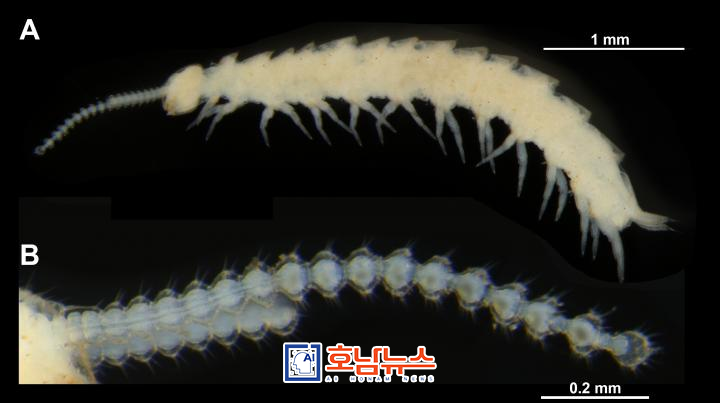 한국애지네 / 사진제공=국립호남권생물자원관 |
국립호남권생물자원관이 경남 거제도 토양에서 새로운 애지네류를 발견해 ‘한국애지네’로 명명했다. 국내에 그동안 2종만 기록돼 있던 애지네류에서 신종이 확인되면서 섬 지역 토양 생물다양성 연구의 범위를 넓히는 계기가 됐다.
기후에너지환경부 산하 국립호남권생물자원관(관장 박진영)은 10월 8일 보도자료를 통해 섬 지역 생물다양성 조사 과정에서 거제도에 서식하는 애지네류를 신종으로 확인했다고 밝혔다.
애지네류는 몸길이가 2~8㎜에 불과한 작은 절지동물이다. 겉모습은 지네를 닮았지만 입 모양은 곤충과 유사하며, 지네나 곤충과는 다른 ‘결합강(Symphyla)’으로 분류된다.
눈이 퇴화돼 있고 빛을 피하는 특성이 있어 숲속 낙엽이나 습한 흙 속에 숨어 산다. 몸집이 작고 서식 환경도 눈에 잘 띄지 않아 일반인이 쉽게 관찰하기 어려운 생물이다.
자원관에 따르면 전 세계적으로 약 200종의 애지네류가 알려져 있으며, 국내에는 그동안 ‘애지네’와 ‘동양애지네’ 2종만 기록돼 있었다. 이번 발견은 국내에 서식하는 애지네류의 다양성이 기존에 알려진 것보다 높다는 점을 보여준다.
국립호남권생물자원관과 경북대학교 황의욱 교수 공동연구진은 거제도에서 채집한 개체의 형태와 유전정보를 분석해 기존에 알려지지 않은 새로운 종임을 확인했다.
연구진은 우리나라에서 처음 발견된 점을 고려해 ‘한국애지네(Hanseniella koreana)’라는 이름을 부여했다. 한국애지네는 생김새가 비슷한 기존 종보다 머리 폭이 넓고 꼬리 마디가 두꺼우며, 몸마디에 난 미세한 털이 더욱 촘촘한 특징을 지닌다.
김종국 국립호남권생물자원관 생물분류연구부 전임연구원은 이번 발견이 섬 생태계에 아직 알려지지 않은 다양한 생물이 존재함을 보여주는 사례라고 설명했다. 이어 토양 속 미소생물까지 체계적으로 조사해 섬 지역 생물다양성을 밝혀 나가겠다고 밝혔다.
이번 연구 결과는 국내 동물분류 전문학술지인 ‘한국동물분류학회지(Animal Systematics, Evolution and Diversity)’에 발표될 예정이다. 자원관은 한국애지네를 국가생물종목록에도 공식 등재할 계획이다.
New Species Discovered in Geoje Island Soil…HNIBR Identifies “Hanseniella koreana”
Only two symphylan species previously recorded in Korea…Morphological and genetic analyses confirm a new species
Differences in head width, terminal body segment thickness and fine hair density…Journal publication and national species listing planned
[Mokpo = AI Honam News] aihnnews@kakao.com
The Honam National Institute of Biological Resources (HNIBR) has discovered a new symphylan species in the soil of Geoje Island, South Gyeongsang Province, and named it Hanseniella koreana. The discovery expands research into soil biodiversity on Korea’s islands, where only two symphylan species had previously been recorded nationwide.
In a press release issued on October 8, HNIBR, headed by Director Park Jin-young and affiliated with the Ministry of Climate, Energy and Environment, announced that the species had been identified during a survey of island biodiversity.
Symphylans are tiny arthropods measuring just 2–8 millimeters in length. Although they resemble centipedes, their mouthparts are similar to those of insects. They belong to the class Symphyla, which is distinct from both centipedes and insects.
They lack functional eyes and avoid light, living beneath forest leaf litter or in moist soil. Their small size and concealed habitats make them difficult to observe.
According to HNIBR, approximately 200 symphylan species are known worldwide. Previously, only two species, known in Korean as “aejine” and “dongyang aejine,” had been recorded in Korea. The latest discovery indicates that the country’s symphylan diversity is greater than previously documented.
A joint research team from HNIBR and Professor Hwang Ui-wook of Kyungpook National University analyzed the morphology and genetic information of specimens collected on Geoje Island, confirming that they represent a previously unknown species.
The researchers named the species Hanseniella koreana in recognition of its first discovery in Korea. Compared with similar known species, it has a wider head, a thicker terminal body segment and a denser covering of fine hairs on its body segments.
Kim Jong-guk, a researcher in HNIBR’s Biological Classification Research Department, said the discovery demonstrates that island ecosystems harbor a variety of organisms that remain unknown. He added that the institute would continue systematic surveys, including studies of tiny soil-dwelling organisms, to better understand island biodiversity.
The findings are scheduled for publication in Animal Systematics, Evolution and Diversity, a Korean scientific journal specializing in animal taxonomy. HNIBR also plans to officially register Hanseniella koreana on Korea’s National Species List.
 ai호남뉴스 박충배 편집/논설 aihnnewsr@kakao.com