| [사설] 1.30점 뒤에 가려진 서남권의 생명…국립의대 선정, 원자료부터 공개하라 인구와 도시의 편의가 의료취약지의 절박함을 밀어내서는 안 된다 ai호남뉴스 박충배 편집/논설 aihnnewsr@kakao.com |
| 2026년 10월 10일(토) 10:28 |
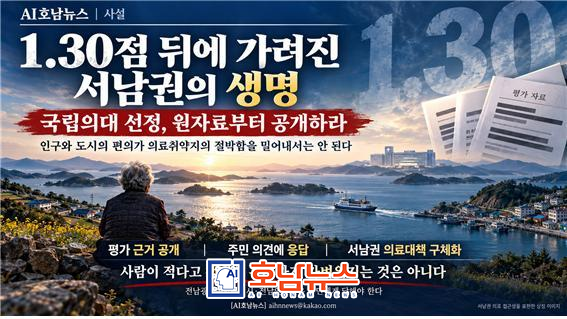 국립의대 선정 원자료부터 공개 / 사진제공=ai이미지 |
국립의과대학은 지역의 간판을 세우기 위한 사업이 아니다. 제때 치료받지 못하는 주민의 생명을 지키고, 의료 공백을 메우기 위한 국가의 책임이다. 그렇다면 후보대학 선정에서 가장 먼저 물었어야 할 질문은 분명하다. 어디에 의사가 더 절실한가. 어디의 주민이 병원까지 가는 길에서 더 큰 어려움을 겪는가. 이번 선정은 그 질문에 충분히 답했는가.
전남광주통합특별시는 지난 8월 30일 순천대를 국립의대 신설 후보대학으로 선정했다. 전남연구원 평가에서 순천대는 89.15점, 목포대는 87.85점을 받았다. 두 대학의 차이는 1.30점이었다. 그중 1.17점이 의대 교원 확보계획에서 발생했다. 작은 점수 차이가 지역의 의료 미래를 가른 만큼, 행정은 그 차이를 만들어낸 근거를 주민 앞에 더 상세히 설명해야 한다.
그러나 점수가 발표됐다고 공정성이 완성되는 것은 아니다. 외부 전문가가 심사했다는 설명만으로 객관성이 입증되는 것도 아니다. 무엇을 제출받았고, 어떤 증빙을 확인했으며, 같은 기준을 어떻게 적용했는지 검증할 수 있어야 공정한 심사다. 숫자는 결과일 뿐, 결과의 정당성을 대신하지 못한다.
이번 논란의 핵심은 이미 보유한 부지와 앞으로 제공받을 부지를 어떻게 평가했느냐에 있다. 목포대는 보유 국유지와 순천시의 조건부 제공 예정 부지를 같은 수준으로 평가한 데 문제를 제기한다. 순천대와 특별시는 후보 추천 단계에서 향후 확보계획의 확실성을 평가한 것이라고 설명한다. 양측의 주장이 맞선다면 행정이 해야 할 일은 명확하다.
평가 당시 계획서와 증빙자료, 심사기준과 판단 근거를 공개해 어느 설명이 자료에 부합하는지 확인하게 해야 한다.
전남연구원은 점수표 뒤로 물러서서는 안 된다. 심사를 맡은 기관이라면 평가 결과를 설명하고 검증에 응할 책임도 져야 한다. 특별시 역시 심사를 위탁했다는 이유로 책임을 넘길 수 없다. 연구원은 평가를 수행했고, 특별시는 그 평가를 근거로 후보를 선정했다. 두 기관 모두 주민에게 답해야 한다.
특히 도시의 정주 여건이 교수 확보에 유리하다는 판단이 평가에 작용했다면, 그 판단이 의료취약지 해소라는 사업 목적과 어떻게 조화를 이루는지 밝혀야 한다. 순천의 정주 여건을 높게 평가했을 가능성은 보도됐지만, 심사위원별 실제 판단 근거가 모두 확인된 것은 아니다. 바로 그렇기 때문에 근거 공개가 필요하다.
인구가 많고 생활시설이 잘 갖춰진 곳은 인력과 자원을 모으기 쉽다. 행정이 그 편의를 반복해서 선택한다면 인구가 적고 기반이 약한 지역은 언제 의료 격차를 벗어날 수 있는가. 취약해서 지원이 필요한 지역을 취약하다는 이유로 다시 뒤로 미루는 것은 균형행정의 실패다.
사람이 적다고 생명의 무게까지 가벼워지는 것은 아니다.
서남권에는 섬과 농어촌이 넓게 분포한다. 섬 주민에게 병원까지의 거리는 지도 위 숫자로 끝나지 않는다. 배편과 기상, 육상 이송과 병원 수용 여부가 겹쳐 실제 치료 접근성을 좌우한다. 응급상황에서 필요한 것은 그럴듯한 발전 구상이 아니라 환자를 받아줄 의료진과 치료시설이다.
목포·무안·신안·해남·완도·진도 등 서남권의 의료 문제를 대학 한 곳의 유치 경쟁으로 축소해서는 안 된다. 의대와 대학병원, 지역병원과 응급이송을 함께 설계해야 할 주민 생존권의 문제다. 후보대학 선정에서 이 절박함을 얼마나 평가했는지, 서남권 주민의 의료 접근성을 어떤 지표로 반영했는지 행정은 구체적으로 밝혀야 한다.
주민 의견도 마찬가지다. 반대 의견이 있다는 사실만으로 모든 선정이 잘못됐다고 단정할 수는 없다. 그러나 반대와 검증 요구를 충분히 설명하고 해소할 책임은 행정에 있다. 의견을 듣는 자리를 마련하는 것과 그 의견을 정책에 반영하는 것은 다른 일이다.
주민이 무엇을 요구했는지, 무엇을 반영했는지, 반영하지 못했다면 이유가 무엇인지 설명하지 않는다면 주민은 자신들의 목소리가 철저히 무시됐다고 느낄 수밖에 없다. 시민은 선정 발표를 받아 적는 구경꾼이 아니다. 이 사업의 재정을 부담하고, 그 의료체계 안에서 살아갈 당사자다.
법원 결정도 논란을 덮는 방패로 삼아서는 안 된다. 광주지법은 10월 2일 목포대의 집행정지 신청을 각하했다. 이는 후보 추천 행위의 처분성 등 신청 요건에 관한 판단이다. 부지 확보 설명과 평가 내용의 공정성을 최종 인정한 결정으로 확대해석해서는 안 된다.
10월 8일 김원이·박지원 의원이 교육부 장관을 만나 직접 재심사를 요구하고, 교육부의 추가 자료 요청 9개 항목 공개를 촉구한 것도 이 검증 문제가 해소되지 않았음을 보여준다. 재심사 요구가 곧 재심사 확정은 아니지만, 교육부는 제기된 의문에 자료와 판단 근거로 답해야 한다.
특별시가 밝힌 서부권 대학병원급 의료 인프라 확충 방향도 구체적인 실행계획으로 바뀌어야 한다. 어디에 어떤 진료기능을 갖추고, 누가 얼마를 부담하며, 언제부터 환자를 받을 것인지 제시해야 한다. 주민에게 필요한 것은 위로의 약속이 아니라 확인 가능한 예산과 일정이다.
AI호남뉴스는 요구한다. 평가 당시 양 대학의 추진계획서와 증빙자료, 심사위원 제공자료와 평가 근거를 공개하라. 개인정보 등 필요한 보호 범위는 정하되, 그것을 검증 전체를 막는 구실로 삼아서는 안 된다. 부지의 법적 권원, 교원 확보계획, 병원 건립 일정과 재원은 외부 전문가가 확인할 수 있도록 해야 한다.
검증 결과 중대한 오류나 기준 적용의 불일치가 확인된다면 재평가를 포함한 시정조치를 해야 한다. 문제가 없다는 결론이라면 그 결론에 이른 근거를 공개해야 한다. 서남권 의료대책은 선정 논란과 별개로 예산·일정·책임기관을 명시해 추진해야 한다.
동부권 주민의 의료 수요도 절실하다. 그 절실함을 인정하면서 서남권의 고통에도 동등하게 답하는 것이 통합특별시의 책무다. 한 지역의 기대를 다른 지역 주민의 침묵 위에 세워서는 안 된다.
공정성을 말하려면 자료를 내놓아라. 균형발전을 말하려면 의료취약지의 생명에 예산과 책임으로 답하라.
1.30점으로 후보는 정할 수 있다. 그러나 그 점수만으로 섬 주민의 불안과 서남권의 의료 공백까지 해결됐다고 선언할 수는 없다. 행정의 신뢰는 선정 발표의 단호함에서 나오지 않는다. 주민의 질문에 끝까지 답하고, 잘못이 있다면 바로잡는 책임에서 나온다.
[Editorial] Lives in Southwestern Jeonnam Behind a 1.30-Point Gap: Disclose the Original Records of the National Medical School Selection
Population size and urban convenience must not outweigh the urgent needs of medically underserved communities
The Special City and Jeonnam Research Institute must explain the evaluation grounds and how residents’ views were reflected—not merely announce scores
[AI Honam News] aihnnews@kakao.com
A national medical school is not a project for enhancing a region’s prestige. It is a national responsibility to protect people who cannot receive timely treatment and to close gaps in medical care. The first questions in selecting a candidate university should therefore have been clear: Where are doctors most urgently needed? Where do residents face the greatest difficulties reaching a hospital? Did this selection adequately answer those questions?
On August 30, the Jeonnam–Gwangju Integrated Special City selected Suncheon National University as its candidate for a new national medical school. In the Jeonnam Research Institute’s evaluation, Suncheon scored 89.15 points and Mokpo National University scored 87.85. The gap was 1.30 points, of which 1.17 came from the faculty recruitment plan. Since such a narrow margin determined the region’s medical future, the authorities must explain to residents, in greater detail, the grounds that produced it.
Announcing scores does not establish fairness. Nor does stating that outside experts conducted the review prove objectivity. A fair evaluation requires that people be able to verify what was submitted, what supporting evidence was examined, and how the same standards were applied. Numbers are results; they cannot substitute for justification.
At the heart of this dispute is how the review assessed land already held and land promised for future provision. Mokpo National University questions whether its existing state-owned site and municipal land conditionally pledged by Suncheon City should have received comparable evaluations. Suncheon National University and the Special City maintain that the candidate recommendation process assessed the certainty of future site acquisition. When those explanations conflict, the authorities’ duty is clear: disclose the plans and supporting documents submitted at the time, the evaluation criteria, and the grounds for judgment so that the public can determine which explanation the records support.
The Jeonnam Research Institute must not retreat behind a score sheet. An institution entrusted with the review must also accept responsibility for explaining its results and submitting them to scrutiny. The Special City cannot pass responsibility elsewhere simply because it outsourced the evaluation. The institute conducted the review, and the Special City selected its candidate on that basis. Both must answer to residents.
If the assessment took account of the view that urban living conditions make faculty recruitment easier, the authorities must explain how that judgment serves the project’s purpose of addressing medical deprivation. Reports have suggested that Suncheon’s living conditions may have been evaluated more favorably, but the actual reasoning of each reviewer has not been fully established. That is precisely why disclosure is necessary.
Places with larger populations and better amenities can attract people and resources more easily. If the administration repeatedly chooses that convenience, when will less populated areas with weaker infrastructure ever overcome their medical disparities? Pushing underserved communities further back because of the very disadvantages that make support necessary is a failure of balanced governance.
A smaller population does not make human life any less valuable.
Southwestern Jeonnam encompasses many islands and extensive rural communities. For island residents, the distance to a hospital is more than a number on a map. Ferry services, weather, transport on land, and a hospital’s ability to accept a patient together determine access to treatment. In an emergency, what matters is having medical staff and facilities ready to receive the patient—not an impressive development proposal.
The medical needs of Mokpo, Muan, Sinan, Haenam, Wando, Jindo, and other southwestern communities must not be reduced to a contest between universities. They concern residents’ right to life and require coordinated planning for a medical school, a university hospital, local hospitals, and emergency transport. The authorities must explain specifically how the selection assessed this urgency and which indicators were used to reflect southwestern residents’ access to medical care.
The same applies to residents’ views. Opposition alone does not prove that every aspect of a selection was wrong. But the authorities have a duty to respond adequately to objections and demands for scrutiny. Providing an opportunity to speak and reflecting those views in policy are different things.
Unless the authorities explain what residents requested, what was incorporated, and why other requests were not accepted, people can only feel that their voices were thoroughly disregarded. Citizens are not spectators expected merely to record a selection announcement. They are the people who finance this project and will live within the medical system it creates.
The court’s decision must not be used as a shield against the controversy. On October 2, the Gwangju District Court dismissed Mokpo National University’s application to suspend the recommendation on procedural grounds. The decision concerned requirements for the application, including whether the recommendation constituted an administrative disposition subject to judicial review. It must not be stretched into a definitive endorsement of the site acquisition claims or the substantive fairness of the evaluation.
On October 8, lawmakers Kim Won-i and Park Jie-won met with the education minister to request a direct reassessment and disclosure of nine items of additional information requested by the Ministry of Education. Their action also demonstrates that the verification questions remain unresolved. A request for reassessment does not mean that reassessment has been approved, but the ministry must answer the questions raised with evidence and the grounds for its judgment.
The Special City’s stated intention to expand university-hospital-level medical infrastructure in the western region must also become a concrete implementation plan. It must identify the location, clinical functions, funding responsibilities, costs, and date when patients can begin receiving care. Residents need verifiable budgets and schedules, not reassuring promises.
AI Honam News demands disclosure of both universities’ plans and supporting documents as submitted at the time of evaluation, the materials supplied to reviewers, and the grounds for their assessments. Necessary protections for personal information and other sensitive material should be defined, but they must not become an excuse to block scrutiny altogether. Outside experts must be able to examine the legal rights to the sites, faculty recruitment plans, hospital construction schedules, and financing.
If verification reveals significant errors or inconsistent application of the criteria, corrective action—including reassessment—must follow. If the review concludes that there were no problems, the evidence supporting that conclusion must be disclosed. Medical measures for the southwestern region must proceed independently of the selection dispute, with clearly identified budgets, schedules, and responsible agencies.
Residents of the eastern region also have urgent medical needs. The Integrated Special City’s duty is to acknowledge those needs while responding equally to the suffering of southwestern communities. One region’s hopes must not be built upon the silence of another region’s residents.
If the authorities claim fairness, they must produce the records. If they promise balanced development, they must answer the needs of medically underserved communities with funding and accountability.
A 1.30-point margin can determine a candidate. But that score alone cannot justify declaring that island residents’ anxieties and southwestern Jeonnam’s gaps in medical care have been resolved. Trust in government does not come from the firmness of a selection announcement. It comes from the responsibility to answer residents’ questions fully—and to correct mistakes when they are found.
 ai호남뉴스 박충배 편집/논설 aihnnewsr@kakao.com