2026.10.12 (월) 06:30




 닫기
닫기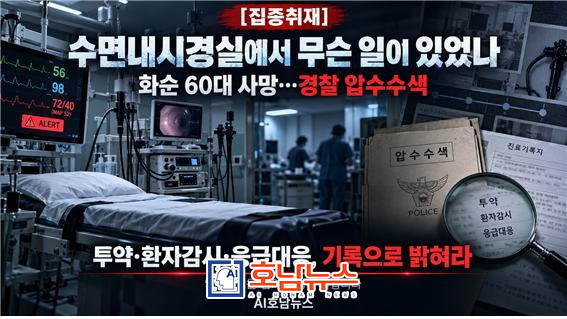 화순 수면내시경 사망 / 사진제공=ai이미지 |
[화순=AI호남뉴스] aihnnews@kakao.com
화순군의 한 의원에서 수면내시경 검사를 받던 60대 남성이 심정지로 숨진 사건과 관련해 경찰이 해당 의원을 압수수색했다.
한 생명이 내시경 검사실에서 갑자기 쓰러졌다. 이제 밝혀야 할 것은 분명하다.
어떤 약물을 얼마나 투여했는지, 환자의 위험 신호를 언제 발견했는지, 심폐소생술과 119 신고는 제때 이뤄졌는지다.
경찰과 언론보도를 종합하면 지난 17일 오전 9시 20분대 화순읍의 한 의원에서 위 수면내시경 검사를 받던 60대 A씨가 심정지 상태에 빠졌다.
의원 측 신고를 받고 출동한 119구급대가 A씨를 인근 병원으로 옮겼지만 끝내 숨졌다.
경찰은 지난 18일 A씨의 시신에 대한 부검을 의뢰하고 사건을 전남경찰청 수사부서로 넘겼다. 이어 20일 해당 의원을 압수수색해 진료기록과 투약자료 등을 확보한 것으로 전해졌다.
현재까지 A씨의 정확한 사망 원인과 지병 여부는 확인되지 않았다. 이 사건으로 입건된 의료진도 없는 것으로 알려졌다.
■ 투약량과 환자 감시가 수사 핵심
경찰 수사의 첫 번째 쟁점은 A씨에게 투여된 진정제의 종류와 용량이다.
프로포폴이나 미다졸람 등 진정제가 사용됐다면 환자의 나이·체중·건강 상태에 맞게 투여됐는지, 추가 투여는 있었는지 확인해야 한다.
검사 전 심장·폐 질환과 수면무호흡증, 알레르기, 복용약 등을 제대로 확인했는지도 조사 대상이다.
더 중요한 것은 검사 중 환자 감시다.
A씨의 산소포화도와 혈압·맥박·호흡을 지속해서 확인했는지, 이상징후를 언제 발견했는지, 산소공급과 기도확보를 즉시 시행했는지가 핵심이다.
■ 심정지부터 119 신고까지 ‘몇 분’ 걸렸나
수사 결과를 가를 결정적 자료는 사고 당시의 시간표다.
경찰은 산소포화도가 떨어진 시각, 의료진이 이상을 발견한 시각, 심폐소생술을 시작한 시각, 119에 신고한 시각을 분 단위로 재구성해야 한다.
병원 진료기록뿐 아니라 내부 CCTV, 내시경 장비 저장기록, 전자의무기록 수정 이력, 119 신고 녹취와 구급활동일지를 서로 대조할 필요가 있다.
환자 상태가 악화한 뒤 응급조치나 신고가 지연됐다면 의료진의 주의의무 위반 여부가 중요한 쟁점으로 떠오를 수 있다.
■ 의원 측, 객관적인 기록으로 답해야
현재까지 공개된 보도에는 해당 의원의 구체적인 공식 입장이 담기지 않았다.
의원 측은 A씨에게 투여한 진정제의 명칭과 용량, 최초 이상징후 발생 시각, 심폐소생술과 119 신고 시각, 당시 의료진 배치와 역할을 밝혀야 한다.
“정상적인 절차에 따라 검사했다”는 포괄적인 설명만으로는 부족하다. 유족과 지역사회가 납득할 수 있도록 객관적인 기록을 제시해야 한다.
■ 압수수색이 곧 의료과실은 아니다
경찰의 압수수색은 의료진의 혐의가 확정됐다는 뜻이 아니다.
정확한 사망 원인과 의료행위 사이의 인과관계를 밝히기 위해 사고 당시 자료를 확보하는 수사 절차다.
수면내시경 도중 환자가 숨졌다는 사실만으로 업무상과실치사 혐의가 성립하는 것도 아니다.
경찰은 의료진의 주의의무 위반이 있었는지, 적절한 조치를 했다면 사망을 피할 수 있었는지, 의료진의 행위와 사망 사이에 직접적인 인과관계가 있는지를 밝혀야 한다.
과도한 진정제 투여나 환자 감시 소홀, 응급조치 또는 119 신고 지연이 확인되고 이 같은 과실이 사망으로 이어졌다면 의료진에게 업무상과실치사 혐의가 적용될 수 있다.
[IN-DEPTH REPORT]
“What Happened in the Sedation Endoscopy Room?”—Police Raid Clinic After Death of Man in His 60s in Hwasun
Patient believed to have suffered cardiac arrest after sedative administration; died after transfer to another hospital
Police secure medical, medication and nursing records; autopsy and toxicology tests underway
Key questions: When was abnormal oxygen saturation detected, and how quickly were CPR and the 119 emergency call initiated?
Clinic has yet to issue an official explanation; sedative dosage, staffing and emergency response must be clarified
“Search and seizure does not establish guilt”—Police focus on possible medical negligence and causation
[Hwasun=AI Honam News] aihnnews@kakao.com
Police have searched and seized records from a clinic in Hwasun County after a man in his 60s suffered cardiac arrest and died while undergoing a sedated upper gastrointestinal endoscopy.
A life was suddenly lost in an endoscopy room. The questions that must now be answered are clear.
What medication was administered and in what amount? When did medical staff first detect warning signs? Were cardiopulmonary resuscitation and the emergency call to 119 initiated without delay?
According to police and media reports, the patient, identified only as “A,” went into cardiac arrest while undergoing a sedated upper gastrointestinal endoscopy at a clinic in Hwasun-eup at around 9:20 a.m. on Sept. 17.
Emergency responders were dispatched following a call from the clinic and transported him to a nearby hospital, but he later died.
Police requested an autopsy on Sept. 18 and transferred the case to an investigative unit at the Jeonnam Provincial Police Agency. On Sept. 20, investigators reportedly searched the clinic and secured medical and medication records.
The exact cause of death and whether the patient had any underlying medical conditions have not yet been confirmed. No medical personnel are known to have been formally booked in connection with the case.
■ Sedative Dosage and Patient Monitoring at Center of Investigation
The first major question is the type and dosage of the sedative administered to the patient.
If sedatives such as propofol or midazolam were used, investigators must determine whether the dosage was appropriate for the patient’s age, weight and health condition, and whether any additional doses were administered.
Police are also expected to examine whether medical staff properly checked for heart or lung disease, sleep apnea, allergies and medications taken by the patient before the procedure.
More importantly, investigators must scrutinize how the patient was monitored during the examination.
The key questions are whether the patient’s oxygen saturation, blood pressure, pulse and breathing were continuously monitored; when staff first detected abnormalities; and whether oxygen support and airway management were provided immediately.
■ How Many Minutes Passed Before CPR and the 119 Call?
The timeline of events will be decisive in determining what happened.
Police must reconstruct, minute by minute, when the patient’s oxygen saturation began to fall, when medical staff recognized the problem, when CPR was initiated and when the emergency call to 119 was made.
Investigators will need to compare the clinic’s medical records with internal CCTV footage, endoscopy equipment logs, electronic medical record revision histories, the 119 call recording and paramedic activity reports.
If emergency treatment or the call for assistance was delayed after the patient’s condition deteriorated, the medical staff’s possible breach of duty of care could become a central issue.
■ Clinic Must Respond With Objective Records
No detailed official statement from the clinic has been included in publicly available reports so far.
The clinic should disclose the name and dosage of the sedative administered, the time the first abnormal signs appeared, when CPR began, when the 119 call was made, and how medical personnel were assigned at the time.
A broad assertion that the procedure was conducted “in accordance with standard protocols” would not be sufficient. Objective records must be presented so the bereaved family and the local community can understand what occurred.
■ Search and Seizure Does Not Establish Medical Negligence
The police search does not mean that wrongdoing by the medical staff has been established.
It is an investigative step intended to secure records from the time of the incident and determine the precise cause of death and whether it was causally connected to medical treatment.
The fact that a patient died during a sedated endoscopy is not, by itself, sufficient to establish professional negligence resulting in death.
Police must determine whether the medical staff breached their duty of care, whether the death could have been prevented through appropriate measures, and whether a direct causal link existed between the staff’s actions or omissions and the patient’s death.
If investigators establish that an excessive sedative dose, inadequate patient monitoring, delayed emergency treatment or a delayed 119 call occurred—and that such negligence contributed to the death—the medical personnel involved could face charges of professional negligence resulting in death.
 ai호남뉴스 박충배 편집/논설 aihnnewsr@kakao.com