2026.10.12 (월) 01:52




 닫기
닫기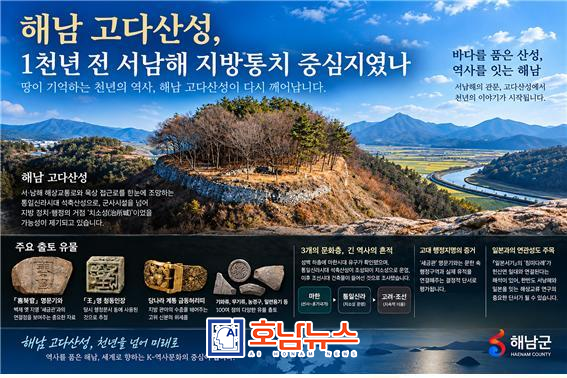 해남 읍호리 고다산성 / 사진제공=ai이미지 |
[해남=AI호남뉴스] aihnnews@kakao.com
전남광주통합특별시 해남군 현산면 고다산성이 단순히 외적을 막기 위해 축조된 산성을 넘어 통일신라시대 서남해안의 정치·행정을 담당했던 지방 거점이었을 가능성을 보여주는 유물이 대거 출토되면서 해남군이 추진하고 있는 약 120억원 규모 읍호리 역사문화권 정비사업에도 관심이 집중되고 있다.
특히 해남군이 올해 발주한 ‘해남 고다산성 시·발굴조사 용역’의 예산은 4억4천만원으로 확인됐다. 해당 용역의 추정가격은 4억원이며 해남군이 발주했다.
고다산성 발굴은 단일 유적 조사에 그치지 않는다. 해남군이 현산면 읍호리 고인돌군과 고다산성, 일평리 일대 유적을 하나의 역사문화권으로 묶어 추진하는 대규모 정비사업의 핵심 사업이다.
■ 4억4천만원 투입한 고다산성 발굴…100여 점 쏟아졌다
해남군은 올해 6월부터 약 3개월에 걸쳐 고다산성에 대한 첫 본격 발굴조사를 실시했다.
조사 결과 성벽과 문지 등 주요 유구와 함께 ‘새금관(塞琴官)’ 명문기와, ‘王(왕)’자가 새겨진 청동인장, 중국 당나라 형식의 금동허리띠 등 100여 점의 유물이 확인됐다.
이 가운데 특히 주목되는 것은 ‘王’자 청동인장과 금동허리띠다.
이들 유물은 일반적인 산성에서 발견되는 군사·생활유물과 달리 당시 지배층 및 행정기능과 관련성을 살펴볼 수 있는 자료다. 발굴성과를 토대로 고다산성이 단순 방어시설을 넘어 통일신라시대 지방의 정치·행정 기능을 담당한 거점 치소성(治所城)이었을 가능성이 제기되고 있다.
■ ‘새금관’ 명문기와…문헌 속 행정구역 실체 밝힐 단서
‘새금관(塞琴官)’이라는 글자가 새겨진 기와도 중요한 자료다.
고다산성이 위치한 현산면 일대의 고대 행정체계와 실제 유적을 연결할 수 있는 자료로 평가되면서 향후 추가 발굴과 명문 판독·연대 분석 결과가 주목된다.
고다산성의 입지도 예사롭지 않다.
산 정상부를 둘러싸는 테뫼식 석축성으로, 북쪽 성벽 바깥쪽은 위로 올라가면서 돌을 안으로 들여 쌓고 내부에는 흙을 다지는 판축기법을 사용한 것으로 조사됐다. 이는 통일신라시대 성곽의 특징을 보여주는 자료로 평가된다.
동쪽 문은 통일신라시대 설치된 뒤 고려와 조선시대에 걸쳐 계단식으로 보수된 흔적도 확인됐다.
■ 산성 밑에는 마한…위에는 통일신라·조선
더욱 주목할 부분은 고다산성에서 서로 다른 시대의 문화층이 확인됐다는 점이다.
성벽 하층에서는 마한시대 유구와 유물이 나왔고 통일신라시대에는 석축산성이 조성됐다. 산성이 폐성된 이후에는 담장을 갖춘 조선시대 건축물이 들어선 것으로 조사됐다.
한 장소에서 마한에서 통일신라를 거쳐 고려·조선으로 이어지는 장기간의 역사 흔적이 확인되고 있는 셈이다.
이는 현산 일대가 특정 시대에만 이용된 군사시설이 아니라 서남해안의 육상·해상 교통망과 연계된 장기적인 지역 거점이었는지를 규명하는 중요한 연구과제가 될 전망이다.
■ 고다산성만 개발하는 게 아니다…약 120억원 규모 ‘역사문화권 프로젝트’
고다산성 발굴의 배경에는 ‘해남 읍호리 유적 역사문화권 정비사업’이 있다.
국가유산청이 추진한 역사문화권 정비사업에서 해남 읍호리 유적은 전국 선도사업 대상지 가운데 하나로 선정됐다.
국가유산청이 당초 발표한 선도사업 계획은 해남을 포함한 각 사업에 총사업비 121억원 규모를 투입하는 내용이었다. 해남 읍호리 역사문화권은 약 88만7,155㎡를 정비구역으로 설정해 △읍호리 고인돌군 정비 △고다산성 정비 △일평리 방문자센터 조성 △역사문화 탐방프로그램 등을 추진하는 계획이다.
이후 해남군 관련 예산 자료에서는 읍호리 역사문화권 정비사업이 총사업비 120억원으로 제시됐으며, 2026년 사업비로 29억9천만원이 반영된 것으로 확인된다.
따라서 고다산성 시·발굴조사비 4억4천만원과 역사문화권 전체 사업비 120억원은 구분해서 볼 필요가 있다.
4억4천만원은 올해 고다산성 시·발굴조사 용역 예산이고, 약 120억원은 고다산성과 읍호리 고인돌군, 일평리 유적, 탐방·방문자 시설 등을 포괄하는 역사문화권 정비사업 전체 규모다.
■ 탐방센터 건립도 움직였다…올해 3월 부지 시굴
역사문화권 사업은 발굴조사와 동시에 관광·교육 기반시설 조성으로도 이어지고 있다.
한국문화유산협회 자료에 따르면 영해문화유산연구원은 지난 3월 31일 현산면 읍호리 265-1 일원에서 ‘해남 고다산성 탐방센터 조성부지 시굴’ 현장공개를 실시했다.
해남군은 앞서 한국디자인진흥원과 협력해 읍호리 유적의 역사경관과 공공시설물 디자인 개발에도 나섰다.
사업에는 현산 역사문화권 탐방센터, 일평리유적 방문자센터, 탐방로 조성, 주민참여 프로그램 등이 포함돼 있다.
결국 해남군의 구상은 고다산성 하나를 복원하는 데 머물지 않고,
읍호리 고인돌군 → 고다산성 → 일평리 유적 → 탐방·방문자센터 → 역사문화 탐방로
를 하나의 역사문화 네트워크로 연결하는 방향으로 읽힌다.
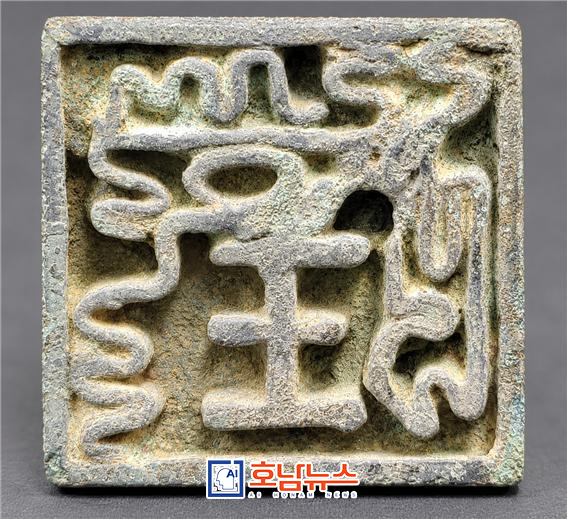 해남군 현산면 청동인장 / 사진제공=해남군청 |
■ 2025년 시굴→2026년 본격 발굴…조사 단계도 확대
고다산성에 대한 조사는 단계적으로 진행됐다.
한국문화유산협회 자료를 보면 2025년 10월 30일 고다산성 시굴조사 학술자문회의가 개최됐으며 당시 성벽 구조와 문지 등이 주요 조사 대상으로 제시됐다.
이어 올해에는 4억4천만원 규모 시·발굴조사 용역이 추진됐고, 6월부터 약 3개월간 본격적인 발굴이 이뤄졌다.
지난 9월 17일에는 영해문화유산연구원이 고다산성 현장에서 학술자문회의와 일반인 대상 발굴현장 공개를 실시했다.
2025년 시굴조사 → 2026년 탐방센터 부지 시굴 → 고다산성 본격 발굴 → 학술자문·현장공개로 조사와 정비사업이 점차 구체화되고 있는 것이다.
■ 다음 목표는 ‘국가유산 지정’
해남군의 다음 과제는 고다산성의 역사적 성격을 보다 명확하게 규명하고 이를 토대로 국가유산 지정을 추진하는 것이다.
군은 이번 발굴성과를 역사문화권 정비사업의 향후 방향 설정에 활용하고 고다산성의 국가유산 지정을 추진해 서남해안을 대표하는 역사문화유산으로 육성한다는 계획을 밝히고 있다.
그러나 첫 본격 발굴에서 중요한 성과가 나왔다고 해서 고다산성의 전체 실체가 규명된 것은 아니다.
산성 내부의 행정 관련 건물지와 창고·군사시설 등의 존재 여부, 성벽 전체 축조 시기, 문지 구조, 마한시대 유적과 후대 산성의 관계, ‘새금관’ 명문기와와 당시 지방행정체계의 관계 등은 추가 조사를 통해 규명해야 할 부분이다.
특히 방송에서 “추가 발굴까지 최소 4년”이라는 전망이 제시된 만큼 앞으로 해남군이 연차별 발굴 범위와 예산, 국가유산 지정 목표시점, 발굴유적 보존·정비방식을 어떻게 구체화할지도 관심사다.
■ 120억원이 ‘건물 짓기’보다 유적의 가치 밝히는 데 쓰여야
역사문화권 정비사업의 성패를 좌우할 부분도 여기에 있다.
탐방센터와 방문자센터, 탐방로 등 관광 인프라 구축도 필요하지만 고다산성의 역사적 가치를 뒷받침하는 것은 결국 충분한 발굴조사와 학술연구, 유구 보존, 출토유물 분석이다.
특히 ‘王’자 청동인장과 ‘새금관’ 명문기와 등 이번에 출토된 유물의 정확한 연대와 용도, 당시 지방통치체제에서 고다산성이 차지했던 위상을 규명한다면 고다산성의 역사적 가치는 한층 구체화될 수 있다.
약 120억원 규모의 역사문화권 정비사업이 단순한 시설물 조성사업을 넘어 ‘해남의 고대사를 다시 쓰는 조사·보존·활용 사업’으로 이어질 수 있을지가 앞으로의 관건이다.
고다산성은 이제 첫 문을 열었다.
천 년 넘게 돌담과 흙 속에 묻혀 있던 ‘王’자 인장과 명문기와가 말하기 시작한 역사를 어디까지 밝혀낼 것인지는 앞으로 이어질 발굴과 학술조사에 달려 있다.
[In-Depth]
“More Than a Defensive Fortress”… ‘王’ Bronze Seal Unearthed at Godasanseong Fortress in Haenam, Emerging as a Key Site in the KRW 12 Billion Historical and Cultural Heritage Project
KRW 440 million allocated this year for trial excavation and full-scale archaeological investigation of Godasanseong Fortress…first major excavation launched in June
More than 100 artifacts uncovered, including roof tiles inscribed “Saegwan (塞琴官),” a bronze seal bearing the character “王” (King), and a Tang-style gilt-bronze belt ornament
Findings raise possibility that the fortress served as a regional administrative and political center during the Unified Silla period…three cultural layers spanning Mahan to Joseon identified
Approximately KRW 12 billion earmarked for the Eupho-ri Historical and Cultural Heritage District Development Project…KRW 2.99 billion allocated for 2026
Project to connect Eupho-ri dolmens, Godasanseong Fortress and Ilpyeong-ri archaeological sites through visitor centers and historical trails
Trial excavation also conducted at proposed Godasanseong visitor center site…preservation to be combined with tourism and educational use
Haenam County plans to seek designation as a nationally recognized heritage site and develop it into a major historical and cultural asset of Korea’s southwestern coastal region
Full character of the fortress remains to be determined…multi-year excavation, conservation and restoration plans still need to be detailed
[Haenam = AI Honam News] aihnnews@kakao.com
Godasanseong Fortress in Hyeonsan-myeon, Haenam County, is drawing renewed attention following the discovery of artifacts suggesting that it may have been more than a defensive stronghold. The findings indicate that the fortress may have functioned as an important political and administrative center along Korea’s southwestern coast during the Unified Silla period.
The discoveries are also bringing greater attention to Haenam County’s approximately KRW 12 billion Eupho-ri Historical and Cultural Heritage District Development Project, of which Godasanseong is a central component.
In particular, Haenam County allocated KRW 440 million this year for the “Godasanseong Fortress Trial and Archaeological Excavation Project.” The estimated base cost of the contract was KRW 400 million, with Haenam County commissioning the project.
The excavation of Godasanseong is not an isolated archaeological project. It forms a key part of a broader initiative by Haenam County to integrate the Eupho-ri dolmen complex, Godasanseong Fortress and archaeological sites around Ilpyeong-ri into a unified historical and cultural heritage district.
■ KRW 440 Million Excavation Uncovers More Than 100 Artifacts
Beginning in June, Haenam County carried out the first major archaeological excavation of Godasanseong Fortress over a period of approximately three months.
The investigation uncovered major structural remains, including fortress walls and a gate site, as well as more than 100 artifacts. Among the most significant finds were roof tiles bearing the inscription “Saegwan (塞琴官),” a bronze seal engraved with the Chinese character “王” (wang, meaning “king”), and gilt-bronze belt ornaments in the style of China’s Tang Dynasty.
The bronze seal and gilt-bronze belt ornaments have attracted particular attention.
Unlike ordinary military or everyday artifacts typically found at fortress sites, these objects may provide clues to the presence of an elite ruling class and administrative functions.
Based on these discoveries, researchers have raised the possibility that Godasanseong was not merely a defensive fortress, but a regional administrative stronghold, or chiso-seong (治所城), responsible for political and administrative functions during the Unified Silla period.
■ “Saegwan” Inscribed Roof Tiles Could Link Archaeology with Ancient Administrative Records
The roof tiles inscribed with the characters “Saegwan (塞琴官)” are another important discovery.
They are considered potentially significant evidence linking the archaeological remains at Godasanseong with the ancient administrative system of the Hyeonsan area. Further excavation, interpretation of the inscription and chronological analysis will be needed to establish their precise historical significance.
The fortress itself is also noteworthy.
Godasanseong is a stone fortress encircling the summit of a mountain, a type commonly referred to in Korea as a temoe-style mountain fortress. Investigators found that stones on the outer side of the northern wall were progressively set inward as the wall rose, while the interior foundation was reinforced using rammed-earth construction techniques.
These structural features are regarded as valuable evidence for understanding fortress-building techniques during the Unified Silla period.
The eastern gate is believed to have been initially constructed during Unified Silla and subsequently repaired in stages during the Goryeo and Joseon periods.
■ Mahan Beneath the Fortress, Unified Silla and Joseon Above
One of the most notable results of the excavation is the identification of cultural layers belonging to different historical periods.
Archaeological features and artifacts dating to the Mahan period were discovered beneath the fortress wall. A stone fortress was subsequently constructed during the Unified Silla period, while buildings surrounded by walls appear to have been erected during the Joseon period after the fortress had ceased functioning in its original role.
In other words, a single site preserves traces of human activity extending from Mahan through Unified Silla and into the Goryeo and Joseon periods.
The findings have therefore raised an important research question: Was the Hyeonsan area not simply a military stronghold during a particular period, but a long-term regional center connected to both land and maritime transportation networks along Korea’s southwestern coast?
■ Not Just Godasanseong — A KRW 12 Billion Historical and Cultural Heritage Project
Behind the excavation lies the broader Eupho-ri Historical and Cultural Heritage District Development Project.
The Eupho-ri archaeological area in Haenam was selected as one of the pilot projects under a national historical and cultural heritage development initiative promoted by Korea’s heritage authorities.
The project covers approximately 887,155 square meters and includes the restoration and maintenance of the Eupho-ri dolmen complex, conservation and development of Godasanseong Fortress, construction of a visitor center at the Ilpyeong-ri archaeological site, and the development of historical and cultural exploration programs.
Haenam County budget documents subsequently identified the overall project cost at approximately KRW 12 billion, with KRW 2.99 billion allocated for 2026.
It is therefore important to distinguish between the two figures.
The KRW 440 million budget applies specifically to this year’s trial and archaeological excavation of Godasanseong Fortress, while the approximately KRW 12 billion budget covers the broader historical and cultural heritage project encompassing Godasanseong, the Eupho-ri dolmen complex, Ilpyeong-ri archaeological sites, visitor facilities and related infrastructure.
■ Visitor Center Project Also Moving Forward
The historical heritage initiative is progressing not only through archaeological excavation but also through the development of tourism and educational infrastructure.
On March 31, the Yeonghae Cultural Heritage Research Institute conducted and publicly presented a trial excavation at 265-1 Eupho-ri, Hyeonsan-myeon, the proposed site for a Godasanseong visitor and exploration center.
Haenam County has also worked with the Korea Institute of Design Promotion on historical landscape planning and public facility design for the Eupho-ri heritage area.
Plans include a Hyeonsan Historical and Cultural Heritage Exploration Center, an Ilpyeong-ri archaeological visitor center, historical trails and community participation programs.
The county’s broader vision can therefore be summarized as an interconnected heritage network:
Eupho-ri Dolmen Complex → Godasanseong Fortress → Ilpyeong-ri Archaeological Site → Visitor and Exploration Centers → Historical and Cultural Trails
Rather than restoring Godasanseong as an isolated monument, the project seeks to integrate several archaeological and historical resources into a single cultural heritage network.
■ From 2025 Trial Excavation to Full-Scale Investigation in 2026
Archaeological investigation of Godasanseong has proceeded in stages.
In 2025, a trial excavation and academic advisory review were conducted to examine the structure of the fortress walls, gates and related remains.
This year, the investigation expanded into a KRW 440 million trial and full-scale excavation project, with major fieldwork carried out for approximately three months beginning in June.
On September 17, the Yeonghae Cultural Heritage Research Institute held an academic advisory meeting at the Godasanseong excavation site and opened the excavation area to the public.
The progression can therefore be summarized as:
2025 trial excavation → 2026 trial excavation of visitor center site → full-scale excavation of Godasanseong → academic review and public opening of the excavation site
The archaeological investigation and broader heritage development project are thus becoming increasingly concrete.
■ Next Goal: National Heritage Designation
Haenam County’s next major task is to determine the historical character and significance of Godasanseong more precisely and use those findings as a basis for seeking national heritage designation.
The county plans to incorporate the latest excavation results into the future direction of the historical and cultural heritage development project and ultimately develop Godasanseong into a representative historical and cultural heritage site of Korea’s southwestern coastal region.
However, despite the significance of the first major excavation, the full nature of Godasanseong has yet to be established.
Further archaeological work is needed to determine whether administrative buildings, warehouses or military facilities existed inside the fortress; when different sections of the walls were constructed; how the gates evolved; how the earlier Mahan remains relate to the later fortress; and how the “Saegwan” roof-tile inscription relates to the region’s ancient administrative system.
A television report has suggested that at least four more years of excavation may be required, making Haenam County’s future annual excavation schedule, budget allocations, target date for national heritage designation, and conservation and restoration strategy key issues to watch.
■ KRW 12 Billion Must Go Beyond Buildings to Reveal the Site’s Historical Value
How the historical and cultural heritage project is implemented will ultimately determine its success.
Visitor centers, exploration facilities and historical trails can provide important tourism infrastructure. However, the historical significance of Godasanseong will ultimately depend on sufficient archaeological excavation, academic research, preservation of structural remains, and detailed analysis of the artifacts already discovered.
Determining the exact age and function of the bronze seal bearing the character “王,” the “Saegwan” inscribed roof tiles and other artifacts could significantly deepen understanding of Godasanseong’s role within the regional governance system of its time.
The central question is therefore whether the approximately KRW 12 billion historical and cultural heritage project will go beyond the construction of facilities and become a comprehensive program of archaeological investigation, conservation and public use capable of rewriting our understanding of Haenam’s ancient history.
Godasanseong has only begun to reveal its secrets.
For more than a thousand years, the bronze seal, inscribed roof tiles and ancient structures remained buried beneath stone and soil. How much of the story they can ultimately tell will depend on the archaeological excavations and academic research that follow.
 ai호남뉴스 박충배 편집/논설 aihnnewsr@kakao.com