2026.10.11 (일) 22:43




 닫기
닫기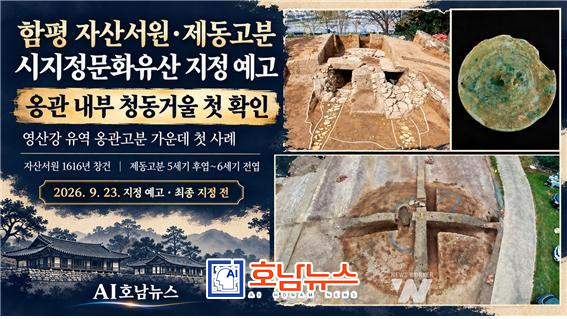 함평지산서원 시문화제 / 사진제공=ai이미지 |
전남광주통합특별시 함평군의 자산서원과 엄다리 제동고분이 시지정문화유산 기념물 지정 예고 대상에 올랐다. 조선시대 호남 사림의 역사와 영산강 유역 고대 장묘문화를 각각 보여주는 유산이다.
함평군은 지난 27일 두 유산이 23일 지정 예고됐다고 밝혔다. 지정 예고는 최종 지정이 아니다. 의견 수렴 등의 절차가 남아 있어 현재 단계는 ‘지정 추진’으로 표현해야 한다.
함평군 엄다면의 자산서원은 조선 중기 학자 곤재 정개청을 기리기 위해 1616년 창건됐다. 정개청이 기축옥사에 연루돼 유배 중 숨진 뒤 제자와 지역 유림이 신원 운동을 벌였고, 서원은 이후 정치적 변화 속에서 여러 차례 훼철과 복설을 겪었다. 한국학중앙연구원은 이 연혁을 조선 후기 정치와 서원, 지역 유림의 관계를 살필 수 있는 사례로 설명한다.
자산서원과 관련된 기록유산인 『곤재우득록』 목판은 1987년 이미 유형문화유산으로 지정됐다. 한국학중앙연구원 자료에 따르면 정개청의 문집을 간행하기 위해 제작된 목판은 원래 108판이었으며 현재 48판이 남아 있다. 이번 지정 예고 대상인 서원과 기존 지정 유산인 목판은 구별된다.
엄다리 제동고분은 5세기 후엽부터 6세기 전엽 사이에 조성된 것으로 평가된다. 무덤의 형태와 내부 구조, 출토 유물을 함께 살필 수 있어 당시 함평 지역의 장례문화와 사회상을 연구하는 자료로 주목받고 있다. 특히 영산강 유역 옹관고분 가운데 옹관 내부에서 청동거울이 확인된 첫 사례라는 점이 강조된다. 이는 한반도 전체에서 청동거울이 처음 출토됐다는 의미는 아니다.
고분 북동쪽에서는 조선시대 태항아리도 확인됐다. 연구자들은 이를 고대의 장묘 공간이 후대에 다시 인식되거나 활용됐을 가능성을 살피는 자료로 보고 있다. 다만 청동거울만으로 무덤 주인의 신원이나 교류 상대를 확정할 수는 없다. 제동고분의 발굴 성과와 보존 방향은 2025년 학술행사에서도 논의됐으나, 개별 발표문의 원문 확인이 필요한 해석은 단정하지 않아야 한다.
한편 자산서원의 사액 연도는 자료에 차이가 있다. 함평군 발표를 전한 최근 보도는 1679년으로, 한국민족문화대백과사전의 자산서원 항목은 1678년으로 기록한다. 정확한 연도는 지정 관련 조사자료와 당시 기록을 대조해 확인할 필요가 있다.
“Bronze Mirror Found Inside Burial Jar in First Recorded Case” — Hampyeong’s Jasan Seowon and Jedong Tomb Proposed for Municipal Heritage Designation
Jasan Seowon honors scholar Jeong Gae-cheong; it was demolished and rebuilt five times
Jedong Tomb dates from the late fifth to early sixth century and offers evidence of burial practices in the Yeongsan River basin
The “first” bronze mirror discovery refers specifically to a find inside a burial jar at a jar-coffin tomb in the Yeongsan River basin
Sources disagree on whether Jasan Seowon received its royal charter in 1678 or 1679
[Hampyeong = AI Honam News] aihnnews@kakao.com
Jasan Seowon and Jedong Tomb in Eomda-ri, Hampyeong County, have been proposed for designation as municipal heritage monuments. The two sites illuminate different periods of local history: the scholar community of the Joseon era and ancient burial practices in the Yeongsan River basin.
Hampyeong County announced on September 27 that the proposed designations had been publicly notified on September 23. Public notice does not mean that designation is final. The process, including the collection of opinions, is still under way.
Jasan Seowon, in Eomda-myeon, was founded in 1616 to honor the Joseon scholar Jeong Gae-cheong, known by the pen name Gonjae. After Jeong was implicated in the Gichuk Purge and died in exile, his students and local scholars campaigned to clear his name. The seowon was subsequently demolished and rebuilt several times amid political change. The Academy of Korean Studies describes its history as a case that sheds light on the relationship between late Joseon politics, scholarly institutions and local Confucian communities.
Woodblocks used to print Jeong’s collected writings, Gonjae Udeungnok, are also associated with Jasan Seowon. They were separately designated as tangible cultural heritage in 1987. According to the Academy of Korean Studies, 48 of the original 108 woodblocks survive. The woodblocks’ existing designation is distinct from the proposed designation of the seowon.
Jedong Tomb is believed to have been built between the late fifth and early sixth centuries. Its form, internal structure and excavated objects provide material for studying burial customs and society in the Hampyeong area. Of particular interest is a bronze mirror found inside a burial jar—the first reported find of its kind from the interior of a burial jar at a jar-coffin tomb in the Yeongsan River basin. This does not mean it was the first bronze mirror discovered on the Korean Peninsula.
A Joseon-era jar used in a placental burial was also found northeast of the tomb. Researchers regard it as evidence worth examining when considering whether the ancient burial site was recognized or used again in a later period. The bronze mirror alone, however, cannot establish the identity of the person buried there or identify a specific trading partner. The tomb’s excavation results and preservation were discussed at an academic event in 2025, but interpretations requiring confirmation against the individual papers should not be presented as settled findings.
Sources also differ on the year Jasan Seowon received its royal charter. Recent reports relaying Hampyeong County’s announcement give 1679, while the Academy of Korean Studies’ entry on the seowon gives 1678. The date requires comparison with the designation survey and historical records.
 ai호남뉴스 박충배 편집/논설 aihnnewsr@kakao.com