2026.10.11 (일) 18:23



 닫기
닫기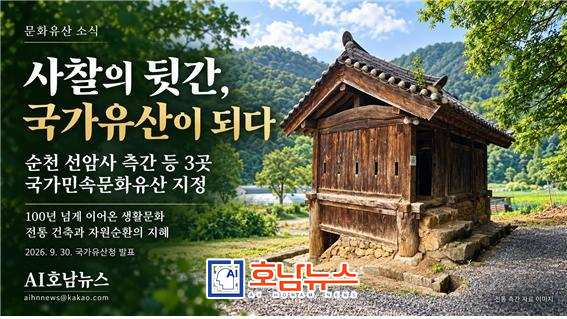 사찰의 뒷간 국가유산되다 / 사진제공=ai이미지 |
순천 선암사의 전통 화장실인 ‘측간’이 국가민속문화유산으로 지정됐다. 사찰의 불전과 탑 중심으로 조명되던 문화유산의 범위를 수행자들의 일상과 공동생활 공간까지 넓혔다는 점에서 의미가 있다.
국가유산청은 9월 30일 ‘순천 선암사 측간’, ‘영월 보덕사 해우소’, ‘합천 해인사 국일암 해우소’ 등 사찰의 전통 뒷간 3곳을 국가민속문화유산으로 지정했다고 밝혔다. 원래 자리와 형태를 유지하면서 현재까지 실제로 사용되고 있다는 점이 주요 평가 근거다.
선암사 측간의 역사는 문헌과 사진, 건물에 남은 수리 기록을 통해 확인할 수 있다. 국가유산청은 『조계산선암사사적』의 1704년 ‘청측(圊廁)’ 기록과 일제강점기 선암사 전경 사진, 1928년 수리 당시의 상량 묵서를 근거로 현존 건물이 1920년대 이전부터 존재하며 변천해 왔다고 설명했다.
한국학중앙연구원 문화유산 해설에는 1540년 관련 기록을 근거로 당시 측간이 있었다는 내용과 1928년 중수, 1996년 수리 사실이 소개돼 있다. 다만 측간의 존재를 보여주는 옛 기록과 현재 건물의 건립연대는 구분해야 한다. 이를 곧바로 ‘현재 건물이 500년 동안 원형 그대로 남았다’는 의미로 해석하기는 어렵다.
첨부 기사에 소개된 선암사 측간은 정면 6칸·측면 4칸 규모의 정(丁)자형 건물이다. 자연 지형의 높낮이를 활용해 앞에서는 단층으로, 뒤에서는 하부 공간이 드러나는 중층 누각 형태로 구성됐다.
문 대신 가슴 높이의 칸막이를 설치하고, 눈높이에는 빛과 바람이 통하는 살창을 뒀다. 이러한 구조는 채광과 환기, 조망을 함께 고려한 전통 사찰 뒷간의 특징을 보여준다.
측간은 불교 공동체의 생활질서를 살펴볼 수 있는 공간이기도 하다. 국가유산청 자료에 따르면 전통 선종사원의 주요 생활공간인 ‘칠당가람’에는 화장실을 뜻하는 동사(東司)가 포함되며, 계율서에도 사용 규범이 전한다. 분뇨를 왕겨·낙엽 등과 함께 발효해 밭의 거름으로 되돌리는 전통 방식 역시 사찰의 자원순환 문화를 보여주는 요소로 평가됐다.
관련 학술연구에서도 해우소의 문화적 의미를 살펴볼 수 있다. 최건업의 「불교가 한국의 주거문화에 미친 영향」은 해우소를 불교의 사상과 철학이 반영된 공간 명칭의 사례로 설명한다. 오성호의 「똥과 한국시의 상상력: 정호승과 최승호의 시를 중심으로」는 해우소를 인간과 자연의 물질순환, 성스러움과 일상이 교차하는 공간으로 분석한다. 두 연구는 해우소의 문화적 의미를 이해하는 자료이며, 선암사 측간의 건립연대를 직접 입증하는 연구와는 구별된다.
국가유산청은 해당 지방자치단체와 소유자 등과 협력해 지정된 해우소 3곳을 체계적으로 보존·관리하고 역사문화관광자원으로 활용할 계획이다.
“More Than a Century of Everyday Monastic Life”: Seonamsa Temple’s Traditional Outhouse Designated as National Folklore Cultural Heritage
Historic photographs and a 1928 repair inscription trace its development, highlighting traditional architecture adapted to sloping terrain
Recognition sheds light on monastic community life and resource reuse; historical records must be distinguished from the surviving building’s construction date
[Suncheon = AI Honam News] aihnnews@kakao.com
The traditional outhouse at Seonamsa Temple in Suncheon has been designated as National Folklore Cultural Heritage. The designation is significant because it broadens heritage recognition beyond Buddhist halls and pagodas to include spaces that reflect practitioners’ daily lives and communal living.
On September 30, the Korea Heritage Service announced the designation of three traditional temple outhouses: the Seonamsa Temple Outhouse in Suncheon, the Bodeoksa Temple Haeuso in Yeongwol, and the Gukiram Hermitage Haeuso at Haeinsa Temple in Hapcheon. A key consideration was that these buildings retain their original locations and forms while remaining in actual use.
The history of Seonamsa’s outhouse can be traced through written documents, photographs, and repair inscriptions preserved in the building. According to the Korea Heritage Service, a reference to cheongcheuk (圊廁), meaning a toilet, in the 1704 Historical Record of Seonamsa Temple on Jogyesan Mountain, panoramic photographs taken during the Japanese colonial period, and an ink inscription recording repairs in 1928 demonstrate that the surviving building existed before the 1920s and has undergone changes over time.
Heritage commentary published by the Academy of Korean Studies also cites records associated with 1540 as evidence that an outhouse existed at that time. It notes major repairs in 1928 and further repairs in 1996. However, historical evidence of an outhouse’s existence must be distinguished from the construction date of the present building. These records do not establish that the surviving structure has remained unchanged for 500 years.
The Seonamsa outhouse described in the accompanying article has a T-shaped floor plan, measuring six architectural bays across the front and four along the side. It uses the natural slope of the ground so that it appears as a single-story building from the front, while the exposed lower space at the rear gives it a two-level pavilion-like form.
Instead of doors, the toilet compartments have chest-high partitions. Wooden lattice windows positioned at eye level admit light and air. These features illustrate how traditional temple outhouses combined natural lighting, ventilation, and outward views.
The outhouse also offers insight into the daily order of a Buddhist community. According to the Korea Heritage Service, dongsa (東司), meaning a toilet, was included among the seven principal buildings of a traditional Seon Buddhist monastery, known as childang garam. Rules governing its use are also recorded in monastic disciplinary texts. The traditional practice of fermenting human waste with rice husks and fallen leaves before returning it to fields as fertilizer was likewise recognized as evidence of resource reuse within temple life.
Academic studies also explore the cultural meaning of the haeuso, a term for a temple toilet that literally means “a place to relieve worries.” Choi Keon-up’s “Influence of Buddhism on Korean Housing Culture” identifies haeuso as an example of a spatial name reflecting Buddhist thought and philosophy. Oh Seong-ho’s “Feces in Modern Korean Poetry: Focusing on the Poetry of Jeong Ho-seung and Choi Seung-ho” examines the haeuso as a space where exchanges of matter between humans and nature, and the sacred and the everyday, intersect. These studies help explain its cultural significance but should be distinguished from research directly establishing the construction date of Seonamsa’s outhouse.
The Korea Heritage Service plans to work with the relevant local governments and owners to systematically conserve and manage the three designated outhouses and promote their use as historical and cultural tourism resources.
 ai호남뉴스 박충배 편집/논설 aihnnewsr@kakao.com