2026.10.11 (일) 10:40




 닫기
닫기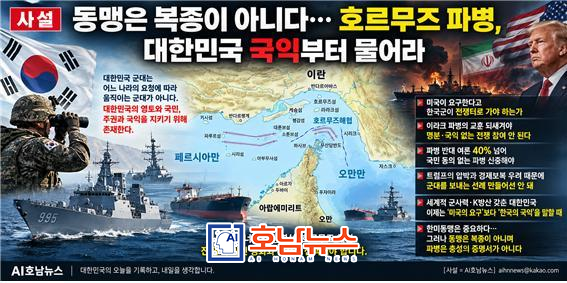 동맹은 복종이 아니다 / 사진제공=ai호남뉴스 |
[사설=AI호남뉴스] aihnnews@kakao.com
미국이 요구하면 대한민국은 또 군대를 보내야 하는가.
호르무즈 해협을 둘러싼 전쟁이 격화되면서 대한민국이 다시 중대한 선택의 갈림길에 섰다. 미국은 동맹국들에 군사적 기여를 요구하고 있고 한국의 파병 여부도 국제사회의 관심사가 되고 있다.
그러나 대한민국 정부가 가장 먼저 물어야 할 질문은 미국이 무엇을 원하는지가 아니다.
“대한민국이 왜 이 전쟁에 참여해야 하는가.”
이 질문에 국민이 납득할 만한 답을 내놓지 못한다면 한국군 파병은 다시 생각해야 한다.
대한민국 국군은 어느 나라의 요청에 따라 움직이는 군대가 아니다. 대한민국의 영토와 국민, 주권과 국익을 지키기 위해 존재한다.
■ 이라크전의 교훈을 잊었는가.
우리는 이미 2003년 이라크전에서 비슷한 선택을 경험했다.
당시 미국은 이라크가 대량살상무기를 보유하고 있다는 논리를 전쟁의 중요한 명분으로 내세웠다. 그러나 전쟁 이후 그러한 대량살상무기는 발견되지 않았다.
한국은 미국의 요청과 한미동맹 등을 고려해 파병을 결정했고 자이툰부대를 이라크 아르빌에 보냈다. 다행히 한국군은 공격적인 전투보다는 재건과 의료·민사 지원 등을 중심으로 활동했다.
그러나 20여 년이 지난 지금 우리는 당시의 결정을 냉정하게 돌아봐야 한다.
동맹이라는 이유만으로 미국이 벌이는 모든 전쟁에 참여하는 것이 과연 대한민국의 국익인가.
그 질문을 다시 호르무즈 앞에서 던져야 한다.
■ 호르무즈는 이라크보다 더욱 위험할 수 있다
현재 호르무즈 문제는 전후 복구지역에 군대를 보내는 문제가 아니다.
세계 에너지 수송의 핵심 통로에서 미국과 이란을 비롯한 여러 국가의 군사력이 충돌할 가능성이 존재하는 상황이다.
한국 함정이나 해상초계기가 파견된다면 처음에는 ‘상선 보호’, ‘항행 안전’, ‘기뢰 탐색’, ‘구조 지원’이라는 이름으로 출발할 수 있다.
그러나 전쟁에는 경계선이 흐려지는 순간이 찾아온다.
한국 함정이 공격받으면 어떻게 할 것인가.
한국군이 이란군과 교전한다면 그것은 이미 단순한 항행 지원이 아니다.
대한민국이 전쟁 당사국이 되는 문제다.
따라서 정부는 파병을 검토하기 전에 파병 목적과 작전지역, 무기사용 원칙, 교전수칙, 철수조건을 국민과 국회에 명확하게 공개해야 한다.
■ 국민이 반대하는 전쟁을 정부가 밀어붙여서는 안 된다
최근 조사에서도 호르무즈 파병 반대 의견이 40%를 넘는 것으로 나타나고 있다.
이것을 단순한 반미 감정으로 치부해서는 안 된다.
국민은 전쟁의 대가가 무엇인지 알고 있기 때문이다.
전쟁터에 보내는 것은 장비가 아니다.
대한민국의 아들과 딸이다.
단 한 명의 장병이라도 전쟁터에 보내려면 정부는 국민에게 설명해야 한다.
왜 가야 하는가.
무엇을 지키기 위해 가는가.
어디까지 싸우는가.
언제 돌아오는가.
이 네 가지 질문에 명확하게 답하지 못한다면 파병해서는 안 된다.
■ 트럼프의 요구, 거부한다고 한미동맹이 무너지는가
미국 트럼프 행정부의 요구가 강하다고 해서 대한민국의 선택권이 없어지는 것은 아니다.
한미동맹은 대한민국 안보의 중요한 축이다.
북한의 핵·미사일 위협이 존재하는 현실에서 미국의 확장억제와 정보·정찰 능력, 연합방위체계가 갖는 전략적 중요성을 가볍게 평가해서도 안 된다.
그러나 한미동맹과 미국이 벌이는 모든 전쟁에 한국군이 참여하는 것은 전혀 다른 문제다.
대한민국 헌법은 국군의 해외파병에 국회의 동의를 요구하고 있다.
대한민국 대통령도, 미국 대통령도 마음대로 한국군을 해외 전쟁터에 보낼 수 없다는 의미다.
그것이 주권국가다.
■ “파병 안 하면 관세·경제보복”…그것이 동맹인가
더욱 우려되는 것은 경제 문제다.
미국은 관세와 대미 투자, 방위비, 반도체와 조선 등 여러 분야에서 한국과 협상하고 있다.
이 과정에서 호르무즈 파병 문제가 경제협상과 연결돼서는 안 된다.
만약 군대를 보내지 않았다는 이유로 관세나 통상 압박이 가해진다면 정부는 오히려 당당하게 문제를 제기해야 한다.
군인의 생명과 국가의 전쟁 참여를 관세 몇 퍼센트와 거래하는 나라가 되어서는 안 된다.
경제보복이 두려워 군대를 보내기 시작한다면 대한민국의 파병 결정권은 사실상 다른 나라가 갖는 것과 무엇이 다른가.
이것만큼은 분명히 선을 그어야 한다.
■ 대한민국은 2003년의 대한민국이 아니다
대한민국의 국력도 크게 달라졌다.
한국은 세계적인 경제력을 갖춘 국가이며 반도체·조선·자동차·배터리·원전·방위산업에서 국제적 경쟁력을 확보하고 있다.
군사력 평가에서도 세계 최상위권에 올라 있다.
K9 자주포를 비롯해 K2 전차, 천무, FA-50, 잠수함과 군함 등 한국 방산은 세계시장에서 경쟁하고 있다.
과거처럼 미국이 무기를 주고 한국이 일방적으로 안보를 제공받던 시대와는 국제환경 자체가 달라지고 있다.
미국 역시 한국의 조선과 반도체, 방산과 제조업 능력을 필요로 한다.
한미관계는 이제 ‘한국만 미국을 필요로 하는 관계’가 아니라 ‘미국도 한국을 필요로 하는 관계’로 발전해야 한다.
그런 대한민국이 미국의 요구가 나올 때마다 “거절하면 불이익을 받지 않을까”부터 걱정한다면 국력의 성장에 걸맞은 외교라고 하기 어렵다.
■ 9·11 이후 25년, 전쟁의 문법도 바뀌었다
2001년 9·11 테러 이후 세계는 미국이 주도하는 ‘테러와의 전쟁’ 속으로 들어갔다.
아프가니스탄과 이라크가 그 중심이었다.
그러나 25년이 지난 지금 세계질서는 완전히 달라졌다.
미·중 전략경쟁, 러시아·우크라이나 전쟁, 중동의 군사충돌, 북한 핵·미사일 위협이 동시에 진행되고 있다.
대한민국은 더 이상 세계의 모든 분쟁에서 미국의 선택을 그대로 따라갈 수 없다.
특히 북한과 군사적으로 대치하고 있는 한국이 해군 함정과 항공전력 등을 중동에 파견한다면 한반도 대비태세에 어떤 영향을 주는지부터 검증해야 한다.
우리 앞마당을 지켜야 할 전력을 수천㎞ 떨어진 전쟁터로 보내면서 그것이 정말 대한민국의 안보에 도움이 되는지 묻는 것은 너무나 당연하다.
■ 그렇다고 호르무즈를 외면하자는 것도 아니다
자주외교는 국제사회의 책임을 외면하는 고립주의가 아니다.
호르무즈 해협은 한국 경제에도 매우 중요하다.
한국 선박과 국민이 위험에 처한다면 국가는 보호해야 한다. 국제상선에 대한 공격과 해상교통로 봉쇄 역시 국제사회가 공동 대응해야 할 문제다.
따라서 필요하다면 한국 선박 보호, 국민 구조, 기뢰 제거, 항행 안전, 인도적 지원과 같은 제한적 역할은 검토할 수 있다.
그러나 여기에는 분명한 선이 있어야 한다.
미국의 전쟁을 돕는 것과 대한민국의 국민과 해상교통로를 지키는 것은 다르다.
한국군이 파견된다면 미국의 공격작전에 자동 편입되어서는 안 된다.
이란 본토 공격이나 보복작전에 한국군이 참여해서도 안 된다.
그 선을 정부와 국회가 명확하게 그어야 한다.
■ 이제 대한민국의 자주권을 말할 때다
자주외교를 주장한다고 한미동맹을 버리자는 것이 아니다.
오히려 건강한 동맹이라면 서로의 국익과 주권을 존중해야 한다.
미국의 국익과 대한민국의 국익이 같다면 함께하면 된다.
그러나 다르다면 대한민국은 “아니다”라고 말할 수 있어야 한다.
그것이 동맹국이지 종속국이 아니다.
한국은 미국과 싸울 필요도 없고 미국을 적으로 돌릴 이유도 없다.
하지만 미국의 요구를 거절할 수 없는 나라가 되어서도 안 된다.
대한민국은 이제 그 정도의 국력과 군사력, 경제력과 외교적 자산을 갖췄다.
정부와 국회에 요구한다.
호르무즈 파병을 미국과의 관계만으로 판단하지 말라.
국민에게 파병의 명분과 목적을 먼저 설명하라.
한반도 안보에 미칠 영향을 공개하라.
작전범위와 철수조건을 명확하게 제시하라.
그리고 대한민국 국익에 부합하지 않는 전쟁이라면 미국 대통령 앞에서도 당당하게 “NO”라고 말하라.
우리는 미국의 적이 아니다.
그러나 미국의 전쟁에 언제든 군대를 보내야 하는 나라도 아니다.
동맹은 복종이 아니다.
파병은 충성의 증명서가 아니다.
그리고 대한민국 국군의 생명과 대한민국의 전쟁 참여를 결정하는 최종 기준은 워싱턴의 요구가 아니라 대한민국의 헌법, 대한민국 국민, 대한민국의 국익이어야 한다.
지금이야말로 대한민국이 국력에 걸맞은 자주외교를 시작할 때다.
“미국이 원하는 대한민국”이 아니라, “대한민국이 선택하는 대한민국”이 되어야 한다.
[Editorial] An Alliance Is Not Submission: On a Hormuz Deployment, South Korea Must Put Its National Interest First
Must South Korean troops be sent to war simply because the United States asks?
Lessons from the Iraq War must not be forgotten: South Korea should not join a war without clear justification or national interest
More than 40% oppose deployment: No military commitment should be rushed without public consent
Fear of pressure or economic retaliation from the Trump administration must never become a precedent for sending Korean troops to war
With world-class military capabilities and a globally competitive defense industry, South Korea must now speak of “Korean national interests” before “American demands”
The ROK-U.S. alliance remains vital—but an alliance is not submission, and military deployment is not a certificate of loyalty
[Editorial = AI Honam News] aihnnews@kakao.com
Must South Korea send its troops yet again simply because the United States asks?
As conflict surrounding the Strait of Hormuz intensifies, South Korea once again stands at a critical crossroads. The United States is calling on its allies to make military contributions, and the question of whether South Korea will deploy its forces has drawn international attention.
But the first question the South Korean government should ask is not what Washington wants.
“Why should South Korea participate in this war?”
If the government cannot provide an answer that the Korean people can accept, then any deployment of South Korean troops must be reconsidered.
The Republic of Korea Armed Forces do not exist to move at the request of another country. They exist to defend the territory, people, sovereignty, and national interests of the Republic of Korea.
■ Have We Forgotten the Lessons of the Iraq War?
South Korea faced a similar choice during the 2003 Iraq War.
At the time, the United States cited Iraq’s alleged possession of weapons of mass destruction as a major justification for war. Yet no such stockpiles were found after the invasion.
Taking into account Washington’s request and the ROK-U.S. alliance, South Korea ultimately decided to deploy troops and sent the Zaytun Division to Erbil, Iraq. Fortunately, South Korean forces focused primarily on reconstruction, medical assistance, and civil affairs rather than offensive combat operations.
More than two decades later, however, we must examine that decision with a critical eye.
Does being an ally mean South Korea should participate in every war fought by the United States?
Does doing so truly serve the national interest of the Republic of Korea?
Those questions must now be asked again over the Strait of Hormuz.
■ Hormuz Could Be Even More Dangerous Than Iraq
The situation in Hormuz is not simply about deploying troops to a postwar reconstruction zone.
It concerns the possibility of direct military confrontation involving the United States, Iran, and other powers in one of the world’s most strategically important energy corridors.
If South Korean naval vessels or maritime patrol aircraft are deployed, their mission may initially be described as “protecting merchant vessels,” “ensuring freedom of navigation,” “mine clearance,” or “search and rescue.”
But in war, operational boundaries can quickly become blurred.
What happens if a South Korean warship comes under attack?
What happens if South Korean forces exchange fire with Iranian forces?
At that point, the mission would no longer be merely about maritime security.
It could mean that the Republic of Korea itself has become a party to the conflict.
Before considering deployment, therefore, the government must clearly disclose to the public and the National Assembly the purpose of the mission, operational area, rules governing the use of force, rules of engagement, and conditions for withdrawal.
■ The Government Must Not Force Through a War the Public Opposes
Recent polling has shown that more than 40 percent of South Koreans oppose deploying forces to the Strait of Hormuz.
This should not simply be dismissed as anti-American sentiment.
The public understands the price of war.
What we send into a war zone is not merely military equipment.
We send the sons and daughters of the Republic of Korea.
Before even one service member is sent into a war zone, the government owes the public clear answers:
Why are they going?
What are they going to defend?
How far will they be expected to fight?
When will they return?
If the government cannot clearly answer these four questions, South Korean troops should not be deployed.
■ Would Saying No to Trump Really Destroy the ROK-U.S. Alliance?
Strong demands from the Trump administration do not mean South Korea has lost its right to make its own decision.
The ROK-U.S. alliance remains a crucial pillar of South Korea’s national security.
Given the continuing threat posed by North Korea’s nuclear weapons and missiles, the strategic importance of U.S. extended deterrence, intelligence and surveillance capabilities, and the combined defense structure must not be underestimated.
But maintaining the ROK-U.S. alliance and participating in every American war are entirely different matters.
The Constitution of the Republic of Korea requires the consent of the National Assembly for the deployment of Korean armed forces abroad.
Neither the president of South Korea nor the president of the United States can unilaterally send South Korean troops into a foreign war.
That is what sovereignty means.
■ “Deploy Troops or Face Tariffs and Economic Retaliation”—Is That an Alliance?
The economic dimension is even more troubling.
The United States and South Korea are negotiating across a wide range of issues, including tariffs, investment in the United States, defense cost-sharing, semiconductors, and shipbuilding.
The question of a Hormuz deployment must not become a bargaining chip in those economic negotiations.
If Washington were to impose tariffs or other trade pressure because South Korea refused to send troops, the Korean government should firmly challenge such pressure.
A nation must never trade the lives of its soldiers or its participation in a war for a few percentage points on tariffs.
If fear of economic retaliation becomes a reason to send troops abroad, then who truly holds South Korea’s authority to decide whether its military goes to war?
A clear line must be drawn.
■ South Korea Is Not the Same Country It Was in 2003
South Korea’s national strength has changed dramatically.
It is now a major economic power with global competitiveness in semiconductors, shipbuilding, automobiles, batteries, nuclear energy, and defense industries.
Its military capabilities also rank among the strongest in the world.
South Korean defense products—including the K9 self-propelled howitzer, K2 main battle tank, Chunmoo multiple-launch rocket system, FA-50 light combat aircraft, submarines, and warships—are now competing in international markets.
The international environment is no longer one in which South Korea simply receives weapons and security protection from the United States.
The United States also needs South Korea’s capabilities in shipbuilding, semiconductors, defense manufacturing, and advanced industry.
The ROK-U.S. relationship must therefore evolve from one in which “South Korea needs America” into one in which “America also needs South Korea.”
If South Korea still responds to every American request by first asking, “What punishment might we face if we refuse?” then its diplomacy has failed to keep pace with the growth of its national power.
■ Twenty-Five Years After 9/11, the Rules of War Have Changed
After the September 11 terrorist attacks in 2001, the world entered an era dominated by the U.S.-led “War on Terror.”
Afghanistan and Iraq stood at its center.
Twenty-five years later, however, the global order has fundamentally changed.
U.S.-China strategic competition, the Russia-Ukraine war, military conflict in the Middle East, and North Korea’s nuclear and missile threats are unfolding simultaneously.
South Korea can no longer simply follow Washington’s decisions in every international conflict.
In particular, if a country facing North Korea across a heavily armed frontier sends naval vessels and air assets thousands of kilometers away to the Middle East, it must first determine what impact that deployment would have on military readiness on the Korean Peninsula.
It is entirely reasonable to ask whether sending assets needed to defend our own front yard to a battlefield thousands of kilometers away truly makes South Korea safer.
■ This Does Not Mean South Korea Should Ignore Hormuz
Strategic autonomy does not mean isolationism or abandoning South Korea’s responsibilities to the international community.
The Strait of Hormuz is critically important to the South Korean economy.
If South Korean citizens or vessels are placed in danger, the state has an obligation to protect them. Attacks against international merchant shipping and attempts to obstruct maritime traffic are also issues that may require a collective international response.
South Korea could therefore consider carefully limited roles where necessary, including protecting Korean vessels, rescuing citizens, clearing mines, safeguarding maritime navigation, and providing humanitarian assistance.
But there must be a clear boundary.
Helping the United States wage a war is not the same thing as protecting South Korean citizens and vital maritime trade routes.
If South Korean forces are deployed, they must not be automatically incorporated into U.S. offensive military operations.
South Korean troops must not participate in attacks on Iranian territory or retaliatory combat operations.
The government and the National Assembly must draw that line clearly.
■ It Is Time for South Korea to Assert Its Sovereignty
Calling for strategic autonomy does not mean abandoning the ROK-U.S. alliance.
On the contrary, a healthy alliance should respect the sovereignty and national interests of both countries.
When American and South Korean interests coincide, the two countries should act together.
But when their interests diverge, South Korea must be capable of saying:
“No.”
That is the position of an ally—not a subordinate.
South Korea has no reason to fight the United States or turn America into an adversary.
But neither should South Korea become a country incapable of refusing an American demand.
The Republic of Korea now possesses the national power, military strength, economic capacity, and diplomatic assets necessary to make its own decisions.
We therefore call on the government and the National Assembly:
Do not judge the Hormuz deployment solely through the lens of relations with the United States.
Explain to the Korean people the justification and purpose of any deployment.
Disclose its potential impact on security and military readiness on the Korean Peninsula.
Clearly define the operational scope and conditions for withdrawal.
And if participation in this war does not serve the national interests of the Republic of Korea, then South Korea must be prepared to stand before the president of the United States and say, firmly and confidently:
“NO.”
We are not an enemy of the United States.
But neither are we a country obligated to send our troops whenever America goes to war.
An alliance is not submission.
Military deployment is not a certificate of loyalty.
The ultimate standard for deciding whether South Korean soldiers risk their lives—and whether the Republic of Korea becomes involved in a war—must not be the demands of Washington.
It must be the Constitution of the Republic of Korea, the will of the Korean people, and the national interests of the Republic of Korea.
Now is the time for South Korea to pursue an independent foreign policy commensurate with its national strength.
South Korea must no longer be “the Korea that America wants.”
It must become “the Korea that chooses for itself.”
 ai호남뉴스 박충배 편집/논설 aihnnewsr@kakao.com