2026.10.11 (일) 10:39




 닫기
닫기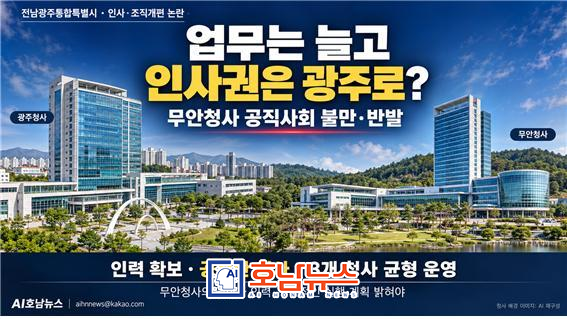 업무는 늘고 인사권은 광주로 / 사진제공=먀dlalwl |
전남광주통합특별시의 조직개편과 후속 인사를 둘러싸고 무안청사 공직사회의 불만과 반발이 이어지고 있다. 핵심 쟁점은 확대되는 업무에 필요한 인력을 어떻게 확보할 것인지, 인사 총괄 기능의 광주 배치가 청사 간 권한 불균형을 심화시키는지다.
전남도청공무원노동조합과 전남도청열린공무원노동조합은 인사·조직 권한의 광주 집중 우려와 승진 기준의 불투명성, 직렬과 업무 특성을 고려한 보직 배치 문제를 제기했다.
열린노조는 장기간 과장급 직무대행을 수행한 직원들이 승진에서 제외됐다며 인사 기준 공개를 요구했다. 이는 노조의 주장으로, 집행부는 해당 인사의 기준과 판단 근거를 설명할 필요가 있다.
무안청사 직원들의 불만은 인사에만 머물지 않는다. 광주일보는 보건·복지 기능을 통합하면서 직원들이 기존 지역에 남을 경우, 확대된 광주·전남 전체 업무를 누가 담당할 것인지에 대한 문제 제기가 무안청사에서 나왔다고 보도했다.
업무 범위와 실제 인력 배치가 맞지 않을 수 있다는 우려다.
업무가 확대되는 부서에 필요한 인원이 충원되지 않으면 기존 직원의 부담이 커지고 민원 처리와 현장 대응에도 차질이 생길 수 있다.
다만 무안청의 부서별 부족 인원, 초과근무 증가와 민원 지연 규모는 현재 확인한 자료만으로 확정하기 어렵지만 무안청 근무 공무원들의 블만은 갈수록 고조되어 가고 있다.
집행부는 업무량과 정원·현원을 공개해 이러한 우려에 답해야 한다.
전남광주의 기존 공무원노조와 청사별 직원들의 요구도 엇갈리고 있다.
광주 측은 기존 근무지와 생활권 보장을 강조하고, 전남 측은 핵심 부서와 권한의 균형 배치를 요구해 왔다. 광주 직원들의 무안 이동 문제를 개인의 근무 기피로만 설명하기보다, 종전 근무지 보장 원칙 아래 필요한 인력을 확보할 계획이 마련됐는지 따져야 한다.
집행부가 이동 대책을 전혀 마련하지 않은 것은 아니다. 근무지 이동자에게 최대 3점의 근무성적평정 가점, 이사비와 주거·교통비 지원을 제공하는 방안이 보도됐다.
희망자가 부족하면 시·군 전입 인력을 활용한다는 방침도 있다.
그러나 지원책의 존재와 필요한 인원을 실제로 확보하는 것은 별개의 문제다. 무안청에 몇 명이 필요하고, 언제까지 어떤 직렬을 충원할 것인지가 핵심이다.
인사 총괄 기능의 광주 배치 논란은 이 불만을 더욱 키우고 있다. 열린노조는 행정규칙 개정으로 광주청사 인사정책관에게 인사 총괄권을 부여하려 한다며 반발했다. 9월 29일 밤 입법예고한 뒤 다음 날까지 의견을 받도록 한 절차도 충분한 의견 수렴을 어렵게 한다고 비판했다.
‘광주는 본청, 무안은 지청’이라는 표현을 공식 지위로 단정할 근거는 확인되지 않았다.
민형배 시장은 특정 청사를 중심으로 운영하지 않고 3개 청사를 균형 있게 운영하겠다고 밝혔다.
하지만 정책 결정과 인사 권한은 광주에 집중되고 무안에는 집행 업무와 부담이 남는다면, 무안청사의 사실상 지청화를 우려하는 비판이 제기될 수 있다.
이는 실제 권한 배분을 기준으로 검증해야 할 문제다.
민 시장은 무안청사 공무원들의 불만을 조직개편 과정의 일시적인 반발로 넘겨서는 안 된다.
승진 기준, 청사별 인사 권한, 확대 업무에 필요한 인력과 충원 일정을 공개하고 노조·직원들과 협의해야 한다.
권한 배분을 결정하면서도 업무를 수행할 인원을 확보하지 못하고, 현장의 불신까지 해소하지 못한다면 시장의 조직 운영과 갈등 조정 능력 부족이라는 비판을 피하기 어렵다.
통합행정의 성과는 기존 직원에게 추가 업무를 떠넘겨 얻을 수 없다.
민형배 시장은 무안청사의 권한과 인력을 함께 보장하는 구체적인 실행 계획으로 책임에 답해야 한다.
“More Work, but Personnel Authority Goes to Gwangju?”…Discontent and Opposition Among Muan Office Civil Servants
Jeonnam unions criticize promotion criteria, centralized personnel authority, and insufficient consultation
Mayor Min Hyung-bae urged to disclose staffing plans for Muan and measures for balanced operation of the three offices
[MUAN—AI Honam News] aihnnews@kakao.com
Discontent and opposition continue among civil servants at the Muan Office over organizational restructuring and subsequent personnel appointments in Jeonnam–Gwangju Integrated Special City. The central questions are how to secure enough staff to handle expanded responsibilities and whether placing overall personnel management authority in Gwangju will deepen the imbalance of authority among the offices.
The Jeonnam Provincial Government Employees’ Union and the Jeonnam Provincial Government Open Employees’ Union have raised concerns about the concentration of personnel and organizational authority in Gwangju, unclear promotion criteria, and assignments that fail to account for employees’ occupational specialties and job requirements.
The Open Employees’ Union demanded disclosure of promotion criteria, saying that employees who had served for extended periods as acting division heads were excluded from promotion. These are the union’s claims, and the administration needs to explain the criteria and reasoning behind its decisions.
Concerns among Muan Office employees extend beyond personnel matters. The Gwangju Ilbo reported that employees questioned who would handle the expanded workload covering both Gwangju and Jeonnam if health and welfare functions were consolidated while staff remained in their existing locations.
The concern is that staffing arrangements may not match the scope of responsibilities.
If departments taking on additional duties do not receive enough staff, existing employees may face heavier workloads, potentially disrupting public service delivery and field operations.
Although the available information does not establish the number of staff shortages by department, increases in overtime, or the extent of service delays, dissatisfaction among civil servants working at the Muan Office is continuing to intensify.
The administration should respond by disclosing workload figures, authorized staffing levels, and actual staff numbers.
The existing civil service unions and employees across the Jeonnam–Gwangju offices also have differing demands.
The Gwangju side has emphasized protecting existing work locations and maintaining employees’ established living arrangements, while the Jeonnam side has called for a balanced allocation of key departments and authority. Rather than treating Gwangju employees’ reluctance to move to Muan solely as an individual unwillingness to relocate, the issue should be examined in terms of whether a workable staffing plan exists within the principle of protecting existing work locations.
The administration has introduced measures to encourage transfers. Reported incentives include up to three additional points in performance evaluations, moving expenses, and housing or commuting assistance.
It also plans to recruit employees through transfers from city and county governments if there are not enough volunteers.
However, offering incentives and actually securing the required staff are separate matters. The key questions are how many employees Muan needs, which occupational specialties are required, and when those positions will be filled.
Controversy over placing overall personnel management authority in Gwangju is adding to these concerns. The Open Employees’ Union opposed a proposed administrative rule amendment that would grant this authority to the personnel policy officer at the Gwangju Office. It also criticized the consultation process, saying that publishing the proposal late on September 29 and accepting comments only until the following day made meaningful consultation difficult.
There is no verified basis for describing “Gwangju as the headquarters and Muan as a branch office” as their officially established status.
Mayor Min Hyung-bae has stated that the three offices would operate in a balanced manner without any single office serving as the center.
However, if policy decisions and personnel authority become concentrated in Gwangju while Muan is left with implementation duties and the associated workload, concerns could arise that the Muan Office is effectively being reduced to a subordinate branch.
This issue must be assessed against the actual distribution of authority.
Mayor Min should not dismiss dissatisfaction among Muan Office employees as a temporary reaction to restructuring.
He should disclose promotion criteria, personnel authority by office, staffing requirements for expanded duties, and recruitment timelines, and consult with unions and employees.
If the administration allocates authority without securing the personnel needed to carry out the work, and fails to address distrust among employees, the mayor will face criticism over his ability to manage the organization and resolve conflicts.
Successful administrative integration cannot be achieved by shifting additional work onto existing employees.
Mayor Min Hyung-bae must demonstrate accountability through a concrete implementation plan that ensures both adequate staffing and meaningful authority for the Muan Office.
 ai호남뉴스 박충배 편집/논설 aihnnewsr@kakao.com