2026.10.11 (일) 10:40




 닫기
닫기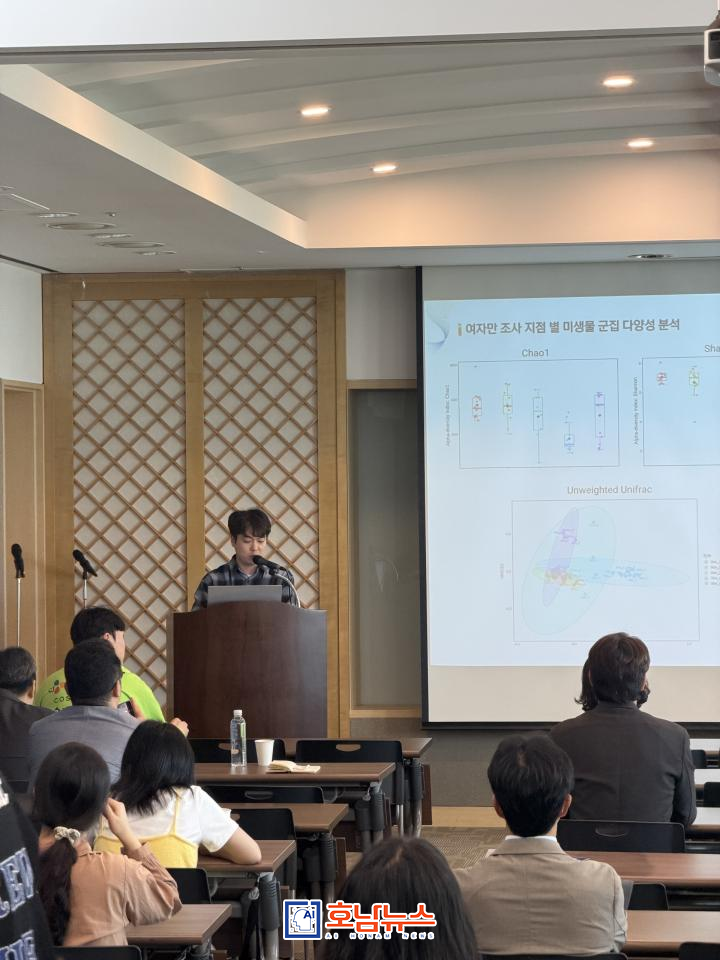 온실저감기술 학술대회 / 사진제골=국립호남권생물자원관 |
국립호남권생물자원관이 국가 생물자원 연구기관들과 함께 미생물과 미세조류 등을 활용한 온실가스 저감 기술의 연구 성과를 공유하고 산업적 활용 가능성을 논의했다.
기후에너지환경부 산하 국립호남권생물자원관(관장 박진영)은 국립생물자원관, 국립낙동강생물자원관과 함께 지난 10월 1일 제주국제컨벤션센터에서 열린 ‘2026 한국생물공학회 정기학술대회’에서 특별 공동세션을 개최했다고 2일 밝혔다.
이번 세션은 ‘생물공학 기반 온실가스 저감 기술과 탄소중립을 위한 새로운 패러다임’을 주제로 마련됐다. 이산화탄소와 메탄의 생물학적 저감·자원화 기술을 소개하고, 탄소중립을 위한 생물공학의 역할과 연구 방향을 논의했다.
세션은 이날 낮 12시 50분부터 오후 2시 30분까지 제주국제컨벤션센터 401호에서 진행됐으며, KAIST 조병관 교수가 좌장을 맡았다.
발표는 총 6건으로 구성됐다. 국립생물자원관 권대률 연구사는 세균을 이용한 이산화탄소 전환 기술을 중심으로 생물학적 탄소 포집·활용(CCU) 동향을 소개했다. 국립낙동강생물자원관 박수빈 전임연구원은 미세조류를 활용한 생물학적 CCU 기술을 발표했다.
국립호남권생물자원관 류상돈 전임연구원은 ‘연안 습지 미생물의 시·공간적 변화와 메탄자화균의 분리·활용 가능성’을 주제로 연구 성과를 공유했다. 연안 습지 미생물 군집의 변화 양상과 온실가스 저감에 기여할 수 있는 신규 균주 확보 성과가 주요 내용이다.
국립호남권생물자원관은 섬·연안에서 확보한 생물자원을 바탕으로 온실가스 저감 기능을 가진 균주를 분리하고 그 특성을 규명하는 연구를 지속해 왔다.
산업 현장과 연계한 기술 발표도 이어졌다. 한국환경공단 유병택 차장은 미세조류 기반 이산화탄소 저감 기술을, 포항산업과학연구원 김승진 책임연구원은 제철소 배출가스의 생물학적 전환 기술에 대한 실증과 상용화를 발표했다. GS건설 이동열 팀장은 산업 배출가스를 새로운 에너지원으로 활용하는 방안을 소개했다.
참석 기관들은 이번 세션을 통해 생물자원 기반 탄소중립 기술의 연구 성과를 공유하고 기관 간 협력 기반을 확대했다. 아울러 온실가스 저감·자원화 기술의 실용화와 산업적 활용 가능성을 모색했다.
박남진 국립호남권생물자원관 환경대응연구실장은 “이번 특별 공동세션은 세 개 생물자원관이 각 기관의 연구 성과를 공유하고, 생물자원을 활용한 탄소중립 기술의 발전 방향을 함께 모색하는 뜻깊은 자리였다.”며 “앞으로도 기관 간 협력을 강화해 생물자원의 새로운 가치를 발굴하고, 기후·환경 위기 대응에 기여할 수 있는 실용적인 연구 성과를 창출해 나가겠다.”고 밝혔다.
“Seeking Carbon Neutrality Solutions in Island and Coastal Microorganisms”… Three National Biological Resource Institutes Hold Joint Academic Session
Six presentations explore greenhouse gas mitigation and resource conversion at a biotechnology conference in Jeju
Honam institute shares findings on coastal wetland microbial communities and newly isolated methane-oxidizing bacteria
[Mokpo — AI Honam News] aihnnews@kakao.com
The Honam National Institute of Biological Resources (HNIBR) joined fellow national biological resource research institutes to share research findings on greenhouse gas mitigation technologies using microorganisms and microalgae and discuss their potential industrial applications.
HNIBR, led by Director Park Jin-young and affiliated with the Ministry of Climate, Energy and Environment, announced on October 2 that it had held a special joint session with the National Institute of Biological Resources and the Nakdonggang National Institute of Biological Resources at the 2026 Korean Society for Biotechnology and Bioengineering conference. The event took place at the International Convention Center Jeju on October 1.
The session, titled “Biotechnology for Greenhouse Gas Mitigation toward Carbon Neutrality,” introduced biological technologies for reducing carbon dioxide and methane and converting them into useful resources. Participants also discussed biotechnology’s role in achieving carbon neutrality and future research directions.
The session ran from 12:50 p.m. to 2:30 p.m. in Room 401, chaired by Professor Cho Byung-kwan of KAIST.
Six presentations were delivered. Kwon Dae-ryul, a researcher at the National Institute of Biological Resources, reviewed trends in biological carbon capture and utilization (CCU), focusing on bacterial carbon dioxide conversion technologies. Park Su-bin, a research associate at the Nakdonggang National Institute of Biological Resources, presented biological CCU technologies utilizing microalgae.
Ryu Sang-don, a research associate at HNIBR, presented “Spatio-temporal Bacterial Community Dynamics and Novel Methanotroph Isolation in Coastal Wetland Sediments.” His presentation covered changes in coastal wetland microbial communities over space and time, along with findings on newly isolated bacterial strains that could contribute to greenhouse gas mitigation.
HNIBR has continued to isolate and characterize microbial strains with greenhouse gas mitigation capabilities using biological resources collected from island and coastal environments.
The session also featured presentations linking research to industrial applications. Yoo Byung-taek, a deputy manager at the Korea Environment Corporation, introduced microalgae-based carbon dioxide reduction technology. Kim Seung-jin, a principal researcher at the Research Institute of Industrial Science and Technology, presented pilot demonstration and commercialization efforts for the biological conversion of steel mill off-gas. Lee Dong-yeol, a team leader at GS Engineering & Construction, discussed ways to utilize industrial flue gas as a new energy resource.
Through the session, the participating institutes shared research outcomes on biological resource-based carbon neutrality technologies and expanded the foundation for inter-institutional cooperation. They also explored opportunities for practical implementation and industrial use of greenhouse gas mitigation and resource conversion technologies.
“This special joint session provided a meaningful opportunity for the three institutes to share their research findings and jointly explore future directions for carbon neutrality technologies utilizing biological resources,” said Park Nam-jin, head of HNIBR’s Environmental Response Research Division.
“We will continue to strengthen cooperation among the institutes, discover new value in biological resources, and produce practical research outcomes that contribute to addressing climate and environmental crises,” he added.
 ai호남뉴스 박충배 편집/논설 aihnnewsr@kakao.com