2026.10.11 (일) 20:03




 닫기
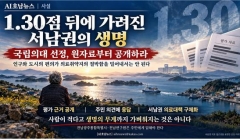
닫기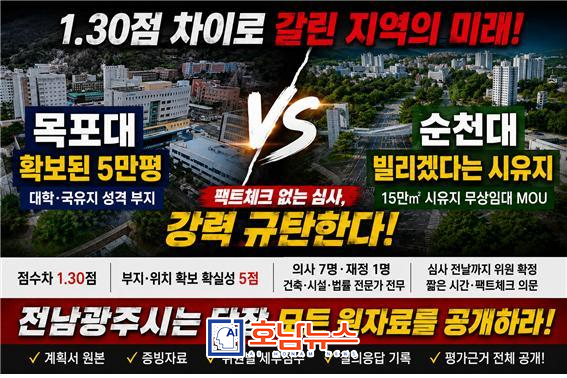 전남광주 의대심사공개하라 / 사진제공=ai호남뉴스 |
[전남광주=AI호남뉴스] aihnnews@kakao.com
전남광주 국립의과대학 후보대학 선정 결과를 둘러싼 논란이 이제 단순한 ‘목포와 순천의 지역갈등’ 차원을 넘어섰다.
핵심은 어느 대학이 선정됐느냐가 아니다.
두 대학이 실제로 확보한 조건과 앞으로 확보하겠다는 계획을 심사위원들이 명확하게 구별해 평가했느냐는 것이다.
그리고 그 중심에 의과대학 및 대학병원 부지가 있다.
국립순천대는 89.15점, 국립목포대는 87.85점을 받았다. 두 대학을 가른 점수는 불과 1.30점이었다. 그런데 평가 항목 가운데 ‘부지·위치 확보의 확실성’ 관련 배점만 5점인 것으로 보도됐다.
그렇다면 이 5점을 어떤 사실과 어떤 법률적 검증을 바탕으로 매겼는지는 당락 자체만큼 중요한 문제가 된다.
■ 목포대는 ‘확보된 부지’, 순천대는 ‘무상임대 MOU’
현재까지 공개된 자료를 비교하면 두 대학의 부지 조건에는 분명한 차이가 있다.
목포대는 목포시 용해동에 약 5만평 규모의 국유지 성격의 대학 부지를 의대 설립 예정지로 제출했다고 밝히고 있다.
반면 순천대가 제시한 곳은 순천시 조례동 드라마촬영장 인근 15만1,719㎡, 약 4만6천평 규모의 순천시 소유 시유지다. 순천시와 순천시의회, 순천대가 의대 유치가 확정될 경우 이 부지를 무상 임대한다는 내용의 업무협약을 체결한 상태였다.
여기에는 중요한 차이가 있다.
이미 대학이 사용할 권원을 확실하게 갖춘 부지와, 지방자치단체 소유 토지를 앞으로 제공받겠다는 협약은 법률적으로나 사업 실현 가능성 측면에서 동일한 개념이라고 보기 어렵다.
더욱이 목포MBC 보도에 따르면 해당 순천시유지는 공시지가 기준 약 286억원으로 언급됐으며, 후보대학 심사 당시 순천대 소유도 국유지도 아니었다. 후보 선정 이후에도 순천시장은 의대 인허가와 관련해 소유권 문제를 해결하기 위한 절차가 필요하다는 취지로 설명했다.
그렇다면 심사위원들이 반드시 물었어야 한다.
“현재 누구의 땅인가.”
“순천대가 언제, 어떤 법적 절차를 통해 사용할 수 있는가.”
“무상임대만으로 의대 건축과 국립대 시설 설치가 가능한가.”
“불가능하거나 추가적인 소유권 이전이 필요하다면 언제까지 완료할 수 있는가.”
이 검증 없이 단순히 ‘15만㎡ 부지 제공 MOU가 있다’는 이유만으로 높은 실현 가능성을 인정했다면 문제가 심각하다.
더 심각한 것은 이 문제가 ‘처음 발견된 문제’가 아니라는 점이다
■ 목포MBC의 9월 2일 보도는 더욱 주목할 대목을 제시한다.
순천시와 순천대가 시유지를 의대 관련 부지로 활용하는 문제는 2년 전인 2024년에도 검토됐고 법률적 문제가 제기됐다는 것이다.
당시에는 신대지구 시유지를 의대 부속병원 후보지로 검토했지만 자체 검토 과정에서 법률적 문제가 확인됐다는 것이 보도의 핵심이다. 이번에는 후보지가 신대지구에서 조례동으로 바뀌고 면적이 확대됐지만, ‘시유지를 국립대 의대 부지로 어떻게 적법하게 확보할 것인가’라는 본질적인 문제는 다시 검증 대상이 됐다.
따라서 전남연구원과 전남광주통합특별시는 답해야 한다.
2년 전에도 제기됐던 문제를 이번 심사위원들이 알고 있었는가.
관련 법률 검토서를 확인했는가.
순천시가 제출한 MOU와 소유권 이전 가능성을 법률전문가가 검토했는가.
그렇지 않았다면 무엇을 근거로 ‘부지 확보의 확실성’을 평가했는가.
1.3점으로 당락 갈랐는데 부지 항목은 5점
이 문제를 가볍게 볼 수 없는 이유가 숫자에 있다.
최종 격차는 1.30점이다.
그런데 부지 확보 관련 평가 항목의 배점은 5점이다.
따라서 부지의 법적 확보 가능성과 실현 가능성에 대한 평가가 조금만 달라졌더라도 전체 결과에 영향을 미쳤을 가능성을 배제할 수 없다.
더구나 전체 점수 차이의 대부분은 ‘교원 확보계획’에서 발생했다. 공개된 평가 결과에 따르면 순천대가 이 항목에서 목포대보다 1.17점 앞섰다.
결국 이번 선정은 거대한 점수 차이로 결정된 것이 아니다.
부지, 병원, 교수 확보와 같은 몇몇 핵심 항목의 정성적 판단이 사실상 당락을 결정한 구조다.
그럴수록 평가 근거는 더욱 엄격하게 검증돼야 한다.
그런데 심사위원 8명 가운데 건축·시설 전문가는 없었다
여기서 또 하나의 문제가 발생한다.
목포MBC 취재에 따르면 최종 심사위원 8명 가운데 7명이 의사이고 1명이 재정 분야 전문가였다. 의대 설립·의학교육 2명, 임상·기초의학 3명, 지역 필수·공공의료 및 보건정책 2명, 병원 운영·재정 타당성 1명으로 구성됐다.
의학교육을 평가하는 데 의학 전문가가 참여하는 것은 당연하다.
그러나 평가항목에는 단순한 의학교육만 있었던 것이 아니다.
의대와 교육병원 시설 확보, 건립 일정, 부지 확보 가능성과 사업 실현 가능성까지 들어 있었다.
그렇다면 최소한 건축·시설, 국공유재산, 행정법 또는 국립대 시설 관련 전문가의 검증이 필요하지 않았느냐는 질문은 합리적이다.
더욱이 심사는 8월 29일 진행됐는데 심사위원 8명이 모두 확정된 시점은 전날인 28일 오후 6시까지였다는 보도도 나왔다.
목포대는 심사위원들이 1시간 남짓 계획서를 검토하고 20분 발표와 30분 질의응답을 진행했다고 주장하고 있다. 전남연구원 측 설명과 함께 객관적인 심사 시간표를 공개해 사실관계를 확인해야 한다.
수십 년 지역 숙원과 수천억원대 인프라, 의대·대학병원 건립 가능성을 좌우하는 판단을 이 정도의 절차로 충분히 검증할 수 있었는지는 반드시 따져봐야 한다.
■ ‘계획’과 ‘확보’를 같은 것으로 평가해서는 안 된다
AI호남뉴스가 특히 강조하는 것은 이것이다.
공공사업 심사에서 가장 위험한 것은 미래의 약속을 현재 확보된 실적으로 둔갑시키는 것이다.
‘확보했다’와 ‘확보할 예정이다’는 다르다.
‘소유하고 있다’와 ‘MOU를 체결했다’도 다르다.
‘법적으로 사용할 수 있다’와 ‘향후 법적 문제를 해결하겠다’ 역시 전혀 다른 개념이다.
따라서 목포대가 이미 사용권원이 확보된 5만평 규모 부지를 제시했다면 그것은 ‘현재 확보된 기반’으로 평가해야 한다.
반대로 순천대가 순천시 소유 부지에 대해 무상임대 MOU를 제시했다면 MOU의 법적 구속력, 공유재산 관련 절차, 소유권 또는 사용권 확보 가능성, 의대 시설 설치 가능 여부와 소요기간을 별도로 검증했어야 한다.
두 자료를 단순히 ‘양쪽 모두 5만평가량의 부지가 있다’는 식으로 평가했다면 그것은 면적 비교이지 부지 확보의 확실성 평가가 아니다.
팩트체크 없는 심사였다면 결과부터 재검증해야 한다
더 큰 문제는 제출된 계획서의 사실 여부를 어디까지 확인했느냐다.
심사는 발표 경연대회가 아니다.
국립의대는 수천억원의 공공재원이 들어가고 향후 수십 년 동안 지역 의료체계를 좌우하는 국가사업이다.
대학이 “할 수 있다”고 쓰면 가능한 것으로 인정하고, 지자체가 “제공하겠다”고 하면 확보된 것으로 인정하고, “교수를 확보하겠다”고 하면 확보 가능성이 있다고 판단하는 식이어서는 안 된다.
등기부, 토지대장, 공유재산 관리계획, 관련 조례와 법률검토서, 병원 건축 가능 여부, 인허가 일정, 교수 확보 근거자료까지 대조하는 팩트체크가 평가의 출발점이어야 했다.
그런데 현재까지 공개된 자료만으로는 이러한 검증이 어느 수준까지 이뤄졌는지 확인하기 어렵다.
그래서 세부자료 공개가 필요하다.
허위·중대한 과장이 확인된다면 ‘감점’으로 끝낼 문제가 아니다
여기서는 한 가지를 분명히 해야 한다.
현재 공개된 보도만으로 순천대가 허위자료를 제출했다고 단정할 수는 없다.
시유지를 제공받겠다는 MOU를 ‘향후 확보계획’으로 정확히 기재했다면 그 자체를 허위라고 할 수 없기 때문이다.
그러나 만약 앞으로 원본 계획서를 확인한 결과, 아직 소유권이나 적법한 사용권원을 확보하지 않은 토지를 이미 확보한 것처럼 표현했거나, 법률상 중대한 제약을 알면서도 이를 누락해 심사위원이 현실과 다른 판단을 하도록 했다면 이야기는 완전히 달라진다.
그 경우에는 단순한 감점 문제가 아니라 평가결과의 유효성 자체를 다시 검토해야 한다.
특히 허위 또는 중대한 과장자료가 평가점수와 선정 결과에 실질적 영향을 미쳤다는 사실이 객관적으로 확인된다면, 전남광주시는 교육부 지침과 해당 심사기준에 따라 선정취소·자격박탈 또는 재평가가 가능한지까지 법률 검토해야 한다.
반대로 자료가 사실이고 법적으로 실현 가능한 계획이었다면 그 근거를 공개하면 된다.
그래야 순천대 역시 불필요한 의혹에서 벗어날 수 있다.
이제 필요한 것은 ‘승복하라’가 아니라 ‘자료를 공개하라’다
민형배 전남광주통합특별시장은 9월 2일 국립의대 문제에 대해 “큰 고비를 넘었다”고 평가했다.
그러나 1.3점 차이의 결과를 둘러싸고 부지와 교원 확보, 심사위원 전문성 문제가 연이어 제기되고 있는 상황이라면 행정이 먼저 해야 할 일은 결과에 대한 승복을 요구하는 것이 아니다.
검증 가능한 자료를 공개하는 것이다.
AI호남뉴스는 전남광주통합특별시와 전남연구원에 최소한 다음 자료의 공개가 필요하다고 본다.
목포대·순천대가 제출한 의대 신설 계획서 원본과 첨부 증빙자료
양 대학 의대·대학병원 예정부지의 소유권 및 사용권 확보 증빙
■ 순천시 시유지 무상임대 MOU와 관련 법률검토 자료
‘부지·위치 확보 확실성’ 5점에 대한 대학별 세부점수와 평가사유
심사위원 8명의 분야별 자격·전문성 및 선정 과정
19개 세부지표별 위원별 원점수와 최고·최저점 제외 내역
양 대학 발표 후 진행된 질의응답 내용과 답변자료
교원 확보계획에서 1.17점 차이가 발생한 구체적인 평가근거
이 자료가 공개되면 논란은 상당 부분 정리될 수 있다.
순천대의 계획이 더 우수했다면 자료가 그것을 증명할 것이다.
반대로 확보되지 않은 부지를 확보된 부지와 사실상 동일하게 평가했고, 실현 가능성에 대한 법률 검증조차 제대로 하지 않았다면 심사 결과를 다시 들여다보는 것이 당연하다.
36년을 기다린 국립의대다.
1.3점으로 지역의 미래를 갈랐다면 그 1.3점은 누구라도 납득할 수 있을 만큼 투명해야 한다.
의혹을 덮는 것이 지역통합이 아니다.
사실을 공개하고, 잘못된 평가는 바로잡고, 허위나 중대한 과장이 확인되면 책임을 묻는 것. 그것이 공정이고 행정의 신뢰다.
전남광주 국립의대 선정 논란을 끝내는 방법은 의외로 간단하다.
“계획서를 공개하라. 점수를 공개하라. 그리고 1.3점의 근거를 국민 앞에 증명하라.”
[Editorial]
“Is a Secured 50,000-Pyeong Site Really the Same as Municipal Land to Be Borrowed?”
Release the Raw Data Behind the National Medical School Review
Mokpo National University proposed a roughly 50,000-pyeong site in Yonghae-dong under university/public ownership…
Sunchon National University proposed about 150,000㎡ of Suncheon City-owned land based on an MOU for free lease
The appraised public value of the proposed Sunchon site is about KRW 28.6 billion…
Sunchon National University had not secured ownership of the land at the time of the evaluation
Mokpo MBC: Legal issues surrounding use of municipal land had already been reviewed two years ago…
How thoroughly was legal feasibility examined in this year’s screening?
The final score gap was only 1.30 points, while “certainty of securing the site and location” alone carried 5 points…
A category large enough to potentially alter the outcome
Of the eight evaluators, seven were medical doctors and one was a finance expert…
No specialist in construction, facilities, public property, or administrative law
The panel was finalized only the day before the evaluation…
Questions remain over whether 19 indicators and the overall project plans could have been sufficiently verified in such a short time
If plans, MOUs, and future acquisition possibilities were treated as if they were assets already secured, that would amount to a serious distortion of the evaluation
If false statements or material exaggerations are found in the submitted documents, authorities should consider not just score deductions but disqualification, cancellation of selection, or re-evaluation
The Jeonnam-Gwangju Metropolitan Government should disclose the original proposals from both universities, supporting documents, evaluator-by-evaluator scores, and the full Q&A records
[Jeonnam-Gwangju = AI Honam News] aihnnews@kakao.com
The controversy surrounding the selection of a candidate university for the Jeonnam-Gwangju National Medical School has now moved beyond a simple regional rivalry between Mokpo and Suncheon.
The key question is not which university was selected.
The real issue is whether the evaluators clearly distinguished between conditions that had already been secured and plans for resources that might be secured in the future.
At the center of that question are the proposed sites for the medical school and its teaching hospital.
Sunchon National University received 89.15 points, while Mokpo National University received 87.85 points. The difference was just 1.30 points. Yet the evaluation category relating to the “certainty of securing the site and location” was reportedly worth 5 points.
That means the factual and legal basis on which those 5 points were awarded is nearly as important as the final result itself.
■ Mokpo National University: “Secured Land”
Sunchon National University: “Free-Lease MOU”
Based on information disclosed so far, there is a clear difference between the site conditions presented by the two universities.
Mokpo National University stated that it proposed a roughly 50,000-pyeong site in Yonghae-dong, Mokpo, consisting of land under university or public ownership, as the planned site for its medical school.
By contrast, Sunchon National University proposed approximately 151,719㎡, or about 46,000 pyeong, of land near the Suncheon Drama Filming Location in Jorye-dong. The land is owned by Suncheon City.
At the time, Suncheon City, the Suncheon City Council, and Sunchon National University had signed an MOU under which the city would provide the land free of charge if the medical school bid succeeded.
That is an important distinction.
Land for which a university already has a definite legal right of use cannot automatically be regarded as equivalent, either legally or in terms of project feasibility, to land owned by a local government that is expected to be provided in the future through an agreement.
According to reporting by Mokpo MBC, the Suncheon municipal land in question was valued at approximately KRW 28.6 billion based on officially assessed land prices, and at the time of the candidate-university evaluation it was neither owned by Sunchon National University nor classified as national property.
Even after the university was selected, the mayor of Suncheon reportedly explained that procedures would still be required to resolve the ownership issue in connection with approval of the medical school project.
If so, the evaluators should have asked several basic questions.
“Who currently owns the land?”
“When and through what legal procedure can Sunchon National University obtain the right to use it?”
“Is a free lease alone sufficient to construct a national university medical school and related facilities?”
“If additional transfer of ownership or other legal measures are necessary, when can they realistically be completed?”
If those issues were not verified, and the mere existence of an MOU promising roughly 150,000㎡ of land was treated as sufficient proof of feasibility, then the problem is serious.
■ Even More Troubling: This Was Not a Newly Discovered Issue
Mokpo MBC’s September 2 report raised another significant point.
The issue of using Suncheon City-owned land for a medical school project had reportedly already been reviewed two years earlier, in 2024, when legal concerns were raised.
At that time, municipal land in the Sindae district had been considered as a possible site for an affiliated hospital, but legal issues were reportedly identified during an internal review.
This time, the proposed location was changed from Sindae to Jorye-dong and the land area was expanded.
But the essential question remained the same:
How can municipal land be lawfully secured and used for a national university medical school?
That question should have been thoroughly examined again.
The Jeonnam Research Institute and the Jeonnam-Gwangju Metropolitan Government therefore need to answer several questions.
Were the evaluators aware that similar legal issues had already been raised two years ago?
Did they review the relevant legal opinions?
Was the MOU submitted by Suncheon City, as well as the possibility of transferring ownership or securing lawful usage rights, reviewed by qualified legal experts?
If not, on what basis was the “certainty of securing the site” scored?
■ The Final Gap Was 1.30 Points, While the Site Category Was Worth 5
The numbers are why this issue cannot be dismissed.
The total gap between the two universities was just 1.30 points.
Yet the site-related category alone was worth 5 points.
That means even a relatively small difference in the assessment of legal certainty or feasibility regarding the site could potentially have affected the overall result.
Moreover, much of the final score difference reportedly came from the category concerning the faculty recruitment plan. According to disclosed evaluation results, Sunchon National University scored 1.17 points higher than Mokpo National University in that category.
This was therefore not a selection decided by an overwhelming margin.
Rather, the outcome appears to have been determined by qualitative judgments in a few key areas, including the site, hospital infrastructure, and faculty recruitment.
The narrower the margin, the stricter and more transparent the evidentiary basis for those judgments must be.
■ Yet There Was No Construction or Facilities Specialist Among the Eight Evaluators
Another issue also deserves scrutiny.
According to Mokpo MBC, seven of the eight final evaluators were medical doctors and one was a specialist in finance.
The panel reportedly consisted of two experts in medical school establishment and medical education, three in clinical and basic medicine, two in essential and public healthcare and health policy, and one in hospital operation and financial feasibility.
There is nothing unusual about including medical experts in the evaluation of a medical school.
But the evaluation was not limited to medical education.
It also included the availability of medical school and teaching hospital facilities, construction schedules, site acquisition, and overall project feasibility.
That raises a reasonable question: should the process not have included experts in construction, facilities, public property, administrative law, or national university infrastructure?
There are also reports that the evaluation took place on August 29, while all eight panel members were not finalized until around 6 p.m. the previous day, August 28.
Mokpo National University has claimed that evaluators reviewed the proposal for only about an hour, followed by a 20-minute presentation and approximately 30 minutes of questions and answers.
The Jeonnam Research Institute should disclose the objective evaluation timetable so that these claims can be verified.
This project involves a decades-long regional aspiration, infrastructure costing hundreds of billions or even trillions of won, and the feasibility of establishing a medical school and university hospital.
It is therefore legitimate to ask whether such a far-reaching decision could truly be verified adequately within such a compressed process.
■ A “Plan” Must Not Be Treated as the Same Thing as Something Already “Secured”
This is the point AI Honam News considers especially important.
One of the greatest dangers in public-project evaluation is allowing a future promise to be treated as if it were an already secured asset.
“To have secured” something is not the same as “planning to secure” it.
“To own” land is not the same as “having signed an MOU.”
“To have the legal right to use a site” is not the same as “planning to resolve legal issues later.”
If Mokpo National University had already secured legal use of approximately 50,000 pyeong, that should have been assessed as an existing asset.
If Sunchon National University proposed Suncheon City-owned land based on a free-lease MOU, then the evaluators should have separately examined the MOU’s legal force, procedures governing public property, the possibility of securing ownership or usage rights, whether medical school facilities could legally be built there, and how long those procedures would take.
If the two proposals were effectively assessed as though “both universities had around 50,000 pyeong of land,” then the exercise would have been little more than a comparison of land area.
It would not have been a genuine evaluation of the certainty of securing the site.
■ If There Was No Fact-Checking, the Result Itself Must Be Re-Examined
An even larger issue is the extent to which claims in the proposals were independently verified.
This was not a presentation contest.
A national medical school is a major public project involving enormous public expenditure and shaping regional healthcare for decades.
It is not enough for a university to say, “We can do it,” for an evaluator to assume that it can.
Nor should a local government’s statement that it “will provide” land automatically be treated as proof that the land has already been secured.
And a promise to “recruit professors” should not be treated the same as a verified ability to recruit them.
Fact-checking should have begun with independent verification of land registry records, cadastral records, public property management plans, relevant ordinances and legal opinions, construction feasibility, approval schedules, and documentary evidence supporting faculty recruitment.
Yet based on information made public so far, it remains unclear how thoroughly such checks were conducted.
That is precisely why the detailed records must now be disclosed.
■ If Falsehoods or Material Exaggerations Are Found, This Cannot End with a Simple Score Deduction
One point must be stated clearly.
Based on publicly available reporting alone, it is not possible to conclude that Sunchon National University submitted false information.
If the university accurately described the municipal land as a site it planned to secure in the future through an MOU, that in itself would not constitute false information.
But the situation would be entirely different if the original proposal reveals that land for which ownership or lawful usage rights had not yet been secured was presented as though it had already been secured.
Likewise, if significant legal restrictions were known but omitted in a way that led evaluators to form an inaccurate view of the project’s feasibility, the validity of the evaluation itself would have to be reconsidered.
If false or materially exaggerated information is objectively proven to have had a meaningful effect on the score and the final selection, the Jeonnam-Gwangju Metropolitan Government should conduct a legal review under the Ministry of Education’s guidelines and the applicable evaluation rules to determine whether cancellation of the selection, disqualification, or a re-evaluation is warranted.
On the other hand, if the submitted information was accurate and the project is legally feasible, the authorities should simply disclose the evidence.
That would also help Sunchon National University clear itself of unnecessary suspicion.
■ What Is Needed Now Is Not “Accept the Result,” but “Release the Records”
On September 2, Jeonnam-Gwangju Metropolitan Mayor Min Hyung-bae described the national medical school issue as having “passed a major hurdle.”
But when questions continue to emerge over land, faculty recruitment, and the expertise of the evaluation panel in a contest decided by just 1.30 points, the first task of government should not be to demand acceptance of the outcome.
It should be to disclose verifiable evidence.
AI Honam News believes that the Jeonnam-Gwangju Metropolitan Government and the Jeonnam Research Institute should disclose, at minimum, the following materials:
The original medical school establishment proposals submitted by Mokpo National University and Sunchon National University, including all supporting documents
Documentary proof of ownership and legal usage rights for the proposed medical school and university hospital sites of both universities
The MOU concerning the free lease of Suncheon City-owned land and all related legal review documents
The university-by-university scores and written reasons for the 5-point category on “certainty of securing the site and location”
The qualifications, areas of expertise, and selection process of the eight evaluators
The evaluator-by-evaluator raw scores for all 19 detailed indicators, including the highest and lowest scores excluded from calculation
The complete Q&A records following the presentations of both universities, including their responses and supporting materials
The specific basis for the 1.17-point difference in the faculty recruitment category
If these materials are disclosed, much of the controversy can be settled.
If Sunchon National University’s plan was genuinely superior, the records will demonstrate that.
But if unsecured land was effectively treated in the same way as already secured land, and if legal feasibility was not properly verified, then the evaluation result should be reviewed again.
The region has waited 36 years for a national medical school.
If a 1.30-point difference determined the future of an entire region, then every fraction of that difference must be transparent enough for the public to understand and accept.
Suppressing questions is not regional unity.
Disclosing the facts, correcting any flawed evaluation, and holding those responsible accountable if falsehoods or serious exaggerations are proven — that is what fairness and public trust require.
There is, in fact, a simple way to bring the controversy over the Jeonnam-Gwangju National Medical School selection to an end:
“Release the proposals. Release the scores. And prove to the public exactly where that 1.30-point difference came from.”
 ai호남뉴스 박충배 편집/논설 aihnnewsr@kakao.com