2026.10.11 (일) 20:00




 닫기
닫기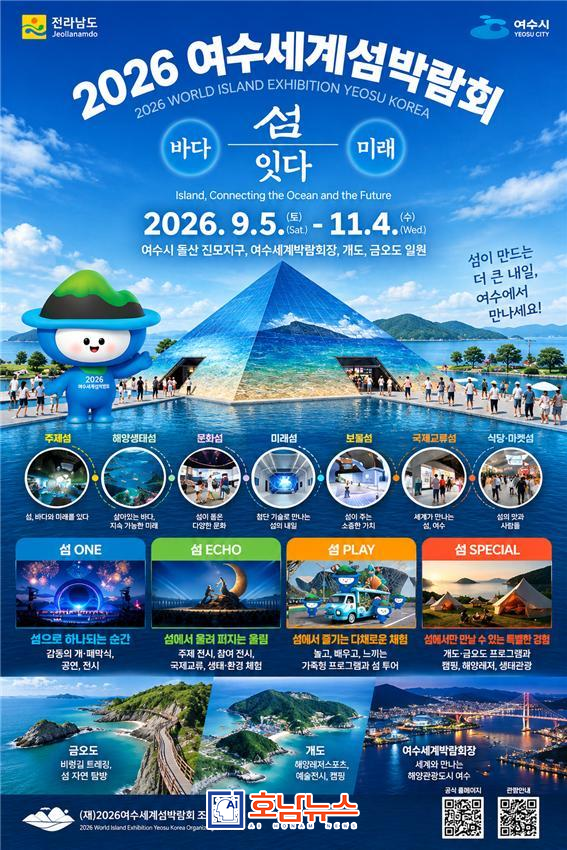 세계섬박람회 박람회 / 사진제공=여수시청 |
[여수=AI호남뉴스] aihnnews@kakao.com
세계 최초로 ‘섬’을 주제로 내건 2026여수세계섬박람회가 5일 전남광주 여수시 돌산읍 진모지구에서 막을 올렸다.
개막 첫날부터 가족 단위 관광객과 여행객, 외국인들의 발길이 이어지면서 행사장은 모처럼 활기를 띠었다. 특히 피라미드 형태의 거대한 ‘주제섬’은 관람객들이 줄지어 사진을 찍는 박람회의 대표 명소로 떠올랐다.
하지만 이제부터가 진짜 시험대다.
박람회에 직접 투입되는 사업비만 713억원이다. 목표 관람객은 300만명이다. 박람회는 11월 4일까지 61일 동안 계속된다.
300만명을 61일로 단순 계산하면 하루 평균 약 4만9,180명이 찾아와야 한다.
그러나 300만명이 입장했다고 해서 박람회가 성공했다고 단정할 수 있을까.
AI호남뉴스가 주목하는 지점은 바로 여기에 있다.
“300만명이 여수에 왔느냐”가 아니라 “그 300만명이 여수에서 무엇을 하고, 어디에서 자고, 무엇을 먹고, 실제 섬에는 몇 명이나 들어갔으며, 지역에 얼마를 쓰고 갔느냐”가 이번 박람회의 성패를 가를 핵심 지표다.
■ 첫날 가장 ‘핫한 곳’은 단연 주제섬
개막 첫날 현장에서 가장 많은 관심을 받은 곳은 돌산 진모지구의 ‘주제섬’이었다.
가로·세로 약 40m, 높이 20m의 피라미드 형태로 만들어진 주제섬에는 ‘생명의 나무’를 중심으로 몰입형 미디어 콘텐츠가 펼쳐졌다.
뉴스1 현장취재에서도 관람객들이 개장 전부터 입장을 기다렸고, 주제섬을 배경으로 사진을 찍으려는 행렬이 이어졌다.
한 관람객은 바다 앞의 거대한 피라미드와 영상·음악이 어우러져 웅장하다는 반응을 보였다. 어린이를 동반한 가족들은 체험 콘텐츠가 마련된 ‘보물섬’으로 몰렸다.
광주CBS도 개장 전부터 수백명의 관람객이 대기했으며, 주제섬의 대형 미디어파사드가 가동되자 현장에서 환호가 나왔다고 전했다.
현재까지 개막 초기의 대표 핫플레이스는 ‘주제섬’이라고 평가할 수 있다.
■ KBS 만난 관람객들 “특산물 먹고 다양한 체험…좋은 추억”
KBS 뉴스에 소개된 관람객 반응도 긍정적이었다.
AI호남뉴스가 확보한 KBS 방송 화면을 보면 관람객들은 아름다운 섬과 섬 특산물, 다양한 체험을 박람회의 장점으로 꼽았다.
특히 초등학생 관람객은 여수 360도 파노라마와 쓰레기 재활용 관련 전시 등을 직접 본 경험을 이야기했다.
단순히 섬의 경관을 보여주는 데 그치지 않고 스마트양식·자원순환·해양환경·미래기술 등을 어린이들이 체험하는 교육공간으로 박람회가 활용되고 있다는 의미다.
조직위 역시 주행사장에 주제섬을 비롯해 해양생태섬·미래섬·문화섬·보물섬·국제교류섬·식당·마켓섬 등 8개 전시공간을 조성했다.
■ 그러나 첫날부터 나온 뼈아픈 한마디…“1시간도 안 걸렸다”
화려한 개막 분위기 속에서 반드시 짚어야 할 지적도 나왔다.
연합뉴스가 개막 첫날 만난 제주지역 관람객은 여러 섬 주민의 문화와 이야기를 기대했지만 해양기후와 환경오염 등 여러 주제가 혼재해 집중하기 어려웠다는 취지의 평가를 내놨다.
특히 주요 전시관을 둘러보는 데 1시간도 채 걸리지 않았다며 다시 찾아오게 할 핵심 콘텐츠가 부족해 보인다는 의견을 냈다.
이는 가볍게 넘길 문제가 아니다.
박람회는 하루짜리 행사가 아니라 61일간 계속되는 장기 국제행사다.
첫 방문객의 만족도뿐 아니라 두 번째 방문을 유도할 콘텐츠, 계절과 시기에 따라 달라지는 프로그램, 실제 섬 관광과 연결되는 상품이 있어야 한다.
결국 앞으로의 과제는 명확하다.
“진모지구를 한 번 보고 끝나는 박람회가 될 것인가, 아니면 진모지구에서 출발해 금오도·개도와 여수 전역으로 관광객을 움직이는 박람회가 될 것인가.”
■ 713억원 어디에 들어갔나
박람회의 직접 사업비는 713억원이다.
세부적으로는 국비 64억원, 도비 153억원, 시비 376억원, 입장권 판매 등을 통한 사업수익 120억원으로 구성됐다.
특히 눈여겨볼 부분은 홍보와 콘텐츠 관련 예산이다.
관람객 유치 및 홍보·마케팅 관련 예산이 모두 102억원, 8개 전시관의 콘텐츠 개발·운영에 90억원, 개·폐막식과 공연 등 행사프로그램 개발·운영에 65억원이 책정됐다.
주제섬 외벽에 영상을 송출하는 미디어파사드 설치 계약도 약 21억3천만원 규모이며 외벽 영상 제작·운영에는 별도로 20억원이 책정됐다.
따라서 박람회가 끝난 뒤에는 단순히 “많은 관광객이 찾았다”는 평가만으로는 부족하다.
713억원의 공공투자가 실제 지역경제에 어떤 효과를 가져왔는지 검증해야 한다.
■ 300만명 목표…매일 4만9천명 와야 한다
조직위원회가 공식적으로 제시한 참여 규모는 30개국·300만명이다. 행사장 전체 규모는 18만4,302㎡다.
300만명을 61일로 나누면 하루 평균 약 4만9천명이다.
평일과 주말의 방문객 편차를 고려하면 주말과 연휴에는 이보다 훨씬 많은 인원을 유치해야 한다.
따라서 AI호남뉴스는 앞으로 조직위가 발표하는 단순 누적관람객 숫자뿐 아니라 유료 입장객과 무료 입장객을 구분해 공개할 필요가 있다고 본다.
단체관람객과 재입장객, 초청객 등을 어떻게 집계하는지도 투명해야 한다.
그래야 300만명이라는 숫자의 실질적 의미를 판단할 수 있다.
■ 진짜 승부처는 ‘금오도·개도’
현재 가장 사진이 많이 찍히고 사람이 몰리는 곳은 진모지구 주제섬이다.
그러나 경제적 성공 여부를 판단할 가장 중요한 장소는 오히려 금오도와 개도가 될 가능성이 높다.
왜냐하면 이번 행사의 이름은 단순한 ‘해양박람회’가 아니라 ‘세계섬박람회’이기 때문이다.
관람객들이 전시장 안에서 영상으로 섬을 보고 돌아가는 것이 아니라 실제 배를 타고 섬으로 들어가야 행사의 취지가 완성된다.
조직위도 개도에서 섬섬캠핑장과 예술전시, 해양레저스포츠 체험을 운영하고 금오도에서는 스탬프투어, 캠핑, 금오도·안도 역사전시, 도서관 프로그램 등을 마련했다.
금오도 비렁길 트레킹과 섬 미식 체험 등도 박람회와 연계한다.
진모지구가 박람회의 얼굴이라면 금오도·개도는 박람회의 경제효과를 검증할 현장인 셈이다.
■ 여객선도 반값, 숙박도 할인…관광객을 ‘섬 안으로’
정부와 지자체도 관광객을 실제 섬과 지역 숙박으로 이동시키는 정책을 가동하고 있다.
여수시 관광 홈페이지에는 현재 ‘전남광주 섬 반값여행’, 타지역민 대상 여객선·도선 반값 운임 지원, 섬박람회 연계 남도 숙박할인 BIG 이벤트 추가 할인 등이 안내돼 있다.
교통대책도 대규모다.
여수시는 무료 셔틀버스 11개 노선과 임시주차장 22개소·9,951면을 연계하고, 교통상황에 따라 평시·혼잡·심각 3단계로 차량 진입을 관리한다.
박람회 공식 홈페이지에는 행정안전부·해양수산부·문화체육관광부·기후에너지환경부·국가유산청·해양경찰청 등이 후원기관으로 명시돼 있다.
■ 외국인 9만명보다 중요한 것은 ‘실제 입장객’
국제박람회인 만큼 외국인 관광객 숫자도 중요한 검증대상이다.
개막 첫날 실제 외국인 관람객들이 국제교류섬에서 각국 전시·체험 부스를 둘러보는 모습이 확인됐으며, 참가국 관계자들도 자국의 섬 문화와 정책을 소개했다.
다만 국제행사의 성과를 평가하려면 참가국 숫자와 외빈 숫자보다 실제 해외 일반관광객이 몇 명이나 유료 입장했는지가 중요하다.
외국인들이 여수에서 며칠을 체류했는지, 숙박과 음식·관광 등에 얼마나 소비했는지도 함께 분석해야 한다.
■ 300만명보다 중요한 숫자 7개
AI호남뉴스는 이번 박람회가 끝나는 11월 4일까지 최소 다음 7개 지표를 지속적으로 확인할 필요가 있다고 본다.
① 하루·누적 관람객
유료·무료·단체·초청 관람객을 구분해야 한다.
② 실제 외국인 입장객
참가국 관계자가 아니라 일반 해외 관광객 규모가 중요하다.
③ 금오도·개도 여객선 이용객 증가율
박람회가 실제 섬 관광으로 연결됐는지를 보여주는 가장 직접적인 지표다.
④ 여수지역 숙박률과 평균 체류일수
당일 관광인지 체류형 관광인지 판별할 수 있다.
⑤ 음식점·전통시장·관광지 카드매출 변화
지역 주민들이 체감하는 경제효과를 판단할 핵심 수치다.
⑥ 관람객 평균 체류시간과 재방문율
‘1시간이면 다 본다’는 초기 지적을 박람회가 극복하는지 확인해야 한다.
⑦ 300만명 목표 달성률
61일간 누적 실적을 목표치와 비교해야 한다.
■ “성공했습니다”가 아니라 숫자로 평가해야
5일 개막식에는 윤호중 행정안전부 장관을 비롯해 정치권과 시민·관람객 등 약 5천명이 참석했다.
여수의 365개 섬을 형상화한 드론 퍼포먼스와 거문도 뱃노래, 창작뮤지컬과 축하공연이 여수 밤바다를 수놓았다.
세계 최초라는 상징성도 분명하다.
하지만 세계 최초라는 타이틀이 곧 성공을 의미하지는 않는다.
713억원의 직접사업비를 들인 국제행사가 성공했는지는 폐막식의 화려함이 아니라 박람회가 끝난 뒤 남는 숫자로 평가해야 한다.
몇 명이 왔는가.
몇 명이 섬으로 들어갔는가.
몇 박을 머물렀는가.
전통시장과 음식점에서 얼마를 썼는가.
그리고 박람회를 계기로 다시 여수를 찾겠다는 사람이 얼마나 늘었는가.
300만명이 여수를 스쳐 지나가는 것과 300만명의 소비가 여수와 섬 주민들의 소득으로 연결되는 것은 전혀 다른 이야기다.
2026여수세계섬박람회의 진짜 승부는 이제 시작됐다.
AI호남뉴스는 박람회 기간 관람객 실적과 외국인 방문객, 금오도·개도 여객선 이용객, 숙박률, 지역 상권 매출 등 핵심 지표를 지속적으로 확인해 713억원의 공공투자가 실제 지역경제에 얼마만큼 돌아오는지 추적할 계획이다
[In-Depth Analysis]
“Three Million Visitors Are Expected — But How Much Will Yeosu Actually Gain?”
The KRW 71.3 Billion World Island Expo Faces Its Real Test: Getting Visitors to Travel Beyond the Expo Grounds and Into the Islands
The world’s first international exposition dedicated to the theme of “islands” opened on September 5 and will continue for 61 days through November 4.
The “Theme Island” at the main venue in Jinmo District, Dolsan, emerged as the most popular attraction on the opening day, drawing large crowds to its pyramid-shaped media façade.
While many visitors responded positively, saying the expo made them want to travel to actual islands, some also raised concerns that the main exhibition halls could be viewed in less than an hour, suggesting a lack of content strong enough to encourage repeat visits.
The expo’s direct project budget totals KRW 71.3 billion, consisting of KRW 6.4 billion in national funding, KRW 15.3 billion from the provincial government, KRW 37.6 billion from Yeosu City, and KRW 12 billion in project revenue.
Of the total budget, KRW 10.2 billion has been allocated to publicity and visitor-attraction marketing, KRW 9 billion to exhibition content, and KRW 6.5 billion to event programs.
The target is three million visitors. To reach that goal over 61 days, the expo would need to attract an average of approximately 49,000 visitors per day.
The key challenge is to move visitors from the Jinmo District main venue to Geumodo and Gaedo islands, transforming the event from an “exhibition expo” into a true “regional economy expo.”
Discounted ferry fares, accommodation incentives, island-experience programs, and other tourism support measures are being implemented jointly by the central and local governments.
Ultimately, the expo’s success should not be judged merely by visitor numbers. Hotel occupancy rates, actual island visits, restaurant and market sales, and other indicators of local economic impact will provide a more meaningful measure.
AI Honam News plans to continue tracking attendance, foreign visitors, island tourism, and regional economic effects throughout the expo period.
[Yeosu = AI Honam News] aihnnews@kakao.com
The 2026 Yeosu World Island Expo, the world’s first international exposition dedicated entirely to the theme of islands, opened on September 5 at the Jinmo District in Dolsan-eup, Yeosu.
From the first day, the venue was filled with families, travelers, and foreign visitors. In particular, the enormous pyramid-shaped “Theme Island” quickly became the expo’s signature attraction, with visitors lining up to take photographs in front of the structure.
But the real test begins now.
The expo’s direct project budget alone amounts to KRW 71.3 billion. Its visitor target is three million people. The event will continue for 61 days through November 4.
If three million visitors are evenly distributed over 61 days, the expo would need to attract approximately 49,180 visitors per day.
Yet even if three million people enter the venue, can the expo automatically be considered a success?
That is the point AI Honam News believes requires closer scrutiny.
The key question is not simply, “Did three million people come to Yeosu?” Rather, it is: “What did those visitors do in Yeosu, where did they stay, what did they eat, how many actually traveled to the islands, and how much money did they spend in the local economy?”
Those are the indicators that will ultimately determine the success or failure of the expo.
The Hottest Attraction on Opening Day: Theme Island
The most popular area on the opening day was clearly the “Theme Island” in the Jinmo District, Dolsan.
The pyramid-shaped structure, approximately 40 meters wide and 40 meters long and about 20 meters high, features immersive media content centered around the “Tree of Life.”
According to on-site reporting by News1, visitors began lining up before the venue officially opened, and large numbers gathered to take photographs with the Theme Island in the background.
One visitor said the combination of the massive pyramid, video, and music by the sea created a grand and impressive atmosphere.
Families with children tended to gather around the “Treasure Island,” where hands-on activities are available.
Gwangju CBS also reported that hundreds of visitors were waiting before opening time and that cheers erupted when the large-scale media façade on Theme Island began operating.
At least in the early days of the expo, Theme Island can be regarded as the event’s leading hot spot.
Visitors Interviewed by KBS: “Local Specialties, Various Experiences, and Good Memories”
Visitor reactions reported by KBS News were also largely positive.
According to broadcast footage reviewed by AI Honam News, visitors praised the beautiful islands, local specialties, and variety of hands-on experiences available at the expo.
One elementary school student spoke about seeing Yeosu’s 360-degree panorama and learning about waste recycling.
This suggests the expo is functioning not only as a place to appreciate island scenery but also as an educational space where children can experience themes such as smart aquaculture, resource recycling, marine environments, and future technologies.
The organizing committee has established eight major exhibition zones at the main venue, including Theme Island, Marine Ecology Island, Future Island, Culture Island, Treasure Island, International Exchange Island, Food Island, and Market Island.
A Painful Criticism From the First Day: “It Didn’t Even Take an Hour”
Despite the festive opening atmosphere, critical reactions also emerged.
A visitor from Jeju interviewed by Yonhap News Agency said they had expected to learn more about the culture and stories of people living on different islands but found that topics such as climate change, marine issues, and environmental pollution were mixed together in a way that made it difficult to focus.
The visitor also said that touring the main exhibition halls took less than an hour and expressed concern that the expo lacked compelling content strong enough to encourage a return visit.
This is not an issue that can be dismissed lightly.
The expo is not a one-day festival. It is a 61-day international event.
It therefore needs not only to satisfy first-time visitors but also to offer changing programs, seasonal content, and actual island-tourism products capable of bringing people back for a second visit.
The task ahead is clear.
Will the expo become an event where visitors see Jinmo District once and leave, or will it become a starting point that moves people from Jinmo District to Geumodo, Gaedo, and other parts of Yeosu?
Where Did the KRW 71.3 Billion Go?
The expo’s direct project budget totals KRW 71.3 billion.
The funding consists of KRW 6.4 billion from the national government, KRW 15.3 billion from the provincial government, KRW 37.6 billion from Yeosu City, and KRW 12 billion from project revenue such as ticket sales.
Particularly noteworthy are the expenditures related to publicity and content.
A total of KRW 10.2 billion has been allocated for visitor attraction, promotion, and marketing. Another KRW 9 billion is being spent on the development and operation of content for the eight exhibition halls, while KRW 6.5 billion has been allocated to event programs, including the opening and closing ceremonies and performances.
The contract for installing the media façade that projects video onto the exterior of Theme Island was worth approximately KRW 2.13 billion, while an additional KRW 2 billion was allocated separately for production and operation of the exterior visual content.
For that reason, it will not be enough to declare success after the expo merely because “many people visited.”
The real question is how much economic value the KRW 71.3 billion in public investment generated for the local economy.
Three Million Visitors Means Nearly 49,000 Every Day
The organizing committee’s official target is participation from 30 countries and a total of three million visitors.
The entire expo site covers approximately 184,302 square meters.
Dividing three million visitors across 61 days results in a daily average of roughly 49,000 visitors.
Considering that attendance will vary significantly between weekdays, weekends, and holidays, the expo will need to attract far more than that on peak days.
AI Honam News believes the organizing committee should therefore disclose not only cumulative attendance but also break down the figures into paid visitors, free admissions, group visitors, invited guests, and repeat entries.
Transparency is also needed regarding how visitors are counted.
Without such data, it will be difficult to understand the real meaning of the three-million-visitor target.
The Real Battleground: Geumodo and Gaedo
The most photographed and crowded attraction at present is Theme Island in Jinmo District.
However, the locations that may ultimately matter most in determining the expo’s economic success are Geumodo and Gaedo.
The reason is simple.
This is not merely a “marine expo.” It is the “World Island Expo.”
The purpose of the event will only be fully realized if visitors do not simply watch island-related content inside exhibition halls but actually board ferries and travel to real islands.
The organizing committee is running camping facilities, art exhibitions, and marine leisure-sports programs on Gaedo.
On Geumodo, visitors can participate in stamp tours, camping programs, exhibitions on the history of Geumodo and Ando, and library programs.
The expo is also linked to trekking along Geumodo’s Bireong-gil coastal trail and island-based culinary experiences.
If Jinmo District is the face of the expo, Geumodo and Gaedo are the places where the expo’s real economic impact will be tested.
Half-Price Ferries and Accommodation Discounts: Moving Visitors Into the Islands
The central and local governments are also implementing policies designed to encourage visitors to stay longer and travel beyond the main expo venue.
Yeosu’s official tourism website currently promotes discounted island travel programs, half-price ferry fares for visitors from outside the region, and additional accommodation discounts linked to the World Island Expo.
Transportation measures are also extensive.
Yeosu City is operating 11 free shuttle-bus routes and 22 temporary parking lots providing 9,951 parking spaces.
Vehicle access is being managed under a three-stage traffic system based on normal, congested, and severe traffic conditions.
The official expo website lists the Ministry of the Interior and Safety, Ministry of Oceans and Fisheries, Ministry of Culture, Sports and Tourism, Ministry of Climate, Energy and Environment, Korea Heritage Service, and Korea Coast Guard among the supporting government agencies.
More Important Than 90,000 Foreign Visitors: How Many Actually Entered?
Because this is an international exposition, the number of foreign visitors is another important benchmark.
On the opening day, foreign visitors were seen touring exhibition and experience booths in the International Exchange Island section, while representatives from participating countries introduced their own island cultures and policies.
However, the real measure of an international event is not simply the number of participating countries or invited foreign dignitaries.
What matters is how many ordinary overseas tourists actually purchased tickets and entered the expo.
It will also be important to examine how long foreign visitors stayed in Yeosu and how much they spent on accommodation, food, transportation, and tourism.
Seven Numbers More Important Than the Three-Million Target
AI Honam News believes at least seven key indicators should be monitored continuously until the expo closes on November 4.
First, daily and cumulative attendance should be tracked, with paid, free, group, and invited visitors separated.
Second, the actual number of foreign visitors should be disclosed, especially ordinary overseas tourists rather than official delegates.
Third, the change in ferry passenger numbers to Geumodo and Gaedo should be monitored. This may be the clearest indicator of whether the expo is truly generating island tourism.
Fourth, Yeosu’s hotel occupancy rate and average length of stay should be tracked to determine whether the expo is producing overnight tourism rather than simple day trips.
Fifth, changes in credit-card sales at restaurants, traditional markets, and tourist attractions should be analyzed to measure the impact felt by local businesses.
Sixth, average visitor dwell time and repeat-visit rates should be examined to determine whether the expo can overcome early criticism that “it can all be seen in less than an hour.”
Seventh, the achievement rate of the three-million-visitor target should be monitored continuously throughout the 61-day event.
Success Must Be Measured by Numbers, Not Slogans
Approximately 5,000 people, including Minister of the Interior and Safety Yoon Ho-jung, political figures, citizens, and visitors, attended the opening ceremony on September 5.
A drone performance symbolizing Yeosu’s 365 islands, the traditional Geomundo boat song, an original musical production, and celebratory performances illuminated the night sky over Yeosu.
The symbolic significance of hosting the world’s first island-themed international exposition is undeniable.
But the title of “world’s first” does not automatically mean success.
The success of an international event supported by KRW 71.3 billion in direct project spending should ultimately be judged not by the spectacle of its closing ceremony but by the numbers that remain afterward.
How many people came?
How many traveled to actual islands?
How many nights did they stay?
How much did they spend at traditional markets and restaurants?
And how many people said they would return to Yeosu because of the expo?
Three million people simply passing through Yeosu is very different from three million visitors whose spending translates into real income for local residents and island communities.
The real contest for the 2026 Yeosu World Island Expo has only just begun.
AI Honam News plans to continue tracking key indicators throughout the expo period, including visitor numbers, foreign attendance, ferry traffic to Geumodo and Gaedo, accommodation occupancy rates, and local commercial sales, in order to determine how much of the KRW 71.3 billion in public investment actually returns to the regional economy.
 ai호남뉴스 박충배 편집/논설 aihnnewsr@kakao.com